Direct answer guide
Is Halal Meat Humane? A Direct Answer
A sourced answer to whether halal meat is humane: what dhabihah requires, what the research says about consciousness after the cut, what certification audits and ignores, and why the animal's life — not only its death — decides the question.
In short
- Halal law sets real welfare conditions at the moment of slaughter — a sharp blade, no suffering in view of other animals, no rough handling.
- Those conditions describe an ideal. Whether a given plant meets them is a factual question about that plant, not something the label proves.
- Most of an animal's suffering happens before slaughter: confinement, mutilation, breeding for fast growth, transport. Halal certification rarely audits any of it.
- So the honest answer is conditional: halal slaughter can be humane; halal meat from an industrial system usually is not, on the evidence available.
The short answer
No single yes or no is truthful here. Halal slaughter, performed as the classical manuals describe it, is a deliberately restrained way of killing: a single swift cut with a sharp blade, by a person who has been told to show ihsan — excellence, kindness — to the animal in front of them. Measured against a careless killing, that is a humane standard.
But "halal meat" in a supermarket is not a description of one act. It is the end of a chain: breeding, rearing, feeding, confinement, mutilation, transport, unloading, restraint, killing, processing. The Prophetic instruction governs the last link. Nothing on the label speaks for the rest. When people ask whether halal meat is humane, they are almost always asking about the whole chain — and on that question the documented answer, for industrially produced meat, is that it is not.
What dhabihah actually requires
Across Sunni schools and Shia jurisprudence the core conditions are broadly shared: a permitted species; a Muslim (or, in the Sunni majority view, a Jew or Christian) performing the act; the name of God invoked; a cut severing the throat vessels and windpipe with a sharp implement; blood allowed to drain; and the animal not killed by strangulation, a fall, a blow or being savaged — the categories named in Qur'an 5:3.
Layered on top of the validity conditions is a body of welfare instruction that jurists treat as binding etiquette rather than optional courtesy. The blade is to be sharpened out of sight of the animal. Animals are not to be slaughtered in front of one another. They are to be given water beforehand, led gently, laid down without violence, and not skinned or moved until death is certain. Breaking these does not, in most schools, make the meat unlawful — but it makes the slaughterer blameworthy. That gap between "still lawful" and "still wrong" is where most of this debate lives.
- 01
Before
Water, rest, calm handling, no sight of the blade being sharpened, no witnessing another animal's death.
- 02
Restraint
Laid down gently, held firmly but without injury, head positioned so the cut is clean and single.
- 03
The cut
Sharp implement, swift and complete severing of the throat vessels, invocation of God's name.
- 04
After
No skinning, cutting or moving until all movement has ceased and death is certain.
Conditions drawn from hadith on ihsan in slaughter and their treatment in Sunni and Shia fiqh manuals.
Graphic content — hidden by defaultAn industrial poultry lineShow image
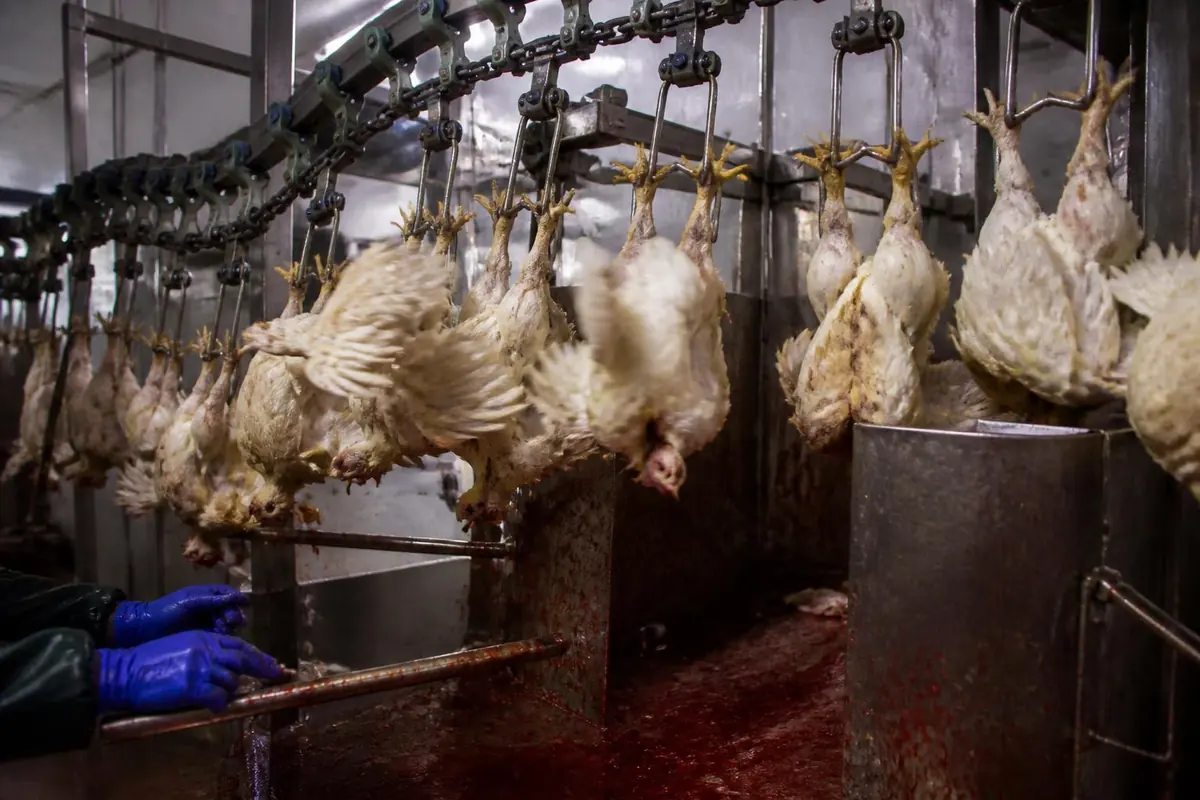
What happens on an industrial line
A modern poultry plant can process well over 100 birds a minute; large cattle plants run several hundred head an hour. At that pace, several of the conditions above become structurally difficult rather than occasionally neglected. Animals are unloaded in crowds, moved through races within sight and sound of the kill floor, restrained mechanically, and cut in sequence. In poultry, birds are typically shackled upside down by the legs before the cut — a position that, in the veterinary literature, is itself a source of pain in birds already carrying leg deformities from fast growth.
Investigative footage from halal and non-halal plants alike has documented mis-cuts requiring a second stroke, animals still conscious and moving well after the cut, and animals entering scalding or processing before death is certain. Such footage is advocacy material: it is selected, not sampled, and it cannot tell you how common a failure is. What it can establish is that the failure occurs and is not merely hypothetical — and audit literature from official veterinary inspection bodies reports the same failure types.
Halal law requires a sharp blade, a single swift cut, and gentle handling.
Explicit in widely accepted hadith and in the manuals of every school.
Mis-cuts, repeat cuts and animals conscious after the cut occur at commercial line speeds.
Documented in official inspection reports and in undercover footage across multiple countries.
Slaughter without stunning causes more pain than slaughter with stunning.
Studies conflict and vary by species, cut quality and restraint. Both advocates and critics overstate the settled character of this literature.
Halal certification schemes generally do not audit rearing conditions.
Read the published scopes: the major standards address species, cut, invocation and contamination, not stocking density or mutilation.
Most suffering in meat production occurs before the animal reaches the slaughterhouse.
Well supported for intensively reared poultry, pigs and dairy cattle; less clear for extensively grazed animals with short transport.
The stunning dispute
Stunning — electrical, gas or captive-bolt — is intended to render the animal insensible before the cut. Several European countries require it; some permit religious exemption. Muslim authorities are genuinely divided. Bodies such as Malaysia's JAKIM and many Gulf certifiers accept reversible stunning that leaves the animal alive, with recovery tests in place. Others, including a number of UK certifiers, reject stunning outright on the grounds that it risks death before the cut and is not part of the received practice.
The science is less decisive than either side's slogans. Studies measuring brain activity after a neck cut in cattle report times to insensibility ranging from a few seconds to well over a minute, with wide variation depending on whether the arteries seal or the animal has a vertebral blood supply to the brain. What is not seriously contested is that a badly executed cut — a dull blade, a restrained and struggling animal, repeated strokes — is worse than either a clean unstunned cut or an effective stun. Execution quality dominates the method debate, and execution quality is what line speed erodes.
The life before the knife
Suppose a plant meets every slaughter condition perfectly. The broiler chicken arriving there has still been bred to reach slaughter weight in roughly six weeks, often on legs that struggle to carry it; has lived in a shed with tens of thousands of birds; has not seen daylight. The dairy cow supplying halal-labelled dairy has been repeatedly impregnated and separated from her calves. The laying hen may have been housed in a cage or a crowded barn, with beak-trimming performed without anaesthetic.
Islamic law has a great deal to say about this part. The obligation of nafaqa — adequate food, water, shelter, rest — is owed to an animal whether or not it will later be slaughtered. Jurists across schools treat an animal's basic entitlements as a right that the owner cannot waive, and classical texts prohibit overloading, beating, starving, mutilating and confining an animal to the point of harm. Al-Ghazali, Ibn Taymiyya, and in the modern period Basheer Ahmad Masri, all read these as binding duties rather than pieties.
That is why the "is halal humane" question cannot be settled at the kill floor. If the animal's rights were violated for weeks or months, a lawful three-second death does not repair them. The slaughter may be valid; the production may still be wrongful. Muslims disagree sharply about whether that wrongfulness transfers to the meat itself or to the buyer — and that is the substance of the factory-farming debate, not a side issue.
What certification does not check
Read the published scope of the major halal standards and the pattern is consistent: they verify permitted species, the validity of the cut and invocation, the competence of the slaughterer, separation from haram substances, and the halal status of ingredients and processing aids. They generally do not assess stocking density, enrichment, light cycles, growth rate, mutilations, transport duration, or the handling of animals before they enter the plant.
What a halal logo does and does not claim
It claims: this product was audited against a named standard for species, slaughter method, invocation and ingredient purity. It does not claim: this animal lived well, was transported briefly, was handled calmly, or died without distress. Those are separate questions, and no mainstream halal mark answers them.
How Muslims answer differently
Formalist
Yes — the slaughter method is humane by design.
Dhabihah, correctly performed, is a merciful death, and its conditions exceed what most secular law requires. Failures in a plant are the sin of that plant's operators, not evidence against the method or against consumers.
Middle
Only as humane as the plant and the farm.
The law's welfare conditions are real obligations. Where a system predictably breaches them, buying from that system is at least discouraged, and the conscientious Muslim should reduce, question suppliers, and prefer better sources.
Maximalist
No — not as the system currently operates.
When harm is structural rather than incidental, purchase is direct assistance to it. Combined with la darar, the prohibition of fasad and the absence of necessity, some argue the resulting product is at minimum makruh and potentially impermissible. This is a contested ijtihad, not a settled ruling.
Where all three agree
Cruelty is never permitted.
No school allows beating, starving, mutilating for convenience, or slaughtering carelessly. The disagreement is about what follows for the buyer — not about whether the animal has rights.
What a careful buyer can do
Ask the certifier, not the retailer, which standard applies and whether it includes any welfare criteria. Ask your butcher where the animals were reared and how far they travelled. Treat "hand-slaughtered" and "traditional" as marketing until someone names the farm. Reduce the volume you buy, which is the single change that most reliably reduces the harm you are connected to and which no scholar has ever discouraged — the Prophet's own household ate meat rarely, and excess in food is discouraged by the Qur'an's own words on israf.
And keep the two questions apart. "Is it halal?" is a legal question with a mostly clear answer. "Is it humane?" is a factual question about a specific supply chain, and the label was never designed to answer it. Someone who wants both has to look past the logo.
Research trail
Sources and further reading
- 01Qur'an 6:38, 5:3, 6:141, 7:31 — Animals as communities, lawful slaughter, prohibition of waste and excess.
- 02Sahih Muslim 1955 (ihsan in slaughter) and related hadith — Sharpen the blade, ease the animal, do not sharpen in front of it.
- 03Shia hadith collections (al-Kafi, Wasa'il al-Shi'a), chapters on animals — Parallel obligations of feeding, watering, rest and gentle handling.
- 04Veterinary and food-science literature on slaughter without stunning — Findings differ by species, cut quality, restraint method and time to insensibility; cited as technical evidence, not rulings.
- 05Halal standards: MS 1500, GSO 2055-1, Codex halal guidelines — Define species, cut, invocation and contamination control; largely silent on husbandry.
References are given so readers can check them in the primary sources. Hadith gradings and scholarly positions are summarised in good faith; where a text is disputed we say so. Verify before you rely on anything here.
Follow the thread
Continue reading
Share this page