Ask a Muslim whether factory-farmed chicken is halal and you will very often get a fast, confident answer: yes, so long as it is slaughtered according to the rules of dhabiha — a Muslim (or, in some readings, a person of the People of the Book), the invocation of God's name, a swift cut to the throat severing the major vessels while the animal is alive. That answer is not wrong. It reflects a real and defensible current within the fiqh tradition. But it is not the only current, and increasingly it is not the only question people are asking. What happened to the bird for the forty-two days before the knife ever touched it? Was it bred to grow so fast its legs could barely carry its own weight? Was it debeaked without anaesthetic as a chick? Was it one of billions raised and killed at a scale and speed that leaves no room for anything resembling the Prophetic model of gentleness toward animals? These are not rhetorical questions designed to shame meat-eaters. They are live disagreements inside Islamic scholarship and among ordinary observant Muslims, and this page tries to set out the strongest version of each position rather than adjudicate between them.
In short
- Classical fiqh conditions for lawful slaughter (dhabiha) concern the moment of killing, not the animal's prior life — a fact the strict-formalist position treats as decisive.
- The jallala rulings show that classical jurists were willing to attach conditions to an animal's feed and upbringing, which the maximalist position treats as a precedent for wider welfare-based restriction.
- The Qur'an pairs halal with tayyib (wholesome/good) often enough that many scholars refuse to treat them as separable tests.
- Nothing here is settled law; readers should treat this as a map of a live debate, not a verdict.
Why this question is hard
Technically halal
Strict formalist
If the species, slaughterer, invocation and cut satisfy dhabiha, cruelty elsewhere is a separate sin rather than a change in the meat's legal status.
Lawful but discouraged
Cautious middle
The slaughter may remain valid while routine cruelty, doubt and available alternatives make consumption ethically blameworthy or makruh.
Potentially haram
Ethical maximalist
Systematic mutilation, deprivation and avoidable harm are treated as integral to production and capable of changing the ruling on what it produces.
Graphic content — hidden by defaultThe conditions behind the legal questionShow image
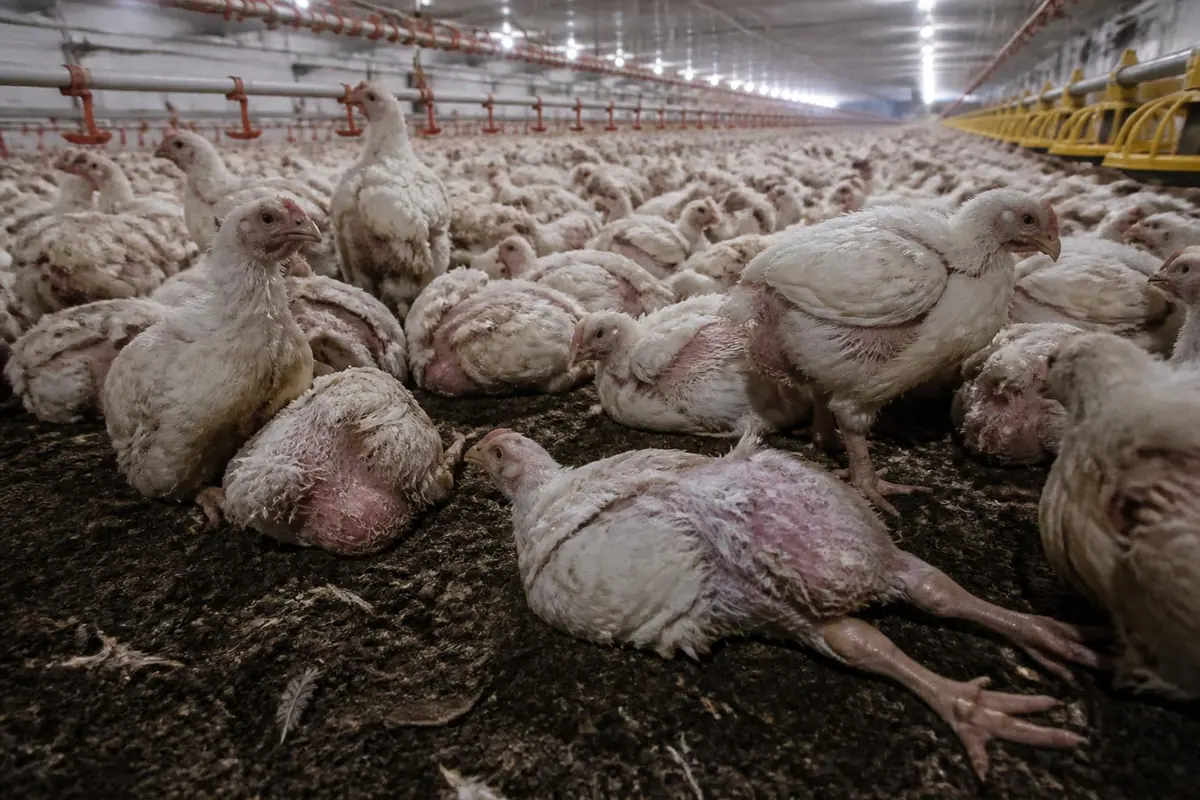
Part of the difficulty is that "factory farming" is not a fiqh category. It is a twentieth-century industrial arrangement — confinement housing, selective breeding for rapid growth, antibiotic use to manage crowding-related disease, mechanised slaughter lines processing thousands of birds an hour — that simply did not exist when the classical schools formed their rulings on dhabiha. Classical jurists were extremely precise about the mechanics of slaughter: which vessels must be cut, whether the slaughterer must be sane and of legal capacity, whether the takbir must be said aloud, what to do if the knife slips. They were comparatively silent on the industrial conditions of animal rearing, because those conditions had no counterpart in seventh- to twelfth-century animal husbandry. That silence can be read two ways. It can be read as permission by omission — the law simply does not regulate what it does not mention, so husbandry conditions are outside the scope of halal determination. Or it can be read as an invitation to extend clearly stated general principles — the prohibition of cruelty, the obligation of ihsan, the linkage of halal to tayyib — into a domain the founders of the schools never had to consider. Both readings are argued in good faith by serious people.
The strict-formalist case
The strongest version of the formalist position does not deny that industrial farming can be harsh. It argues instead that Islamic law, as a legal system, draws a firm and necessary line between what it regulates and what it leaves to individual conscience, custom, or civil regulation. Dhabiha is a legal category with enumerated conditions: a qualified slaughterer, the invocation of God's name, a swift and effective cut severing the oesophagus, trachea, and the two jugular veins, and the animal being alive at the moment of the cut. Meet those conditions and the meat is halal — full stop. This is not indifference to animal welfare; it reflects a considered view that Islamic law, like most legal systems, regulates discrete acts rather than entire supply chains, and that conflating "halal" (a technical legal status) with "ethically ideal" collapses two different kinds of judgment into one, producing confusion rather than clarity.
On this view, the believer who wants better animal welfare should pursue it through consumer choice, advocacy, or supporting higher-welfare halal certifiers — but should not describe conventionally farmed halal-slaughtered meat as haram, because doing so stretches a precise legal term to cover a judgment the term was never built to carry. Ibn 'Abidin's Hanafi formalism and much contemporary halal-certification practice sit comfortably here: certification bodies typically audit the slaughter act and the supply chain's chain of custody, not the welfare conditions of rearing, and this is defended as methodologically correct rather than as a shortcut.
The makruh middle position
Between the two poles sits a position with real traction among contemporary scholars: that meat from harshly industrial systems remains technically halal if properly slaughtered, but that consuming it, when better alternatives are reasonably available, is makruh — discouraged rather than forbidden. This is a familiar move in fiqh: many acts fall short of prohibition while still being disliked, because they sit close to a boundary, or because they involve a diminished form of an obligation (here, ihsan toward animals) without actually violating a hard rule. The makruh framing lets a scholar say, in effect, "I will not tell you this meat is haram, but I do not think you should be at ease eating it either, and if you can choose otherwise, you should." It has the advantage of taking welfare concerns seriously as a matter of Islamic ethics without overturning the settled legal category of dhabiha, and it maps onto how many working scholars actually counsel individual questioners: not with a blanket ruling, but with a graded recommendation tied to what alternatives are realistically available to that person.
Critics of the makruh position, from both directions, find it unsatisfying. Formalists worry it smuggles in an ethical judgment through the back door and creates social pressure that functions like prohibition without the rigour prohibition would require. Maximalists worry it is too soft — that labelling severe, sustained cruelty as merely "disliked" understates the moral stakes. The middle position is nonetheless probably the most common one among thoughtful contemporary imams asked this question directly, precisely because it lets them honour both the legal tradition and their own unease.
The maximalist case
The maximalist argument does not treat husbandry as legally irrelevant to the status of the meat. It builds a case, from within the fiqh tradition itself, that systematic practices in industrial animal agriculture can compromise the outcome. Three strands typically combine. First, mutilation: routine industrial practices such as debeaking of poultry, tail-docking, and castration, frequently performed without anaesthetic and at a scale that leaves no room for individual care, are argued to fall under the Prophetic prohibition of muthla — the mutilation of a living creature — discussed below. Second, denial of a recognisable life: confinement so severe that an animal cannot walk, turn around, dust-bathe, perch, or express basic behaviours is argued to breach the general Qur'anic and Prophetic ethic of ihsan (excellence, and here specifically kindness) toward animals, on the ground that ihsan cannot plausibly be confined to the final seconds of an animal's life while being absent from the years or weeks before it. Third, contamination of feed and constitution: where animals are raised on diets or in conditions classical jurists would have recognised as najis (ritually impure) or harmful, the jallala precedent (below) is invoked directly.
The maximalist position does not necessarily conclude "haram." Some maximalists do reach that conclusion for the worst cases — for instance, meat from birds so mutilated and confined that the entire process is argued to constitute sustained cruelty inconsistent with a valid Islamic slaughter act, not merely an unrelated ethical lapse. Others stop short and argue instead for a strong presumption against such meat without declaring it formally haram, which collapses back toward the makruh position from a different direction. What unites maximalists is the refusal to treat the moment of the knife as legally hermetic, sealed off from everything that came before it.
The formalist reading
Dhabiha is a discrete legal act; husbandry conditions are outside its scope.
Islamic law regulates the act of slaughter with precision because that is what the sources address. Extending 'halal' to cover an entire supply chain's welfare standards imports ethical judgments the term was never designed to carry, and risks making ordinary halal meat consumption a matter of perpetual anxiety without clear legal footing.
The maximalist reading
Systematic cruelty in rearing can compromise the legal status of the resulting meat.
The jallala precedent shows classical jurists were willing to attach conditions to an animal's upbringing and feed, not only to the slaughter act. Given the scale of mutilation, confinement, and unnatural diet in industrial systems, treating the knife as the only relevant moment ignores the spirit of ihsan running through the wider tradition.
The open letter's maximal case
- 01
Establish the facts
Show that confinement, mutilation and high-speed killing are standard features, not isolated abuse.
- 02
Name the duties
Bring ihsan, non-injury, proper maintenance and the animal's protected interests into view.
- 03
Connect purchase to system
Ask whether knowingly funding a harmful production model counts as assisting or normalising wrongdoing.
- 04
Judge the product
Argue—controversially—that pervasive, inseparable harm can move consumption from permissible to forbidden.
The disagreement is concentrated in steps three and four. Most scholars affirm the duties but do not conclude that every resulting product becomes unlawful.
The fullest and most uncompromising version of the maximalist case circulating among Shia Muslims at present is not a fatwa or an institutional ruling but an anonymous open letter addressed to Shia Muslims on the livestock industry, animal suffering, and moral and legal duty today. It is worth setting out in full precisely because it is the strongest version of the argument this page surveys, and because it deserves to be engaged with honestly rather than dismissed by virtue of its anonymity alone. The letter has no named author, institution, or marja' behind it, and its own closing verdict describes itself, in its own words, as a "deduced" or ijtihadi conclusion — a framing that belongs to the letter, not to Shia fiqh as such, and it carries no institutional standing whatsoever. No major Sunni or Shia authority has ruled that meat, dairy, or eggs are haram today, and the overwhelming mainstream position across both traditions remains that animal products are permissible. With that firmly stated, the letter's reasoning is still worth following, because it builds its case as a chain rather than a single leap.
The letter's argument runs, on its own telling, in six steps. First, it argues that traditional slaughter and the modern livestock industry differ in kind, not merely in degree: fiqh rulings on meat were formed under conditions of free-living animals, natural reproductive cycles, and individual, human-scale slaughter, none of which describe the industry as it actually operates today. Second, it documents what that industry does — mother-young separation, permanent caging and confinement, and high-speed industrial slaughter — and reads each against a Prophetic or Alid teaching about kindness to animals. Third, it assembles a cluster of legal principles it says together change the ruling: la darar wa la dirar (serious harm renders a thing forbidden); the prohibition of idha' (causing an animal pain); al-hukm yadur ma'a al-mawdu' wujudan wa 'adaman (a ruling tracks its subject matter, and the subject — a healthy, freely-living animal — has changed); the maxim «ما أُخذ بالسوط فهو حرام» ("what is taken by the whip is forbidden"), extended by analogy from its classical setting in property seized by coercion to forced milking, caged egg production, and forced annual calving; hurmat al-i'ana 'ala al-zulm (the prohibition of assisting wrongdoing, applied to every purchase that finances the system); and al-hukm yataghayyar bi-taghayyur al-zaman (rulings can change with time and circumstance), paired with a call to ihtiyat (caution) wherever harm or injustice is strongly suspected. Fourth, it grounds the whole argument in Islam as a religion of mercy, reading 21:107's "mercy to all the worlds" as extending to animals, and invoking Imam 'Ali's reported warnings against excessive meat-eating — discussed, and their attribution examined, on The Sunnah and Meat. Fifth, it appeals to a cluster of scientific claims about health and environmental harm. Sixth, combining all of the above, it concludes that meat, dairy and eggs are, under present industrial conditions, haram — while explicitly framing that conclusion as conditional rather than permanent, comparable to the way later jurists came to rule tobacco forbidden on grounds of harm despite its absence from the earliest sources, and reversible if husbandry conditions, harms, and the case for necessity changed.
Taken as a chain, the argument is considerably more serious than a simple assertion that modern meat is cruel, and it deserves to be judged as a chain rather than dismissed at the first link. But several serious objections attach to it precisely because it is a chain, and a chain is only as strong as its weakest link. Its anonymity and lack of any named scholarly or institutional backing mean it cannot claim the authority its own language ("fatwa") borrows; readers are owed that context every time its conclusion is cited. Some of its hadith attributions are doubtful on inspection: the report likening habitual meat-eating to the intoxication of wine is widely transmitted from 'Umar b. al-Khattab in Sunni sources, not from the specific location in Nahj al-Balagha the letter cites, and the "graveyards for animals" report is weakly attested despite wide circulation. Several of its empirical claims are overstated or contested — the comparison of animal products to cigarettes, and specific claims linking dairy to prostate and breast cancer or eggs to inflammation, go well beyond what the cited science (IARC's classification of processed meat as carcinogenic and red meat as probably carcinogenic being the more solidly established point) actually supports. And its central legal move — extending «ما أُخذ بالسوط فهو حرام», a maxim concerned in the classical corpus with property seized by coercion, to food produced through animal suffering — is, by the letter's own logic, an analogy it is constructing rather than a text that already says this; readers should recognise it as the letter's own extension rather than as settled Shi'i legal doctrine. None of this makes the letter's underlying concern illegitimate — the six-step structure raises real questions this page has tried to take seriously throughout — but it does mean its haram conclusion is a minority advocacy position, not a ruling, and readers should weigh it accordingly.
Jallala: animals fed filth
The classical discussion of al-jallala (from jalla, filth) is one of the most direct precedents either side can reach for, and it deserves to be set out carefully rather than gestured at. A jallala animal, in the fiqh manuals, is one whose diet has come to consist predominantly of najis (impure) matter — commonly discussed in terms of an animal fed on faeces or carrion to the point that its flesh, milk, or even its smell is affected. The four Sunni schools differ on the details but converge on the underlying principle: what an animal habitually consumes can affect the ruling on consuming that animal or its produce. Hanafi and Hanbali jurists, along with a position within the Shafi'i school, held that the meat and milk of a jallala animal become disliked or even impermissible until the animal is quarantined and fed clean fodder for a specified period (variously given as three days for smaller animals up to forty days for larger livestock in some formulations), after which the ruling reverts to permissibility. Ibn Qudama's al-Mughni and al-Nawawi's al-Majmu' both preserve versions of this quarantine-and-purify remedy, which is itself telling: the remedy is not slaughter method, it is a change of diet and the passage of time, precisely because the concern is what has entered and settled in the animal's body, not what happens at its death.
Formalists reply that jallala is a narrow, specific ruling about a specific and identifiable condition — an animal reduced to eating filth because of neglect or unusual circumstance — and that it cannot be stretched to cover modern industrial feed, which typically consists of grain, soy, and formulated feed additives rather than najis matter in the classical sense, even if that feed is nutritionally poor or ethically troubling for other reasons (land use, antibiotic residues, and so on). On this reading, jallala is a real but narrow doctrine, and using it to indict all industrially fed meat overreads a specific ruling into a general principle it was never meant to support.
Maximalists respond that the principle embedded in jallala — that an animal's diet and condition are not legally invisible facts, and can affect the permissibility or desirability of consuming it — is precisely the point, even if the modern instantiation differs from the classical example. If jurists were willing to quarantine and re-feed an animal before permitting its consumption, they argue, the underlying logic (you become in part what you habitually consume, and this matters religiously) supports at least caution, and arguably restriction, around animals raised in conditions modern classical jurists would very likely have found troubling had they encountered them. This is an argument by analogy (qiyas) from a narrow classical ruling to a broader modern circumstance, and like most such arguments its strength is genuinely contested rather than obvious in either direction.
Muthla and the obligation of ihsan
Two further Prophetic teachings recur constantly in this debate. The first is the prohibition of muthla — mutilating a living creature, historically discussed in the context of using animals for target practice or disfiguring them beyond what is necessary (Sahih Muslim 1958 and related narrations). The second is the hadith in which the Prophet ﷺ is reported to have said that God has prescribed ihsan (excellence, and in this context specifically gentleness and care) in all things, including slaughter: sharpen your blade and let the animal die comfortably (Sahih Muslim 1955). Maximalists read these two teachings together as establishing a general Islamic ethic of minimising animal suffering that cannot coherently be confined to the instant of the cut. If mutilation is prohibited and gentleness in killing is commanded, they ask, on what basis would mutilation and harshness earlier in an animal's life — debeaking, tail-docking, breeding for growth rates that cause chronic pain and lameness — be exempted from the same underlying concern?
Formalists generally do not dispute that muthla is prohibited or that ihsan is commanded; they dispute the inference that these general ethical teachings translate automatically into a change in legal category for the resulting meat. A practice can be sinful, they argue, without rendering the meat haram — sin and legal status are not always identical, and Islamic law has other cases where a wrongful act along a chain (a stolen knife used to slaughter, for instance, in some formulations) does not necessarily invalidate the resulting product's permissibility, though it does incur its own accountability for the wrongdoer. This distinction — between an act being sinful and a product being haram — is one of the load-bearing walls of the entire debate, and different scholars weight it very differently.
Water denial in al-Kafi and the a fortiori case
One of the more specific textual arguments the open letter makes, and one worth examining on its own terms rather than folding into the broader ihsan discussion above, concerns reports preserved in al-Kulayni's al-Kafi condemning the withholding of water from an animal — including material describing it as among the acts that bring divine punishment on the one responsible. The letter's argument here is a fortiori (qiyas al-awla, an argument from the lesser to the greater, or in the reverse direction from the more severe case to what must follow from it a fortiori): if denying an animal a drink of water for a matter of hours is condemned this strongly, the letter asks, what should be said of confining that same animal for the whole of its life, denying it the ability to walk, turn around, or express any natural behaviour at all? Withholding water is a temporary, bounded deprivation with an obvious remedy; permanent confinement is a deprivation with no remedy available to the animal for as long as it lives. On the letter's reading, if the lesser harm is forbidden, the far greater and more sustained harm cannot logically escape the same judgment, and treating confinement as merely regrettable while treating water denial as sinful would be an inconsistency the sources themselves do not license.
The argument is logically tidy, but it depends on two things that need to hold for it to carry real legal weight rather than rhetorical force. First, the underlying hadith material needs to be authenticated to the normal standard applied to Twelver reports — individual narrations in al-Kafi are graded, not accepted as a block, and a report's strength should be established before it carries an argument this far. Second, and more importantly, an a fortiori argument only works if the two cases share the same underlying wrong (the same 'illa). Water denial is straightforwardly a case of deprivation causing direct physical suffering with no offsetting purpose recognised in law; confinement in a commercial barn or cage is deprivation of a different kind, bound up with an economic activity — animal husbandry for food — that the tradition treats as lawful in principle. A formalist reply would be that confinement, however unpleasant, is not equivalent to active deprivation of a basic physiological need in the way withholding water is, and that the comparison, while emotionally forceful, elides a real difference between denying an animal something it needs to survive and failing to give it everything that would make its life pleasant. The letter's proponents would answer that severe, permanent confinement does affect basic physiological and behavioural needs — space to move, contact with offspring, freedom from the injuries that overcrowding produces — and that the difference is one of degree and duration rather than of kind. Neither side's position is obviously wrong; the disagreement turns on how tightly the shared 'illa needs to be drawn before an analogy of this kind is doing real legal work rather than borrowing the emotional weight of one hadith for a materially different situation.
Purchase as assistance in wrongdoing
A separate and, for many readers, more immediately persuasive strand of the letter's case rests on al-i'ana 'ala al-ithm — assistance in sin — grounded in the Qur'anic instruction at 5:2 to cooperate in righteousness and God-consciousness and not to cooperate in sin and transgression. The letter's argument is essentially a demand-signal argument: every purchase of factory-farmed meat, milk, or eggs is a small transmission of demand back through the supply chain to the producer, and a system that depends on millions of such purchases to remain viable is, in an aggregate but real sense, financed by each individual purchase within it. If the underlying production practices are themselves wrongful — on the grounds set out elsewhere on this page — then knowingly and repeatedly funding them, the letter argues, is itself a form of assisting that wrong, not merely a neutral act of buying food.
The standard fiqh reply to this kind of argument is the doctrine of graded assistance: classical jurists have long distinguished between direct, proximate participation in a wrong — handing a weapon to someone you know is about to commit murder with it — and remote, diffuse participation of the kind involved in ordinary commercial life, where a buyer's money passes through many intermediaries before it reaches anyone actually responsible for a wrongful act, and where the buyer has no specific knowledge of, or control over, how that particular producer treats that particular animal. On this view, an individual shopper buying a carton of eggs is several steps removed from the decision to cage hens or cull male chicks, has no realistic way to verify or change those decisions, and cannot reasonably be held to the same standard as someone directly and knowingly enabling a specific wrongful act. Muslim jurists addressing analogous modern questions — for instance, whether banking with an interest-bearing institution for ordinary current-account purposes counts as assisting riba — have generally applied something like this graded standard, distinguishing unavoidable, diffuse participation in a flawed system from direct, avoidable involvement in a specific wrongful transaction.
The letter's rejoinder, and it is a fair one to state clearly rather than wave away, is that the analogy to remote commercial participation understates how directly retail demand drives production decisions in a modern, price- and volume-sensitive supply chain, and that the wrong here is not a single bad actor's misconduct hidden somewhere down an unpredictable chain but the method of production itself — the very thing being purchased is produced by means the letter has already argued are wrongful, not incidentally connected to a wrong elsewhere. On this reading, buying conventionally produced eggs is less like banking with an interest-bearing institution for an unrelated purpose, and more like directly purchasing the product of the practice being objected to, which narrows the distance the graded-assistance reply depends on. This is a genuine disagreement about how remote "remote" really is in a modern retail economy, and it is one of the places where the letter's case is strongest on its own terms, even though — as throughout this page — it remains a contested argument rather than a resolved one, and no major fiqh council has yet ruled that ordinary retail purchase of conventionally farmed meat, dairy or eggs constitutes forbidden assistance in wrongdoing.
What the documentation actually shows
Every step of this argument depends on a factual claim: that the harms described are the ordinary, designed operation of the industry rather than the misconduct of a few bad operators. Two campaigning archives set out to document exactly that. The Humane Foundation's cruelty.farm assembles species-by-species accounts of gestation crates roughly two feet wide, battery and broiler housing, routine mutilations carried out without pain relief, transport lasting hours or days without adequate food, water or rest, and killing "at industrial speed". onefork.org publishes investigation photography from legal facilities in Finland, Manitoba, North Carolina and Missouri under a blunt caption: this is "standard practice inside legal, regulation-compliant facilities. Nothing here is unusual. This is the system working as designed."
Both are advocacy sites with an explicit vegan conclusion, and some of their statistics are stated far more confidently than the underlying evidence supports; we sort the reliable figures from the shaky ones on our What the Investigations Show page. But the descriptive core is checkable against agricultural regulation and industry practice, and it is what matters here. If the harms are designed rather than incidental, the strict-formalist reply — that individual sins by producers do not travel into the food — has to work much harder, because it is no longer answering an allegation about rogue farmers but about a production model. That is the strongest thing this evidence does to the argument, and it is worth stating precisely, because overstating it is what usually gets the whole case dismissed.
The tayyib-based argument
A separate line of argument sidesteps the haram/halal question almost entirely and asks about tayyib instead. The Qur'an repeatedly commands believers to eat of what is halalan tayyiban — lawful and good/wholesome — rather than halal alone (2:168, 5:88, 8:69, 16:114). Many scholars and contemporary Muslim ethicists argue that tayyib carries independent moral weight: food can be technically halal while falling short of tayyib if it is unhealthy, produced through exploitation, or obtained through processes at odds with an Islamic vision of a good and balanced creation. On this reading, factory-farmed meat may well clear the halal bar while failing the tayyib bar, and a believer who takes the Qur'anic pairing seriously has grounds to avoid such meat as a matter of striving for tayyib, without needing to declare it haram at all. This move is attractive precisely because it does not require overturning settled fiqh on dhabiha; it opens a second, parallel register of religious evaluation that can operate alongside the legal one.
The formalist response is that tayyib, in most classical exegesis, was understood substantially in terms of purity, cleanliness, and being free of harm or intoxication, rather than as a freestanding ethical audit of animal welfare, and that reading a modern animal-welfare agenda into tayyib risks anachronism. The tayyib-based argument's proponents reply that exegetical categories are not static, and that applying an enduring principle to new circumstances is exactly what serious engagement with scripture requires — which is, in miniature, the whole shape of this debate.
Consent and the rights of the animal
A further, less legally conventional but increasingly discussed argument draws on the idea that animals have huquq (rights or claims) within the Islamic worldview independent of human use of them — grounded in verses describing animals as communities like human communities (6:38) and hadith in which the Prophet ﷺ rebukes companions for causing animals unnecessary distress, including narrations about not separating a mother bird from her young and about being merciful to a thirsty animal. Some contemporary writers, notably B.A. Masri in Animal Welfare in Islam, argue these sources establish that an animal's wellbeing is not merely instrumental to human benefit but carries its own standing before God, and that a system which treats animals purely as biological input to a production line — with no capacity to express natural behaviour and no meaningful consideration of distress — fails this standard regardless of what happens at the point of slaughter. This is sometimes loosely described as an argument from the animal's "consent," though that language is borrowed from outside the fiqh tradition and should be treated as an analogy rather than a technical term: no classical jurist framed the issue in terms of consent as such. The more precise fiqh-internal version of the argument is about huquq al-hayawan (rights of the animal) and the human being's role as khalifa (steward), which imposes duties of care that exist whether or not the animal will eventually be eaten.
Critics of this framing worry that it risks importing a rights discourse foreign to the legal structure of fiqh, and that Islamic law has always permitted the killing and eating of animals for food under conditions, which sits uneasily with strong rights language. Proponents respond that huquq al-hayawan is not a modern import but has real roots in the classical texts (Ibn Taymiyyah, al-Ghazali, and others wrote on the duties owed to animals), even if the precise legal mechanism for enforcing those duties in a commercial food system remains underdeveloped.
What would 'haram' even mean here?
It is worth pausing on a distinction usul al-fiqh scholars draw between something being haram li-dhatihi (forbidden intrinsically, because of what the thing itself is — pork, for instance, or carrion) and haram li-ghayrihi (forbidden because of an external factor attached to it — stolen food, for example, which is forbidden not because food is bad but because theft is). This distinction matters enormously for the factory-farming debate, because almost nobody argues that chicken or beef is haram li-dhatihi — the animal itself remains a lawful category of food in every position surveyed here. The live question is whether industrial husbandry conditions could make specific meat haram li-ghayrihi, the way a stolen or unlawfully obtained good is forbidden not in its essence but because of how it was acquired. Framed this way, the maximalist case is a li-ghayrihi argument: it is not claiming chicken has become intrinsically impure, but that the circumstances surrounding a particular bird's life and death may attach an external defect serious enough to affect the ruling. This framing also explains why the makruh middle position feels so natural to many scholars: haram li-ghayrihi claims have historically required a fairly clear, demonstrable external defect (genuinely stolen property, definitively najis feed), and industrial husbandry, troubling as it may be, does not always meet that evidentiary bar for every individual animal in every system, which pushes many scholars toward caution (makruh) rather than a categorical li-ghayrihi prohibition.
Living with unresolved disagreement
This is one of the areas of contemporary Islamic ethics least likely to resolve into a single settled position soon, because it turns on empirical questions (how bad are conditions in a given supply chain, really?), interpretive questions (how far can jallala or muthla be analogised?), and genuinely differing views on what fiqh is for. A reader does not need to resolve all of that before Friday's dinner. What can help is treating the disagreement itself as information: it tells you that reasonable, learned, sincere Muslims land in different places, and that the space between "certainly halal, no further question needed" and "certainly haram" is occupied by real, defensible positions rather than being empty. Practically, this page's purpose is not to tell you which position to hold but to equip you to ask better questions of your own supplier, your own certifier, and your own conscience: what were the conditions like, is there a higher-welfare or smaller- scale alternative reasonably available to you, does your local halal certification scheme audit anything beyond the slaughter act, and how much weight you personally want to give the tayyib standard alongside the halal one. Muslims have navigated contested fiqh questions for fourteen centuries without requiring unanimity first; this is one more such question, taken seriously rather than either dismissed or resolved by fiat.
A note on certification
Halal certification logos typically attest to the slaughter method and supply-chain integrity (no cross-contamination with pork, correct invocation, and so on). Very few certification schemes currently audit rearing-stage welfare as part of the halal label itself, which is precisely why this debate exists in the space certification does not currently cover.
Research trail
Sources and further reading
- 01Qur'an 5:3, 6:118-119, 16:114-115 — Core verses on lawful slaughter and the boundaries of what is forbidden.
- 02Qur'an 2:168, 5:88, 8:69 — The pairing of halal with tayyib as a joint standard, not two separate tests.
- 03Sahih al-Bukhari 5498; Sahih Muslim 1955 — Hadith on sharpening the blade and showing ihsan (excellence/kindness) even in slaughter.
- 04Sunan Abu Dawud 2564; Sunan al-Tirmidhi 1479 — Hadith material commonly cited in the jallala discussion, on eating the meat and milk of animals fed on filth.
- 05Sahih Muslim 1958 — Prohibition of mutilation (muthla) of animals, cited by scholars addressing industrial mutilation practices.
- 06Ibn Qudama, al-Mughni — Hanbali jurist's treatment of jallala and conditions attached to it.
- 07al-Nawawi, al-Majmu' Sharh al-Muhadhdhab — Shafi'i survey of jallala rulings and the quarantine/purification remedy.
- 08Ibn 'Abidin, Radd al-Muhtar — Hanafi formalist emphasis on the conditions of valid dhabiha.
- 09al-Qaradawi, The Lawful and the Prohibited in Islam — Widely read modern synthesis distinguishing legal permissibility from broader ethical excellence.
- 10Foltz, Animals in Islamic Tradition and Muslim Cultures — Academic survey of animal ethics across the fiqh schools.
- 11Masri, Animal Welfare in Islam — Influential modern argument that Islamic law embeds strong welfare obligations independent of slaughter mechanics.
- 12Fiqh Council of North America, statements on halal meat — Contemporary institutional position emphasising method-of-slaughter as the operative legal test.
- 13An Open Letter to Shia Muslims on the Livestock Industry, Animal Suffering and Moral and Legal Duty Today — Anonymous advocacy letter (Persian, PDF supplied to this site by a reader; translations here are ours), not a fatwa or the position of any named jurist or hawza body.
- 14al-Kulayni, al-Kafi, reports on withholding water from an animal — Twelver hadith material cited by the open letter for the principle that denying an animal water is condemned; individual reports require the usual isnad-grading rather than being treated as uniformly authentic.
- 15Qur'an 5:2 — Verse commanding cooperation in righteousness and forbidding cooperation in sin and transgression (al-i'ana 'ala al-ithm wa al-'udwan), the textual anchor for the assistance-in-wrongdoing argument discussed here.
References are given so readers can check them in the primary sources. Hadith gradings and scholarly positions are summarised in good faith; where a text is disputed we say so. Verify before you rely on anything here.
Follow the thread
Continue reading
Share this page