There is no serious debate in Islamic law about whether milk and eggs are halal. Unlike the question of factory-farmed meat, where the slaughter act sits at the centre of a contested judgment, milk and eggs raise no comparable legal hurdle at the point of consumption: an egg is not slaughtered, and milk is drawn from a living animal without harming it, which is precisely why the Qur'an treats milk as a sign of divine generosity rather than a regulated legal category requiring conditions. And yet dairy and eggs sit at the centre of one of the more emotionally charged debates among ethically engaged Muslims today, because the production systems behind a supermarket carton of milk or a box of eggs bear very little resemblance to the household cow or the free-ranging hens implicit in most classical and even early-twentieth-century discussion. This page treats the legal question as settled and spends its time on the ethical one, which is not settled at all.
In short
- Milk and eggs from permitted animals are ordinarily lawful; this does not settle every question about processing, sourcing or ethical responsibility.
- The Qur'an speaks of milk with unusual warmth (16:66, 47:15), which many draw on as a reason for gratitude rather than avoidance.
- Modern industrial dairy involves practices — repeated forced insemination, early calf separation, culling of 'spent' cows, and a veal trade as a structural by-product — that were simply not part of the household-animal picture assumed by earlier generations.
- Male chick culling is close to universal in commercial egg-laying hatcheries because male chicks of laying breeds do not grow into economical meat birds.
- Serious, faithful Muslims land in different places here — from continuing to consume conventionally with gratitude, to sourcing carefully, to reducing intake, to switching to plant-based alternatives.
A settled legal question
It is worth stating plainly, before anything else, why milk and eggs occupy such a different legal position from meat. Dhabiha rules exist because slaughter involves killing, and Islamic law regulates killing with precision. Milking a cow and collecting an egg involve no killing at all in the ordinary case — the animal continues living, and in the egg's case has not even been touched. This is one reason the Qur'an can speak of milk in purely celebratory terms without any of the conditional language that accompanies verses about meat. There is also no live jallala-style fiqh objection to ordinary milk or eggs from conventionally fed animals, since mainstream industrial feed (grain, soy, formulated supplements) does not fall under the classical definition of najis fodder that triggers the jallala rulings — a point discussed in more detail below. So when this page raises hard questions about dairy and egg production, none of them are questions about whether milk or eggs are halal. They are questions about tayyib, about ihsan, and about what a conscientious consumer owes the animals behind their food.
Qur'anic praise of milk
And indeed, in cattle there is a lesson for you: We give you to drink from what is in their bellies — between waste and blood — pure milk, palatable to those who drink it.
Surat al-Nahl's description of milk emerging, as it were, from between two things the Qur'an elsewhere treats as unclean, and arriving as something pure and pleasant, is often read as a small meditation on divine power: an unlikely, almost miraculous transformation occurring quietly inside an ordinary animal's body, offered to humanity as sustenance and as a sign (aya) to reflect upon. Surah Muhammad extends the imagery into eschatology:
...rivers of milk, the taste of which never changes... — among the descriptions of the gardens promised to the righteous.
Milk, in other words, is not merely tolerated in the Qur'anic imagination; it is held up as something close to paradisal, a marker of divine favour rather than a merely neutral foodstuff. This matters for the ethical debate because it supplies genuine textual weight to the argument, discussed below, that treating milk itself with suspicion risks a kind of ingratitude toward a provision the Qur'an singles out for praise. Whatever one concludes about modern dairy's production methods, the praise is aimed at milk as such, and that distinction — between the foodstuff and the industry that increasingly supplies it — runs through the whole of this debate.
How modern dairy actually works
- 01
Impregnation
A cow must give birth before lactation begins; commercial systems usually repeat the cycle.
- 02
Separation
Calves are commonly removed early so milk can enter the human supply chain.
- 03
Milking
Yield is maintained through frequent milking, formulated feed and reproductive scheduling.
- 04
Culling
Declining yield, fertility problems or chronic lameness commonly end in slaughter.
Graphic content — hidden by defaultMother and calf separated in a dairy facilityShow image
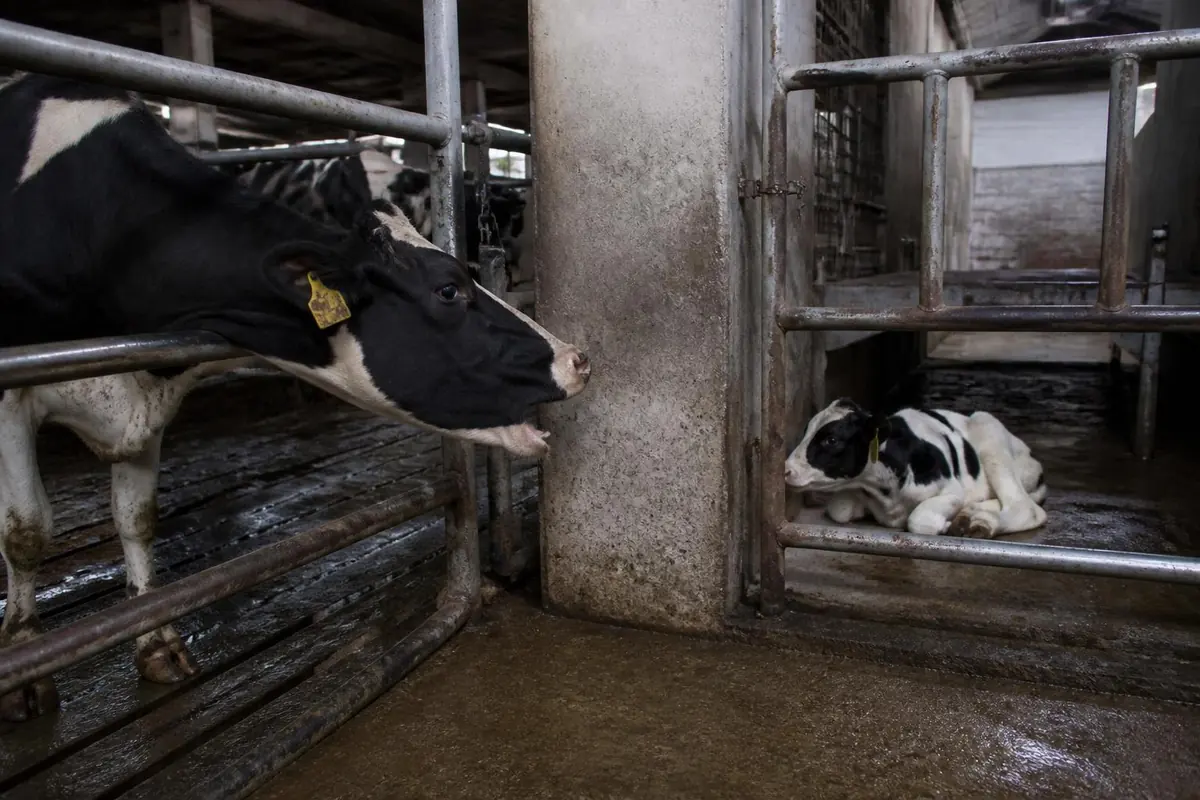
An honest description of a typical large-scale commercial dairy operation is a necessary starting point, not because description settles the ethical question but because the debate cannot proceed usefully without it. A dairy cow produces milk because she has given birth; unlike some popular imagery suggests, cows are not simply always lactating. To maintain continuous milk supply, commercial dairies typically impregnate cows repeatedly — commonly through artificial insemination — on a roughly annual cycle, so that each cow calves again before her previous lactation tapers off. The calf is generally removed from the mother within a day or two of birth, sometimes sooner, which allows the milk that would otherwise go to the calf to be collected for sale, and which is widely reported (including by mainstream veterinary and welfare literature) to cause visible distress to both cow and calf in the short term. Cows are typically culled — sent to slaughter — once milk yield declines with age, lameness becomes chronic, or fertility drops, generally after a small number of lactation cycles well short of a cow's natural lifespan. None of this is exotic or marginal; it describes the ordinary, mainstream operation of the modern dairy sector across most industrialised food systems, not an unusual or abusive outlier within it.
Calf separation, veal, and culling
A structural consequence of the dairy cycle just described is that roughly half of all calves born to dairy cows are male, and male dairy-breed calves are of little value to a dairy operation, since they will never produce milk and are typically not well suited to efficient beef production either. In many dairy industries a significant proportion of these male calves enter the veal trade — often raised for a comparatively short life before slaughter — while in some systems male dairy calves are killed shortly after birth because there is no economically viable use for them at all. This is generally described within the industry itself as a "by-product" of milk production, a framing examined critically below. For the ethically minded consumer, the veal trade and neonatal male-calf culling are arguably the single most morally weighty facts about conventional dairy, because they follow from an economic logic inherent to the system rather than from any unusual cruelty by an individual farmer, and because they are largely invisible on the label of a bottle of milk.
Male chick culling in the egg industry
The egg industry has a structurally similar and, in scale, comparably significant practice. Laying hens have been selectively bred over generations to lay eggs efficiently, at the cost of being poor meat birds; male chicks of laying breeds are therefore of essentially no commercial value to a hatchery, since they will neither lay eggs nor grow into an economical broiler. In the overwhelming majority of commercial hatcheries globally, male chicks are identified and culled — commonly within hours of hatching, historically by methods including maceration or gassing — as a near-universal feature of how commercial egg-laying flocks are replenished, not as an occasional or unusual practice confined to a few poor operators. Some jurisdictions and some producers have moved toward "in-ovo sexing" technology, which determines chick sex before hatching and avoids culling live chicks, but this remains far from universal across global egg supply chains. This practice troubles many Muslims precisely because it sits so far downstream of the egg carton itself that most consumers never encounter it, and because — unlike meat, where at least the principle of eating what is killed for food is textually addressed — the male chicks in question are killed for no purpose related to food at all, simply as a structural consequence of how laying hens are bred and replenished.
Cage, barn, free-range, pasture
Laying-hen housing runs across a spectrum with real welfare differences at each point, and it is worth being precise about them rather than treating "factory farmed" as a single undifferentiated category. Conventional ("battery") cages, now banned or being phased out in a number of jurisdictions though still common globally, confine hens in small wire enclosures offering little room for movement or natural behaviour. "Enriched" or "colony" cages, adopted partly in response to welfare criticism, offer somewhat more space and some nesting or perching provision, but remain a form of permanent confinement. Barn systems remove cages and allow hens to move within an indoor space, typically with access to perches and nest boxes, but without outdoor access. Free-range systems provide access to an outdoor area for at least part of the day, though the quality and actual use of that access varies considerably between producers and jurisdictions. Pasture-raised systems, a smaller and more expensive category, typically provide the most outdoor access and the lowest stocking densities. Dairy housing runs along a related but distinct spectrum, from continuous indoor zero-grazing systems to pasture-based dairying with genuine outdoor grazing for much of the year. None of these categories map onto a halal/haram line — all are within the range fiqh straightforwardly permits — but they map very directly onto how seriously a given operation takes the general Islamic obligation of ihsan toward animals, and this is the register in which most thoughtful Muslim engagement with the spectrum actually operates.
Does 'by-product' framing hold?
The dairy and egg industries typically describe veal and male-chick culling as "by-products" of milk and egg production, implying something incidental, unintended, or marginal to the main business. Critics of this framing argue it is a euphemism that obscures a structural fact: given how laying hens and dairy cows are bred and how reproduction works, it is not an accident or an unfortunate side effect that roughly half of all calves and chicks born into these systems are male and economically surplus to requirements — it is a predictable, planned-for, and in that sense central feature of how the systems are designed to operate, not an unforeseen by-product of them. Defenders of the framing reply that "by-product" is simply an accurate economic description — milk and eggs are indeed the primary product being sold, and the disposal of male animals is a secondary consequence of that primary aim, however uncomfortable — and that renaming it does not by itself change the underlying ethical calculation, which has to be made on its own terms regardless of the word chosen to describe it. Both sides broadly agree on the underlying facts; the disagreement is about whether the vocabulary the industry uses functions to minimise moral attention to those facts.
What investigators document in dairy and eggs
The dairy and egg sections of the Humane Foundation's cruelty.farm archive set out the sequence plainly: annual insemination so that lactation continues, the removal of the calf within hours or days, male calves routed into veal or beef, spent cows slaughtered well short of their natural lifespan, laying hens beak-trimmed and housed at densities that make trimming necessary, and male chicks culled at a day old. onefork.org reduces the same material to one caption beneath a photograph of a dairy cow: "Behind every glass of milk, a mother."
Neither site is a religious source and both argue for a conclusion; their numerical claims need the sorting we give them on our What the Investigations Show page. What they contribute to this debate is the answer to the question the Islamic material keeps posing. The reports collected by Javadi and Masoudi treat separating a mother from her young, painful milking and denying an animal its natural pattern of life as wrongs the owner commits, not preferences the owner may weigh. If those things are occasional lapses in dairy, the classical picture holds comfortably. If they are the production method, then the fact that milk remains legally halal — which it does — stops being the end of the conversation and becomes the beginning of a different one, about tayyib, ihsan and what a purchaser now knows.
The open letter's 'taken by the whip' analogy
An anonymous open letter circulating among Shia Muslims makes the dairy and egg material discussed above the centrepiece of its own, considerably stronger, argument. Where this page has described calf separation, forced annual calving, the culling of male chicks, and caged hen housing as ethically troubling practices within an uncontested legal category, the letter argues they render the resulting milk and eggs haram outright. Its central legal move is to invoke a maxim it presents as a settled Shi'i legal text — «ما أُخذ بالسوط فهو حرام», "what is taken by the whip is forbidden" — and apply it directly to forced milking, caged egg production, veal crates, and forced annual calving. It is important to be precise about what this maxim actually says in the classical corpus: the closely related material there concerns property seized from a person by coercion or the whip — unlawfully taken wealth — not food produced through animal suffering. The letter's extension of that maxim to milk and eggs is its own analogy, not a pre-existing ruling it is simply reporting, and readers should recognise it as such. Paired with this analogy, the letter also reads the Prophetic instruction «لا تکن قاسیاً فإنّ اللحم ینبت اللحم» ("do not be hard-hearted, for flesh grows flesh") as a general prohibition on hard-heartedness toward animals, and argues a fortiori that if withholding a little water from an animal is punished, as one hadith the letter cites suggests, then prolonged confinement, forced separation from young, and unremitting reproductive exploitation are forbidden more clearly still.
The Javadi-Masoudi academic study of animal rights in Islam, by contrast, addresses milking practice without reaching for a haram conclusion at all, which is worth setting alongside the letter's argument as a check on how far the same underlying concern can be pushed within the tradition without collapsing the legal category of dairy itself. The study cites a report that the Prophet ﷺ instructed a Companion given camels to feed the animals well and trim his family's nails so as not to scratch or wound the udders when milking, and a separate report in which he corrected a Companion who milked a she-camel too hard, telling him to "leave a share for her young." 'Ali's own instructions to his zakat collector, preserved in Nahj al-Balagha, go further still: do not separate a she-camel from her young, do not milk her dry so that nothing is left for her calf, and be just between the animals in a herd. These are duties of gentleness and proportion attached to milking as a lawful practice, not an argument that milking itself, or the milk it produces, becomes forbidden when those duties are neglected. The contrast is instructive: both sources draw on a shared concern for the mother animal and her young, but the open letter turns that concern into a legal verdict on the product, while the academic study treats it as a standing duty on the person doing the milking — and only the latter reflects where mainstream Sunni and Shi'i fiqh actually stands today.
The maxim's classical scope, and how far it stretches
Because the "taken by the whip" maxim carries so much of the letter's dairy argument, it is worth setting out where it actually comes from before assessing what it is being asked to do. In the classical corpus, «ما أُخذ بالسوط فهو حرام» belongs to a family of maxims concerned with consent (rida) in the transfer of property. The paradigm case is a person coerced — historically, sometimes literally under threat of the whip — into handing over money, goods, or a right they would not have surrendered freely: a forced sale, an extracted confession used to seize property, a debt settled at the point of a weapon. Because valid ownership transfer in fiqh generally requires free consent, wealth obtained this way is treated as unlawfully taken, and jurists across the schools invoke maxims of this kind to void the transaction and require restitution to the original owner. The maxim, in other words, is about human property wrongfully seized from a human owner who had standing to consent or refuse. It says nothing, in its classical setting, about animals, their milk, or their eggs.
The open letter's move is to read the maxim by extension rather than by its original subject: if wealth taken from an unwilling person by force is forbidden to the one who takes it, the letter argues, then milk extracted from a cow who has no capacity to withhold it — kept in near-continuous pregnancy through repeated artificial insemination, separated from her calf within hours of birth so that none of her milk is left for it, and milked by machine on a schedule set by yield targets rather than her own comfort — sits close enough to the same underlying wrong to be governed by the same principle. The letter extends this to two further cases discussed elsewhere on this page: hens kept in cages too small to permit nesting, perching, or dust-bathing, whose eggs are collected under conditions the hen has no way to resist or escape; and male chicks of laying breeds, killed — commonly within hours of hatching — as a structural consequence of a breeding programme they had no part in and no capacity to consent to. Mastitis, a painful udder infection strongly associated in veterinary literature with high milking frequency and machine-milking regimes optimised for yield rather than udder health, is cited by the letter as a physical marker of exactly the kind of forced, non-consensual extraction the maxim is meant to condemn: a bodily injury that follows directly from the production method rather than from any illness incidental to it.
This extension deserves to be taken seriously rather than dismissed, because the underlying moral intuition — that taking something from a being incapable of withholding it is a different, and arguably worse, wrong than taking it from someone who could at least in principle refuse — is not a foreign import into Islamic ethics. It resonates with the tradition's wider concern for huquq al-hayawan discussed elsewhere on this site, and with hadith material on gentleness in milking and not milking an animal dry. But it should be stated plainly that the extension is exactly that: an analogy the letter is constructing, moving the maxim from its classical subject (coerced human property) to a new one (an animal's bodily produce) that no surviving classical jurist applied it to. Analogy (qiyas) is a recognised tool of Islamic legal reasoning, but a valid qiyas requires a demonstrated shared underlying cause ('illa) between the original case and the new one, and establishing that a cow's inability to withhold milk is legally equivalent to a person's coerced surrender of property — rather than merely emotionally analogous to it — is precisely the kind of judgment that belongs to a qualified jurist working through the matter formally, not to an anonymous letter asserting the analogy holds. No named marja' or fiqh council has endorsed this specific extension, and until one does, it remains a serious argument circulating outside the tradition's normal channels of legal authority, not a ruling. Readers who find the underlying concern compelling — and there is real substance in the welfare picture described above and in the wider step-by-step case this site sets out — should distinguish that from accepting the letter's specific legal mechanism as settled, which it is not.
The purity of milk from impure feed
A specific and less commonly discussed fiqh question concerns milk from an animal whose feed would be classed as jallala — habitually fed on najis matter. Classical jurists who held that the meat of a jallala animal is disliked or impermissible until the animal is quarantined and purified generally extended the same or a closely related ruling to its milk, on the reasoning that milk is a direct bodily product of what the animal has consumed, arguably even more directly connected to feed than meat is. Al-Nawawi's al-Majmu' and Ibn Qudama's al-Mughni both address this, generally converging on the view that milk from a jallala animal carries the same conditional status as its meat, resolved by the same remedy of a clean-feed quarantine period. This matters for the modern debate for the same reason it matters in the meat discussion: it establishes, within the classical tradition itself, that an animal's diet is not legally invisible when it comes to what that animal produces for human consumption. Mainstream industrial dairy and poultry feed — grain, soy, formulated supplements, and in some systems processed animal by-products for non-ruminant feed uses — does not straightforwardly fall under the classical definition of jallala feed, so this precedent does not transfer automatically or cleanly. But it does establish that the question "what was this animal fed, and does that matter religiously?" is a properly fiqh-shaped question rather than an alien import into Islamic legal reasoning, which is why some contemporary writers raise it in relation to more intensive feed regimes even where a strict jallala classification would not apply.
Contested health claims, examined honestly
The open letter does not rest its case on animal welfare alone; it also argues that dairy and eggs cause direct bodily harm, invoking the fiqh principle that serious harm (darar) renders a thing forbidden. Some of what it cites is on genuinely solid ground: the World Health Organization's International Agency for Research on Cancer classifies processed meat as carcinogenic to humans and red meat as probably carcinogenic, and the letter's figure attributing roughly fourteen per cent of global greenhouse-gas emissions to livestock matches commonly cited FAO estimates. But those two established points concern meat and the livestock sector broadly, not dairy or eggs specifically, and it would be dishonest to let the credibility of the meat-related claims transfer automatically to the dairy-specific ones. The letter's claims that dairy is directly linked to prostate and breast cancer, and that eggs cause inflammation, go beyond what the underlying evidence actually establishes: the research literature on dairy and hormone- sensitive cancers is genuinely mixed and epidemiologically contested rather than settled, and the same is true of claims about eggs, cholesterol, and inflammatory markers, where findings vary considerably between studies and have shifted over recent decades of nutrition science. A reader is entitled to take milk and eggs seriously as ordinary foods whose health effects, like most foods eaten in excess or produced industrially, deserve moderation and attention — without accepting the letter's stronger claim that the science already supports treating dairy or eggs as harmful in the legally weighty sense darar requires. Reporting an advocacy claim honestly means saying plainly where it overstates its evidence, not repeating it as settled fact merely because it appears alongside claims that are well established.
The case for continuing to consume
The strongest case for continuing to consume conventional dairy and eggs without particular restriction begins from gratitude. Milk and eggs are affordable, nutrient-dense, widely available staples that feed enormous numbers of people, including many Muslims for whom alternatives are financially out of reach or nutritionally inadequate, particularly for children and during pregnancy. Given the Qur'an's evident warmth toward milk specifically, some scholars and lay Muslims argue that treating an unambiguously halal and Qur'anically praised provision with suspicion or guilt risks a kind of ingratitude (kufr al-ni'ma, ingratitude for a favour) that the tradition actively warns against — that the appropriate religious response to a genuinely good provision is thankfulness and moderate enjoyment, not anxious avoidance. On this view, the ethical problems in modern dairy and egg production are real but belong to a different register than religious permissibility: they are matters for regulation, industry reform, and individual conscience about degree, not matters that should make an ordinarily faithful Muslim feel their carton of milk is spiritually compromised.
The counter-argument from ihsan
The counter-argument does not dispute that milk is halal and praised in scripture; it argues that gratitude for a provision and scrutiny of how that provision is currently produced are not in tension, and indeed that genuine gratitude for something as good as milk is a reason to want it produced in ways that do not routinely involve the culling of male calves and chicks, the early separation of mother and young, and the shortening of an animal's natural life through intensive production cycles. Proponents point back to the general Prophetic ethic of ihsan and to specific hadith material about kindness to animals and their young — including reports discouraging the separation of a mother bird from her offspring — and argue that applying this ethic consistently means the manner of dairy and egg production is precisely the kind of thing Islamic ethics should have something to say about, even though it has nothing to say about the permissibility of milk and eggs themselves. On this view, silence about production methods is not neutrality; it is a choice to let an ethic that clearly exists in the tradition go unapplied to a domain where it obviously bears.
Gratitude and continuity
Milk and eggs are praised, affordable staples; treat them with thankfulness, not suspicion.
The Qur'an speaks of milk almost lovingly. Concerns about production methods are real but belong to the register of industry reform and personal moderation, not religious anxiety about an unambiguously halal, nutrient-dense provision that feeds huge numbers of people affordably.
Ihsan applied consistently
Loving the provision is a reason to care how it is produced, not a reason to look away.
Gratitude for milk and eggs is compatible with, and arguably requires, concern about calf separation, veal, and chick culling. The Prophetic ethic of kindness to animals and their young does not stop being relevant just because the final product is uncontroversially halal.
Middle paths
Most Muslims engaging seriously with this debate do not end up at either pure extreme, and a range of intermediate, practical responses has developed. Reduction — simply consuming less dairy and fewer eggs than a typical Western diet defaults to, without eliminating them — is one of the most commonly adopted paths, and requires no dramatic lifestyle change while meaningfully lowering an individual's contribution to the practices described above. Careful sourcing is another: seeking out pasture-based dairies, producers who rear male dairy calves for beef rather than culling them young, or egg producers using in-ovo sexing or genuinely free-range and higher-welfare systems, accepting a higher price as the cost of a supply chain closer to the ihsan standard. Supporting small, local, or known farms — where a consumer can ask direct questions about calf and chick handling — appeals to those who want confidence beyond what a generic welfare label communicates. And a smaller but growing number of Muslims choose plant-based milks and egg alternatives specifically because of these concerns, while stressing, importantly, that this is a personal ethical and dietary choice rather than a claim that conventional dairy or eggs are religiously impermissible — a distinction worth holding onto carefully in a debate where it is easy to let ethical preference slide into an implied verdict on other people's food. Whichever combination of these a reader adopts, the underlying legal picture does not change: milk and eggs remain halal, and the choice to reduce, source carefully, or substitute is a matter of tayyib and ihsan rather than a matter of avoiding the forbidden.
On labels and claims
"Free-range," "barn-raised," and even "organic" are regulated terms in some jurisdictions and loosely used marketing language in others. None of these labels currently say anything about whether male chicks were culled to produce the flock, or how male dairy calves from a given herd were handled — a consumer who wants that information generally has to ask the producer directly.
Welfare evidence: from system descriptions to outcomes
Calling dairy or egg production cruel is not a substitute for examining a particular system. Welfare depends on breed, housing, herd or flock health, and handling. EFSA's scientific opinions on dairy cows and laying hens examine risks including lameness, mastitis, bone injuries and restrictions on normal behaviour. They establish problems that can be investigated, not that every animal in every facility suffered equally. They are not religious rulings on food.
Distinguish a risk factor from a measured outcome. Stocking density and absence of grazing describe a system; lameness, fractures and transport injuries describe outcomes. An open door does not establish that hens use the outdoor area. A photograph of a grazing cow does not tell you whether her calf stayed with her. Alternatives to early separation also need health and management assessment. Welfare should be examined across the cycle, with a date, sample size and measurement method—not through one reassuring moment.
Ordinary milk and eggs do not require slaughter like meat.
A judgement about the product, not approval of every production method.
Cages and intensive milk production carry documented welfare risks.
EFSA examines these risks; outcomes differ with system and management.
Every egg involves killing a live male chick.
Culling is widespread, but some supply chains use in-ovo sexing or rear males.
A producer's wrongdoing makes all purchases of milk or eggs haram.
Moving from prohibited harm to buyer responsibility requires examining connection, knowledge and alternatives.
These boundaries strengthen rather than weaken the case. A documented harmful practice can be challenged without claiming nutrition science has settled every health question, or that every halal certificate covers welfare. Risk classifications for processed meat cannot simply be transferred to dairy and eggs: each question has its own evidence, exposures and quantities.
Questions that reveal what the label leaves out
A small retailer may not know these details. No answer is an information gap, not proof of a particular abuse. Contact the producer or auditor, then make a decision proportionate to your knowledge and capacity. A farm should not be described as humane merely because it is local: small size and proximity do not replace water, treatment and good handling.
Replacing nutrition and cooking functions
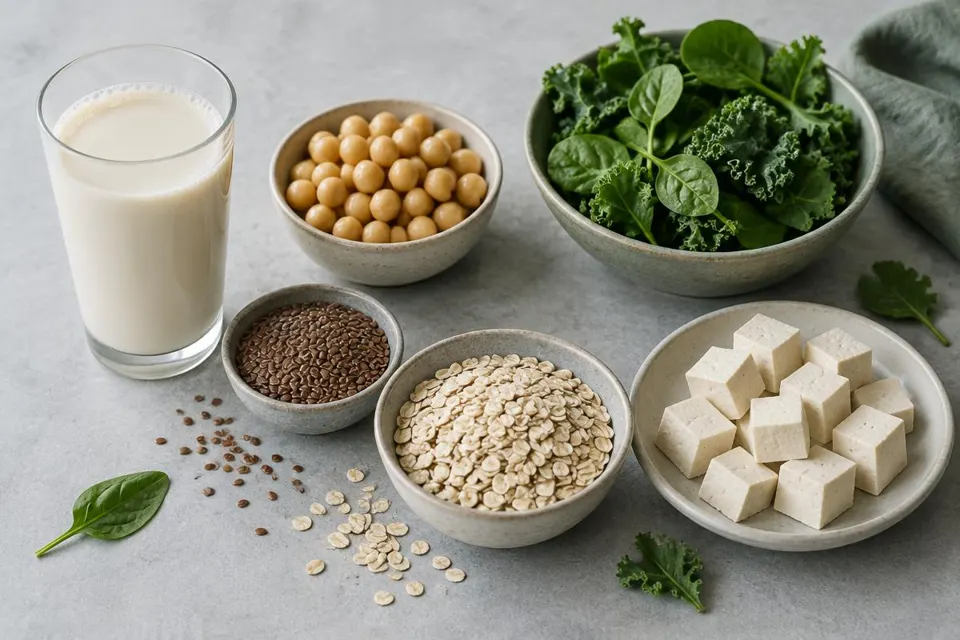
An egg can bind a mixture, help it rise, or provide protein as the main dish. One substitute will not perform every role. Hydrated ground flax can bind some baked goods; aquafaba can help with foam; tofu or chickpeas are more useful for a protein-rich meal. For a plant drink, check protein and calcium and vitamin fortification. White colour and a similar texture do not establish nutritional equivalence to milk.
A change that can last
Start with a regular household recipe, test a substitute, and review fullness, cost, allergies and nutrients. Plant drinks are not substitutes for breast milk or infant formula. Plan changes for children, pregnancy and medical conditions with a qualified nutrition professional. Reducing participation in a supply chain you reject need not make food more expensive or less nourishing, nor become a judgement on another household's circumstances.
Sources for this comparison: EFSA's 2023 scientific opinions on dairy cow and laying hen welfare, and NHS vegan-diet guidance. The first informs welfare assessment and the second nutritional planning; neither issues a religious ruling. EFSA · NHS
Research trail
Sources and further reading
- 01Qur'an 16:66 — Milk described as pure and easy to swallow, drawn from between waste and blood — cited as a sign of God's power and provision.
- 02Qur'an 47:15 — Rivers of milk, unchanging in taste, among the descriptions of Paradise.
- 03Qur'an 6:143, 39:6 — Verses referencing livestock and their young, used in wider discussions of animal husbandry in the Qur'an.
- 04Sahih al-Bukhari 5605 — The Prophet drinks milk and passes the vessel to a Bedouin on his right; evidence of drinking milk, not a required dietary pattern.
- 05al-Nawawi, al-Majmu' Sharh al-Muhadhdhab — Classical treatment of jallala and its implications for milk from animals fed impure matter.
- 06Ibn Qudama, al-Mughni — Hanbali fiqh on the purity of animal produce and conditions on feed.
- 07Compassion in World Farming, reports on dairy cow welfare — Independent welfare-organisation research on culling, lameness, and calf separation in modern dairy systems, used here descriptively and with appropriate caution about sourcing.
- 08RSPCA and industry welfare codes on laying hens — Public welfare-standard documentation describing cage, barn, free-range and pasture systems.
- 09al-Qaradawi, The Lawful and the Prohibited in Islam — General framework on gratitude for lawful provision and moderation in consumption.
- 10Foltz, Animals in Islamic Tradition and Muslim Cultures — Discussion of Islamic textual attitudes to livestock and their young.
- 11Masri, Animal Welfare in Islam — Argument for extending Islamic welfare obligations to dairy and egg production specifically.
- 12FAO reports on global egg and dairy production systems — Background on the scale and structure of contemporary industrial dairy and egg supply chains.
- 13An Open Letter to Shia Muslims on the Livestock Industry, Animal Suffering and Moral and Legal Duty Today — Anonymous advocacy letter (Persian, Persian advocacy text), whose dairy and egg material and health claims are examined critically here.
- 14Mohsen Javadi and Asghar Masoudi, "Animal Rights from the Islamic Perspective", Pazhuhesh-ha-ye Akhlaqi 4:2 (Winter 1392 SH / 2013), 21-48 — Academic study (Qom milieu) on the fiqh and ethics of animal treatment, including milking practice; it assumes lawful use and is not an argument for abstaining from dairy.
- 15Classical fiqh discussions of coercion (ikrah) and the invalidity of property taken by compulsion, e.g. as reflected in Hanafi and Ja'fari contract doctrine — Background on the classical setting of maxims voiding consent obtained under duress or violence, the setting the open letter draws its 'taken by the whip' maxim from; cited here descriptively, not as an endorsement of the letter's extension of it to animal produce.
References are given so readers can check them in the primary sources. Hadith gradings and scholarly positions are summarised in good faith; where a text is disputed we say so. Verify before you rely on anything here.
Follow the thread
Continue reading
Share this page