Merciful PlateFaith · Animals · Food Systems

Practice

Ramadan, Plant-Based

Fasting well on a mostly plant-based diet is entirely achievable — it asks for a little more planning around energy and protein, and a lot of grace around other people's tables.

18 min read10 sections12 sources

Ramadan reorganises the day around two meals instead of three, and around hunger as a teacher rather than an inconvenience. For anyone eating mostly plants, the month asks a little more deliberate planning than it might for someone relying on meat and dairy for a quick protein and fat hit — but it is entirely, comfortably achievable, and arguably closer in spirit to how Ramadan was eaten for most of Islamic history, when meat was an occasional food even at iftar. This page is about the practical mechanics of fasting well on a plant-based diet, and about the adab — the manners — of eating in the intensely communal, generous, and sometimes socially complicated context that Ramadan creates.

In short

  • Suhoor should combine slow-release carbohydrates, protein, fat, and enough fluid and salt to last the day, not just a large plate of rice.
  • Iftar has a structure — dates and water first, then a pause, then a real meal — that plant-based eaters can follow exactly as sunnah describes.
  • Feeding a fasting person carries an enormous, explicitly stated reward (Tirmidhi 807); being the fed guest also has its own etiquette of gratitude.
  • A full month of named, real menus across several Muslim food cultures is included below.
  • Being the only plant-based eater in a household during Ramadan is a common, manageable situation — not a reason to isolate yourself from the table.

Suhoor for sustained energy

The Prophet ﷺ was explicit that suhoor carries a blessing and should not be skipped: "Take suhoor, for indeed in suhoor there is blessing" (Sunan Ibn Majah 1746), and he recommended eating it close to dawn rather than early in the night (Sahih al-Bukhari 1923). Nutritionally, the goal of suhoor is to build a meal that releases energy slowly across a sixteen- or eighteen-hour fast, rather than one that spikes blood sugar and leaves you drained by mid-morning. This is exactly the profile that whole plant foods are naturally good at producing, if you build the plate with intention.

Aim for four things on the suhoor plate: a slow-release carbohydrate, a protein source, a source of healthy fat, and enough salt and fluid to hold hydration through a hot day. Oats cooked with milk alternative and topped with nuts and dates cover the carbohydrate, fat, and a slow trickle of natural sugar in one bowl. A South Asian suhoor of paratha (cooked with minimal oil) alongside spiced chickpeas or scrambled tofu bhurji supplies protein and fat together. A Levantine suhoor of labneh alternative (a thick, strained soy or coconut yoghurt) with olive oil, za'atar, and wholemeal bread gives fat, protein, and salt in one plate. Whatever the cuisine, favour wholegrains over refined ones — brown rice or bulgur over white rice, wholemeal flatbread over refined — because they digest more slowly and stave off the mid-afternoon energy crash that undoes many fasts.

Hydration deserves separate attention. Water alone, drunk in one go at 4am, will not carry you through a long, hot fasting day; you also lose salt through the day, particularly if you are physically active or the weather is warm. A small amount of salt at suhoor — olives, a pinch added to porridge, a salty pickle alongside the meal — combined with two or three glasses of water spread across the suhoor window (rather than one large glass at the very end) will do considerably more for you than water alone.

Iftar: from dates and water, outward

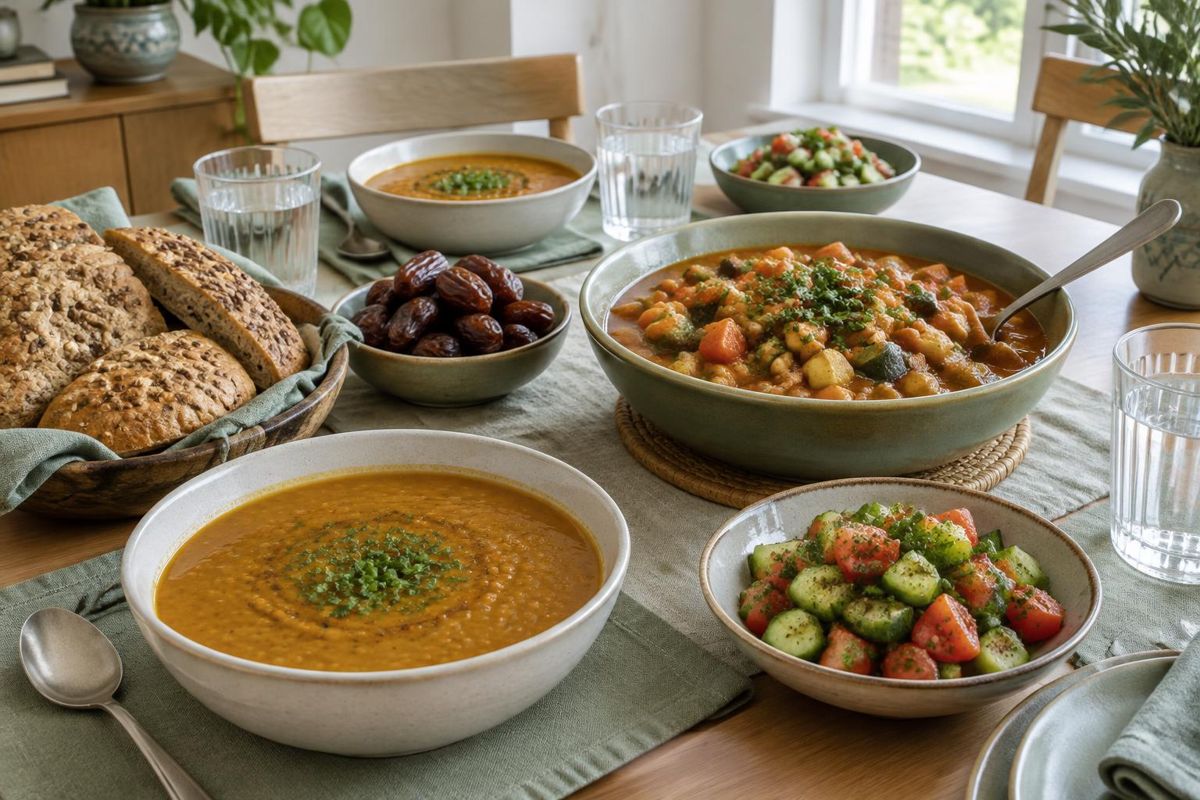
The Prophet ﷺ broke his fast with fresh dates when available, dried dates if not, and water if neither was to hand (Sahih al-Bukhari 1957; Sunan Abi Dawud 2356). This is not an arbitrary detail; dates supply a fast hit of natural sugar to correct low blood glucose after many hours without food, alongside fibre, potassium, and magnesium, and are gentle on a stomach that has been empty all day — considerably gentler than diving straight into a heavy, fried, or very rich meal. A plant-based iftar can and should follow the same structure exactly:

  • First: two or three dates and a glass of water, followed by Maghrib prayer.
  • Second: a light soup or broth — lentil soup (shorbat 'adas), harira, or mercimek çorbası — to rehydrate and gently reawaken digestion before the main plate arrives.
  • Third: the main meal, eaten at a normal pace rather than rushed, built around a pulse or grain protein, vegetables, and a modest portion of rice or bread.
  • Fourth: a small amount of something sweet later in the evening, rather than immediately, once the stomach has had a chance to settle.

This staged approach also protects against the single biggest health complaint of Ramadan — overeating at iftar — because arriving at the main plate already slightly nourished by dates and soup naturally moderates portion sizes. The Qur'an's general instruction on food, "eat and drink, but do not be excessive" (7:31), and the Prophet's ﷺ description of the stomach being divided into thirds for food, drink, and breath (Sunan al-Tirmidhi 2380, graded hasan by some and weak by others though widely cited for its principle) both point the same direction: iftar is a meal to be enjoyed unhurriedly, not a reward to be devoured.

Mosque iftars, and eating gratefully what is served

Communal mosque iftars are one of the loveliest institutions of the month — long rows of trestle tables, volunteers ferrying trays of rice and stew, strangers sitting shoulder to shoulder to break the fast together. They are also, for a plant-based eater, one of the more socially delicate settings, because the food served is communal, prepared in bulk, and rarely labelled. A few practical and adab-based points apply.

First, on the fiqh side: eat what is reasonably available to you without turning your plate into an investigation. If lentil soup, rice, salad, dates, and bread are on the table alongside the meat dish, you are almost never actually short of options, and there is no need to interrogate the volunteers about stock ingredients in a way that disrupts a fast-paced communal serving line. Where genuinely nothing plant-based is available beyond dates and bread, eat that gratefully and consider bringing a small dish to contribute next time — many mosques are glad to have a vegetable or lentil tray added to the rotation, and offering to cook one is usually received far better than a complaint about the existing menu.

Second, on the adab side: the Prophet ﷺ never criticised food that was placed in front of him — he ate what he liked and simply left what he did not, without comment (Sunan al-Tirmidhi 2963). At a mosque iftar prepared by volunteers, often elderly aunties and uncles who have been cooking since before dawn, a visible grimace at a meat-heavy dish, or a pointed question about ingredients asked in a tone of suspicion, causes real and unnecessary hurt. Gratitude for the labour and generosity behind a communal meal matters as much as what is actually on your plate.

Hosting and feeding fasting people

One of the most beautiful and explicit hadith of the month concerns the reward for feeding someone who is fasting.

Whoever feeds a fasting person to break his fast will have a reward like his, without any reduction in the reward of the fasting person.
Sunan al-Tirmidhi 807

This is a tremendous incentive to host, and a plant-based host loses none of this reward by serving a plant-based table — the hadith attaches the reward to the act of feeding a fasting person, not to any particular menu. If you are hosting an iftar for guests whose eating habits differ from yours, the generous and wise course is usually to serve a table that is genuinely welcoming to everyone: hearty lentil and vegetable dishes sit comfortably alongside a guest's own contribution of a meat dish if that eases things, rather than turning your iftar into a statement of principle at your guests' expense. Hospitality, at heart, is about the comfort of your guest, not the purity of your menu.

If you are the one being hosted and you know in advance that the household is not plant-based, a short, warm heads-up beforehand — "I don't eat meat these days, please don't go to any trouble, I'll happily eat whatever vegetables and rice are on the table" — spares your host either an awkward improvisation on the night or an anxious over-catering. Arriving with a dish to share, if the relationship allows it, is often the most graceful solution of all: it removes any burden from the host while ensuring you have something to eat.

Avoiding waste

Ramadan is, ironically, a month in which food waste tends to spike in many Muslim households and mosques, as tables are over-catered against the fear of a fasting guest going hungry. This sits uneasily against the Qur'an's repeated warnings against israf (extravagant waste) in eating (7:31) and the Prophet's ﷺ practice of eating what was served without excess and not discarding food. Practical steps that fit naturally into a plant-based Ramadan: cook pulses and grains in batches that can be frozen and reused across the month rather than cooking a fresh, large pot every night; treat leftover soup as the next day's suhoor base rather than throwing it away; and, when contributing to a mosque iftar, ask what quantities are actually needed rather than defaulting to "more is safer."

Taraweeh energy, digestion, and portion control

Standing for taraweeh on a stomach that has just been loaded with a heavy, rich iftar is uncomfortable and undermines the very worship the meal was meant to fuel. This is one of the clearest practical arguments for the staged iftar structure above: dates and water, then a gap for Maghrib prayer, then soup, then a moderate main plate, leaves the stomach in a far better state for standing, bowing, and prostrating an hour or two later than a single heavy plate eaten in ten rushed minutes. Plant-based meals built around pulses, vegetables, and moderate portions of grain also tend to sit lighter than very rich, fried, or heavily fatty meat dishes, which can help considerably with taraweeh energy and with sleep quality afterwards, though individual digestion varies and this is not a universal rule.

A month of menus

A full thirty-day rotation, organised in five six-day blocks so no dish repeats within a block, drawing on Levantine, North African, South Asian, West African, Indonesian, and Turkish traditions. Each entry names the main iftar dish; assume dates, water, and a light soup precede each one, and fruit or a small sweet follows later in the evening.

  • Days 1-6: Harira (Moroccan tomato-lentil soup as the main, with bread) · Vegetable biryani · Ful medames with flatbread · Rajma-chawal · Gado-gado · Mercimek çorbası with bulgur pilaf.
  • Days 7-12: Loubia (North African white bean stew) · Chana masala with rice · Akara with tomato pepper sauce and gari · Mujadara with tomato-cucumber salad · Freekeh pilaf with roasted vegetables · Turkish white bean stew (kuru fasulye, plant-based).
  • Days 13-18: Sayur lodeh (Indonesian vegetable coconut curry) with rice · Dal makhani (plant-based) with roti · Bamia (Levantine okra and tomato stew) · Egusi-style stew made with extra vegetables and toasted seeds in place of meat, with pounded yam or rice · Couscous with seven-vegetable tagine · Sambosas with a spiced lentil filling.
  • Days 19-24: Moro de guandules-style black-eyed pea and rice (adapted West African/Caribbean crossover common in some communities) · Turkish mercimek köftesi (lentil and bulgur patties) with salad · Palak dal with rice · Tempeh and vegetable satay with peanut sauce · Fattet hummus (Levantine layered chickpea and bread dish) · Thieboudienne-inspired vegetable and rice dish (West African, plant-based adaptation).
  • Days 25-30: Kabuli-style spiced rice with chickpeas and caramelised carrots · Gnocchi-free North African bessara (dried fava bean soup) with bread · South Asian vegetable pulao with raita alternative · Indonesian tempeh orek with rice and stir-fried greens · Turkish pilaf with chickpeas and dried apricots · Final night: a generous mixed table — mujadara, harira, and gado-gado together, echoing the first week and inviting guests to share in the last ten nights.

This rotation is deliberately repetition-light in the first month you try it, but by the following Ramadan you will likely find yourself returning to five or six favourites and letting the rest fall away — which is exactly the natural consolidation described on the Getting Started page.

Travel and i'tikaf

Travelling during Ramadan — for work, family visits, or Umrah — often means eating in settings you do not control: airport food halls, other people's homes, hotel buffets. Carry dates and a few portable staples (nuts, dried fruit, a flask) so that at minimum your fast opens well even if the surrounding food options are limited, and accept that some meals on the road will simply be less plant-based than your ideal; this is a matter of circumstance, not failure. During i'tikaf, when you are observing seclusion in the mosque for the final ten nights, most fiqh guidance permits leaving briefly for genuine necessities including food and drink where the mosque does not provide for worshippers in retreat; plan ahead by bringing dried fruit, nuts, and simple no-cook items so that your seclusion is not repeatedly broken by food logistics.

Eid al-Fitr food

Eid al-Fitr is a day of unambiguous celebration and the fast is, in fact, forbidden on this day precisely because it is a day of feasting and gratitude, not further restraint. A plant-based Eid table loses nothing in festivity: sweet vermicelli (sheer khurma made with a plant milk and dates), ka'ak and ma'amoul (traditionally already plant-based, being butter or oil-based shortbread with date or nut fillings), a spread of vegetable and lentil dishes alongside whatever meat dishes other family members are preparing, and fruit platters make for a generous, inclusive table. If you are attending a family Eid gathering where the main dishes are meat-based, eating the rice, salads, sweets, and any vegetable dishes present, and simply enjoying the occasion rather than treating it as a day to make a point, honours both the spirit of Eid and your own practice.

When you're the only one eating this way at home

Many people reading this page are the only plant-based eater in a household that fasts and feasts together in the ordinary way. This is entirely workable, and does not require cooking two separate kitchens' worth of food every night. The simplest approach is to build the shared iftar around a base that works for everyone — rice, bread, salad, a lentil or bean dish, soup — and to add a small, separate portion of meat for those who want it, rather than cooking two entirely distinct meals. Offer, where you are the one cooking, to prepare the family's usual favourites with your own plant-based version alongside, not instead — this keeps the table unified rather than divided into camps, and often, over the course of a Ramadan or two, wins over other family members simply because the food is good and no one is being asked to sacrifice anything to accommodate you.

Research trail

Sources and further reading

  1. 01Qur'an 2:183-187 (al-Baqarah)the core legislation of the Ramadan fast, its purpose, and its permissions
  2. 02Sunan al-Tirmidhi 807'whoever feeds a fasting person to break his fast will have a reward like his, without any reduction in the reward of the fasting person' — the basis for the virtue of hosting iftar
  3. 03Sahih al-Bukhari 1957 and Sunan Abi Dawud 2356the Prophet ﷺ broke his fast with fresh dates, then dried dates, then water
  4. 04Sunan Ibn Majah 1746hadith on suhoor as a blessed meal that should not be neglected
  5. 05Sahih al-Bukhari 1923 and Sahih Muslim 1095the recommendation to delay suhoor close to dawn
  6. 06Sahih al-Bukhari 6416'eat and drink, but do not be excessive; indeed Allah does not like those who are excessive' — the Qur'anic principle (7:31) applied to iftar tables
  7. 07Qur'an 7:31 (al-A'raf)the general Qur'anic instruction against excess in eating and drinking
  8. 08British Dietetic Association, Ramadan Health and Nutrition Guidanceslow-release carbohydrate and hydration guidance applicable to suhoor and iftar planning
  9. 09Sahih al-Bukhari 6018 and Sahih Muslim 48'whoever believes in Allah and the Last Day, let him honour his guest' — relevant to accepting food graciously when hosted at communal iftars
  10. 10Sunan al-Tirmidhi 2963 (hasan)on not disparaging food; the Prophet ﷺ never criticised a dish, praising what he liked and leaving what he did not
  11. 11Sahih al-Bukhari 6416 and Ibn Kathir, Tafsir al-Qur'an al-'Azim on 7:31classical commentary on moderation as it applies to festive and communal eating, relevant to Eid
  12. 12Fiqh councils' guidance on i'tikaf (e.g. al-Azhar Fatwa Committee; Hanbali fiqh manuals)on the permissibility of leaving the mosque for necessities including food during i'tikaf

References are given so readers can check them in the primary sources. Hadith gradings and scholarly positions are summarised in good faith; where a text is disputed we say so. Verify before you rely on anything here.

Follow the thread

Continue reading