Dear reader,
You have come this far through a site built on argument, citation and caveat — pages that summarise positions, weigh hadith gradings, and try, as carefully as we know how, not to tell you what to conclude. This last page is different in register, though not in honesty. It is written as a letter, because what remains to be said is not really a new argument. It is an invitation, and invitations are better spoken person to person than filed as a ruling.
To whom this is written
This is addressed to Muslims — all of us. Not to one school, not to one country, not to the already convinced. Hanafi, Maliki, Shafi'i, Hanbali, Ja'fari, Zaydi, Ibadi; the person who has never questioned the meat on their plate and the person who stopped eating it years ago; the imam, the butcher, the student, the mother doing the weekly shop. The question this site has spent its whole length on is not the property of any one tradition, because the texts it turns on are held in common: the Qur'an, sound hadith recorded in the collections every school regards as central, and the plain faculties of reason and conscience that our jurists have always expected a believer to bring to a new situation.
We are also not writing as a fatwa body, and nothing here is one. We have no authority to declare anything lawful or unlawful, and we do not attempt it. What we can do is set out, in one place and in plain language, everything that has been argued across this site — the evidence, the principles, the objections, and the places where honest people disagree — so that you can weigh it yourself and take a precise question to a scholar you trust rather than a vague unease.
A difference in kind
The first thing worth saying is the thing most readers underrate. The argument on this site does not begin by claiming that meat is bad. It begins by observing that the meat, milk and eggs the classical jurists were reasoning about are not the same kind of thing as the meat, milk and eggs on a supermarket shelf today — not merely different in quality, but different in the basic shape of the thing being ruled on.
In the Prophet's ﷺ era, animals lived largely in the open. A cow calved roughly once a year rather than being cycled through continuous forced pregnancies. A calf stayed with its mother. Hens scratched in a yard rather than living out a life under artificial light in a cage. There were no growth hormones, no prophylactic antibiotics, no breeding programmes selecting for maximum flesh in minimum time. Slaughter was individual, visible and human-scale: one household, one animal, one blade, one moment of accountability before God and before the neighbours who could see you do it.
The classical permission for meat, milk and eggs was reasoning about that animal, in those conditions, killed that way. It was not reasoning about a bird that never sees daylight, a calf taken from its mother within hours of birth, or a line killing thousands of animals an hour with imperfect stunning. That observation does not by itself settle any ruling. But it reframes the question usefully, and the reframing holds whatever you conclude: the question is not "does Islam permit eating animals" — it plainly does and always has — but "what exactly is being permitted, and is that still the thing in front of me at the till?" Our page on industrial animal agriculture and our essay on whether factory-farmed meat is haram sit with that question at length.
Mother and young
Graphic content — hidden by defaultThe separation behind a glass of milkShow image
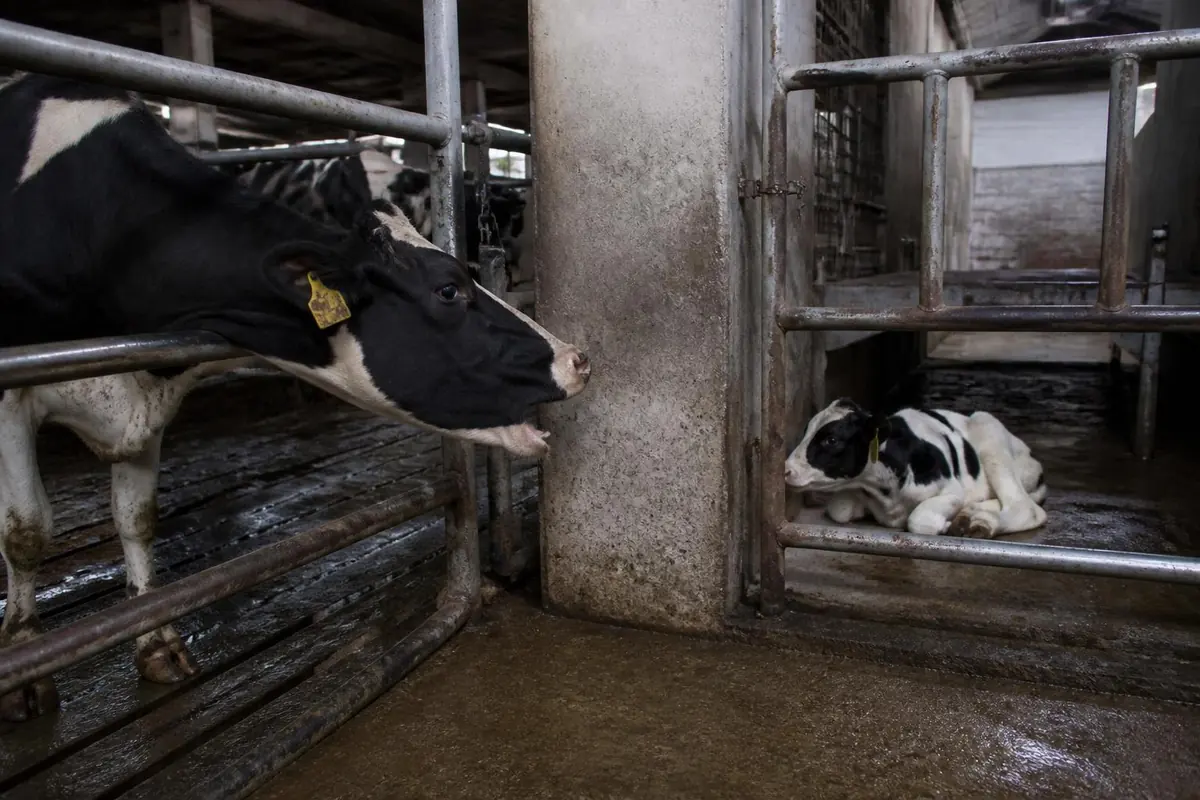
Begin where the texts are clearest. A dairy calf is typically removed from its mother at or within hours of birth so that her milk can be sold rather than suckled; cows are widely reported, in veterinary literature as much as in advocacy, to call for their calves for days afterwards. Male calves, having no place in a milking herd, are killed young or raised for veal. In laying, male chicks have no commercial value at all and are killed on their first day, in the hundreds of millions annually worldwide.
Against this stand reports that no school disputes in substance. The Prophet ﷺ, seeing a mother bird distressed over her taken chicks, asked, "Which of you has distressed this bird? Return her young to her." 'Ali's instructions to zakat collectors tell them not to separate a she-camel from her young and not to milk her dry, leaving a share for the calf. The Imami collections record six rights owed to a mount, and the Sunni collections record the reward for watering a thirsty animal and the punishment of the woman who confined a cat until it died. The argument here is one of degree: if denying a beast a little water on a hot day earns that kind of warning, permanent separation of mother and young, at industrial scale, as ordinary practice, is harder to wave away.
Confinement, mutilation, forced growth
The second catalogue concerns the body and its movement. Laying hens in cages so small that a bird cannot spread her wings across a lifetime. Sows in crates unable to turn around. Broiler chickens bred to reach slaughter weight so fast that their legs frequently cannot carry them. Feedlot cattle that never graze. Beaks trimmed, tails docked, teeth clipped, horns removed, castration performed without pain relief — not out of cruelty of temperament but because at scale it is cheaper, and because animals crowded that tightly injure each other otherwise.
Our law has vocabulary for this already. Mutilation (muthla) is prohibited in reports recorded in both traditions. Branding an animal's face is cursed by name. Overloading a mount beyond its strength is forbidden. The Prophet ﷺ, passing a tethered and starving camel, said: "Do you not fear God regarding this beast God has placed in your hands? It has complained to me that you starve it and overwork it" — and elsewhere, "Either feed it or release it so that it may seek food for itself."
There is a further point, drawn from the classical material rather than from modern advocacy, that we find genuinely striking. 'Ali is at his most insistent about animals held by agents who do not own them and gain nothing personally from their care — precisely because such animals are the ones most likely to be neglected. An animal owned by no one in particular, managed at scale by paid hands answering to a distant shareholder, is exactly the structural position of most animals in industrial agriculture. The jurists were not writing about factory farms. The fit is nonetheless hard to miss.
We say this carefully. No school holds that confinement as such is forbidden; stabling, penning and restraint for legitimate purposes have always been permitted. The claim is narrower and, we think, more defensible: there is a point at which confinement stops serving either the animal's welfare or a genuine human need and becomes an end in itself, optimised for throughput. The texts on gentleness and proportion were not written with that arrangement in mind.
The killing line
Graphic content — hidden by defaultWhat industrial speed can look likeShow image
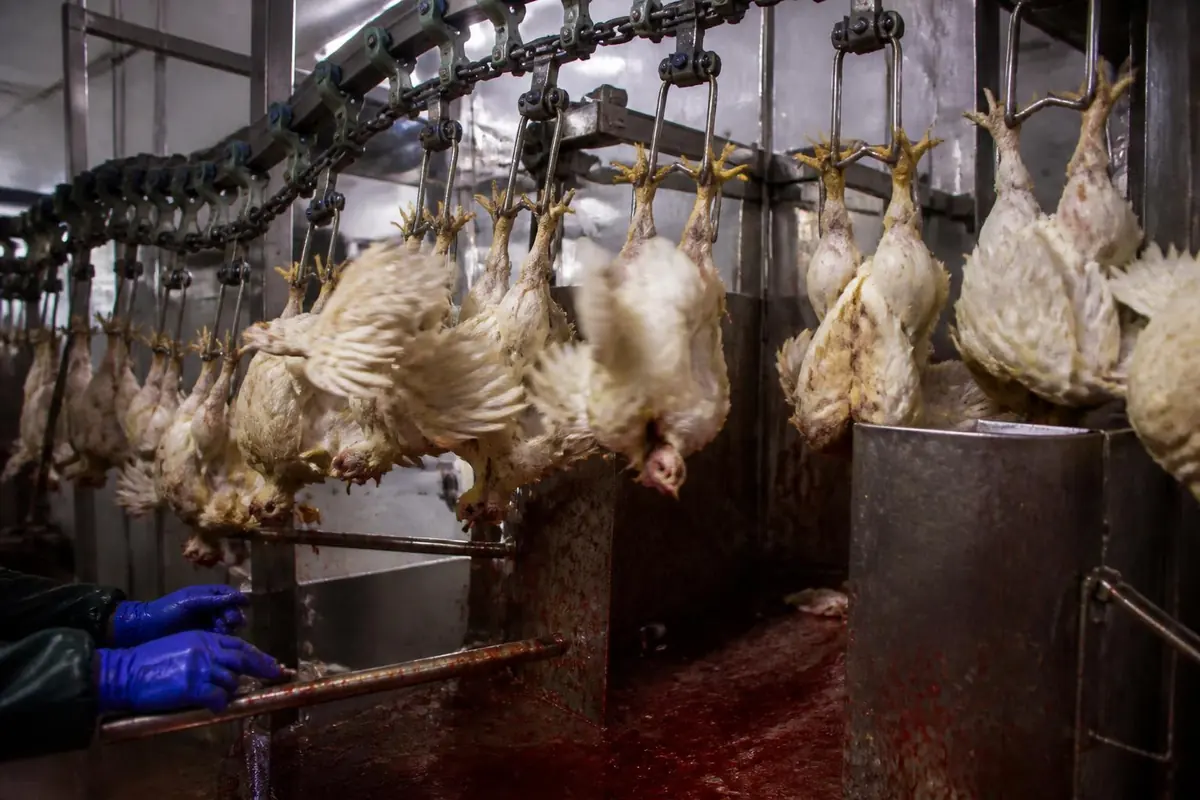
On slaughter, everything turns on one sound and widely transmitted hadith: «إنّ الله کتب الإحسان علی کلّ شیء، فإذا قتلتم فأحسنوا القتلة، وإذا ذبحتم فأحسنوا الذبحة، ولیحدّ أحدکم شفرته ولیرح ذبیحته» — "God has prescribed excellence (ihsan) in all things; so when you kill, kill well, and when you slaughter, slaughter well; let each of you sharpen his blade and spare suffering to the animal he slaughters." This is not a doubtful attribution. It is about as solid as anything on this subject, transmitted and accepted across the schools.
The question, fairly asked even if you reject the conclusion drawn from it: can a line killing many hundreds of animals an hour — where some arrive already injured or collapsed from transport, where stunning fails on a measurable percentage of animals, where the blade is not always sharp and the operator is not always attentive at the end of a long shift — still be described as ihsan in the sense that hadith intends? We are not in a position to adjudicate any particular abattoir for you, and standards vary enormously by country, certifier and plant; our page on slaughter and stunning maps the technical terrain. But the question itself, put against a text no school disputes, is one every conscientious buyer is entitled to sit with.
Milk, eggs and the things called by-products
Many readers who accept everything above still assume that milk and eggs are untouched by it, because no animal is killed to produce them. That assumption does not survive contact with how they are actually produced. A dairy cow gives milk because she is kept continuously pregnant and calving; her calf is removed; her productive life ends in the same abattoir as a beef animal, typically at a fraction of her natural lifespan, when her yield falls. A laying hen's brothers were killed on day one; she herself is slaughtered when her laying rate drops. Milk and eggs are not separate from the slaughter question; they are entangled with it, and dairy in particular carries the mother-and-young problem in its most direct form. Our page on dairy and eggs works through this in detail, as does our page on leather, wool and materials for what is worn rather than eaten.
The conditions of lawful slaughter, one by one
It is worth testing industrial production against the conditions the law itself sets for lawful slaughter, rather than arguing at the level of atmosphere. The schools differ in detail, but a broadly shared list runs: the animal must be alive and not already dying of injury or disease; it must be killed by a swift cut of a sharp blade to the throat vessels; God's name must be pronounced; the slaughterer must be qualified to perform it; the animal should not be tormented before the cut, should not see the blade or other animals being killed, and should be handled gently to the point of slaughter.
Read that list honestly against a high-speed line and you find that some conditions are typically met — the cut, the blade, the invocation, the certification of the slaughterer — while others, the ones about torment, gentleness, sight of the blade and the condition of the animal on arrival, are met unevenly at best. This is the crux of the strongest version of the argument. It does not require you to believe that meat is intrinsically unlawful. It requires you only to ask whether the conditions the law itself already imposes are actually being satisfied in the supply chain you buy from.
The principles our own law already gives us
Several established legal principles bear on this, and we want to name each and be honest about how much weight it can carry.
La darar wa la dirar — no harm, and no reciprocating of harm — is accepted across the schools. Applied here, it covers harm to the animal, harm to human health, and harm to the shared environment. The health part must be stated carefully: the World Health Organization's cancer agency classifies processed meat as carcinogenic and red meat as probably carcinogenic, and antibiotic use in intensive livestock is a recognised driver of resistant bacteria. Claims that go further — that animal products are worse than cigarettes, or that dairy directly causes particular cancers — are contested or overstated, and a maxim about harm can only carry the weight the harm is actually shown to bear. False certainty about harm is no more a service to truth than false certainty about permissibility.
The prohibition of idha' — causing an animal unnecessary pain — is the strongest move available, because it depends on nothing contested. It does not need nutrition science or climate modelling. It needs only the question of whether the animal is caused avoidable suffering, and the classical prohibitions on mutilation, branding the face and overburdening supply the vocabulary directly.
Al-hukm yadur ma'a al-mawdu' wujudan wa 'adaman — a ruling follows its subject matter into existence and out of it. If the subject the classical ruling addressed was a healthy, freely living, traditionally slaughtered animal, and the product before you comes from something structurally different, then on this reading the subject has changed and the ruling may need to be re-derived. This is genuine usul al-fiqh, not an invention; it is used across the tradition for questions from currency to medicine. Whether it can carry a conclusion as strong as prohibition, rather than a narrower judgement about specific practices, is exactly where mainstream jurists part company with the strongest advocates.
Hurmat al-i'ana 'ala al-zulm — the prohibition of assisting wrongdoing, rooted in Qur'an 5:2 — is applied to the ordinary act of purchase: a carton of eggs finances the cage, a bottle of milk finances the forced-breeding cycle. This is a real principle applied to a genuinely contestable question of fact: how direct must the link between purchase and wrong be before "assisting" applies to a global commodity chain rather than a personal transaction? Scholars differ, and reasonably.
Israf and fasad fi'l-ard — waste, and corruption in the earth — apply to a system that converts many calories of grain and enormous volumes of freshwater into few calories of food, on land cleared for the purpose. Ihtiyat, precaution where there is a live possibility of wrongdoing, closes the case: where doubt is substantial, caution favours restraint. And al-hukm yataghayyar bi-taghayyur al-zaman — rulings can shift with changed circumstances — is legitimate methodology, but it is a door that must be walked through by qualified jurists reasoning about specific facts, not a licence for any conclusion a writer wishes to reach.
Halal is not the whole of tayyib
The Qur'an rarely says halal alone. It says halalan tayyiban — lawful and wholesome, good, pure. Certification, as it functions today, is largely an audit of one narrow question: was the invocation made and the cut performed correctly? It very rarely asks how the animal lived, what was done to its body along the way, how it was transported, or what the operation did to the workers and the watershed around it. A certificate can be entirely truthful about what it certifies and still tell you almost nothing about tayyib. That gap — between a technically correct slaughter and a wholesome food — is where this entire discussion lives. Our pages on halal and tayyib and halal certification develop it.
Land, water, waste and the trust of khilafa
The Qur'an makes the human being a khalifa, a trustee, on the earth, and sets a mizan, a balance, that we are told not to transgress. Industrial animal agriculture contributes roughly a seventh of global greenhouse-gas emissions, occupies the majority of agricultural land while supplying a minority of calories and protein, drives deforestation for feed crops, and concentrates nitrogen and phosphorus runoff into rivers and coastal dead zones. Water — the substance the Qur'an calls the origin of every living thing, and which the Prophet ﷺ told a man not to waste even at a running river — is consumed at volumes per kilogram of meat that a smallholder in Medina could not have conceived.
We are careful here. Emissions figures vary by accounting method; some advocacy numbers circulate far beyond their sources. But the direction of the evidence is not seriously disputed, and the concepts of israf, mizan and fasad fi'l-ard were made for questions of exactly this shape. See israf, water and land and khilafa and climate.
The people inside the system
There is a dimension of this question that has nothing to do with animals and is too often left out. Slaughterhouse and processing work is among the most dangerous and worst-paid industrial employment in most countries where it exists, staffed disproportionately by migrants, refugees and people with little bargaining power, with documented rates of injury, respiratory illness and psychological harm. Communities downwind and downstream of intensive operations — again, disproportionately poor — carry the odour, the flies and the contaminated water. Islamic law's concern for the labourer's wage before his sweat dries, and its prohibition on harming a neighbour, are not peripheral to a discussion about food systems. They are part of it. See workers and justice.
Mercy as his defining description
Beneath all of the legal machinery sits a single verse. God did not describe the Prophet ﷺ as a lawgiver first, or a commander first. He described him as a mercy — and not to one nation or one species, but to al-'alamin, the worlds.
"And We have not sent you, [O Muhammad], except as a mercy to the worlds."
The sira reports carry the same character in narrative form: the army halted or diverted so that a nursing dog and her puppies in the road would not be disturbed; the camel that complained of hunger; the bird returned to her nest. These are narrative reports rather than graded legal hadith, and we say so. But an army does not stop for a stray dog unless mercy toward animals sits somewhere near the centre of the moral character it is trying to embody, rather than at its margins. Whatever grade you assign the story, that is what it is doing.
Proportion, appetite and the softening of the heart
The tradition has always been suspicious of appetite left unexamined, and of meat specifically as a food easily taken to excess. A well-known warning against habitual meat-eating — that it develops a hold on a person comparable to wine — is transmitted in Sunni sources from 'Umar ibn al-Khattab, in Malik's Muwatta' and al-Bayhaqi's Sunan al-Kubra, and circulates in later moral literature in other forms. It is frequently misattributed; we would rather cite it accurately than dramatically. A related line about not making our stomachs graveyards for animals is widely quoted and weakly attested, and should be treated as a memorable phrase of uncertain provenance rather than a proof text.
Better attested is the sensibility itself. When a man told Imam al-Rida he had raised a lamb himself and felt pity when it looked at him before he slaughtered it, he was told he would have done better not to rear an animal and then be the one to cut its throat; a parallel report has al-Sadiq telling a man to buy from the market instead. Al-Najafi records it as disliked to slaughter an animal you have personally raised. None of this forbids meat. All of it points the same way: our ethics of food have never been only about what is technically lawful, but about keeping a heart that does not grow careless of the cost.
Creatures that glorify God
Two verses do quiet, heavy work in this whole discussion. The first tells us that every creature on earth and every bird in flight forms "communities like you" — umam amthalukum — which is a strange thing to say about mere property. The second tells us that everything in creation glorifies its Lord, though we do not comprehend how.
"The seven heavens and the earth and whatever is in them exalt Him. And there is not a thing except that it exalts [Him] by His praise, but you do not understand their exaltation."
Read those two verses over a caged hen and a cow calling for her calf and the frame shifts: these are not units of output that happen to be alive; they are, in the Qur'an's own terms, communities and worshippers. And they are voiceless in the specific sense that matters morally. A wronged worker can organise, a wronged tenant can sue, a wronged citizen can protest — and each of those routes, however imperfect, eventually forces the wrongdoer to account. A hen in a cage has none of them. That structural silence is why wrongs of this kind are among the most durable and least self-correcting there are: not because they are worse in principle than wrongs done to a person, but because nothing inside the system generates the pressure that eventually drags most human wrongs into view. "Be an enemy to the oppressor and a helper to the oppressed" was never restricted, in the mouth of the man who said it, to oppression that happens to be loud — and the same man refused the seven regions rather than wrong an ant of a husk of barley.
Shared ground across the schools
It matters that almost nothing above is sectarian. The maxims — la darar, idha', the prohibition on assisting wrongdoing, precaution, the ruling following its subject — exist in equivalent or cognate form across Sunni and Shi'i usul. The central hadith on excellence in slaughter is in Sahih Muslim. The cat, the thirsty animal and the starving camel are in Bukhari and Abu Dawud. The nafaqa material is Imami fiqh at its most mainstream. The verses are read the same way by commentators in both traditions.
Where the traditions genuinely differ — in hadith corpora and grading methods, in the role of a living marja' versus a school's settled position, in specific rulings on stunning, on shellfish, on the meat of the People of the Book — we have set the differences out rather than smoothing them over, in our comparative section. Neither tradition is treated here as the default and the other as a variant. On this subject, more than most, they are not in serious tension.
The honest objections
A letter that only made its own case would not deserve your time. Here are the strongest replies, stated as their proponents would state them.
In short
- The clear position of every classical school is that meat, milk and eggs are lawful. No major Sunni or Shia authority has ruled otherwise, and a website is not a place from which that changes.
- Sin attaches to the wrongdoer, not to the product. On the standard analysis, a farmer who mistreats an animal sins, but the animal lawfully slaughtered is still lawful to eat. Turning producer misconduct into product prohibition is a substantial jurisprudential leap.
- Producers vary enormously. Pasture systems, smallholdings, and genuinely higher-welfare operations exist and are not accurately described by footage from the worst facilities; a blanket ruling would sweep them in with the rest.
- Some health and environmental claims made by advocates outrun their evidence, and an argument built partly on overstated science invites reasonable people to dismiss the sound parts along with the unsound.
- Qurbani and the eating of meat at Eid are rooted in the Qur'an and the Prophet's ﷺ practice. Any argument in this area has to reckon seriously with that, not step around it.
- For many Muslims, meat is bound up with hospitality, family, celebration and the dignity of not making a guest feel judged. An ethic that fractures a household is not obviously the more merciful one.
We take these seriously; several of them we find partly persuasive. Our fullest replies are at objections and responses and qurbani and Eid al-Adha.
What we are and are not claiming
Stated plainly
We are not telling you that meat, milk or eggs are haram. That is not the settled position of Islamic law in any school, and we have found no basis for presenting it as one. What we are saying is narrower: that the conditions under which most animal products are now produced raise real questions under principles every school already accepts; that a minority of serious writers, working from within the tradition rather than against it, have pushed those questions all the way to prohibition; that this minority conclusion is conditional by its own logic, since a prohibition grounded in present conditions ends when those conditions end; and that you are entitled — we would say obliged — to sit with the questions honestly whatever you conclude about the answers.
There is one further point that does not depend on any of the contested reasoning, and we want it to be the thing you remember. Rights owed to animals cannot be waived. A person you have wronged can forgive you and discharge your obligation; an animal cannot. The only way to discharge a duty owed to a creature is to actually perform it. And the duty of maintenance, as al-Tusi states it, holds whether or not the animal's flesh may be eaten — "because they have hurma." Permission to use an animal and duty of care toward it are two separate questions in the law itself, and the first does not answer the second. Whatever you decide about your plate, you are not permitted to treat an animal's welfare as settled by the fact that using it is lawful. That is not advocacy. That is closer to settled fiqh than most of us were ever taught.
The first generation to know
Ours is the first generation for which the science of animal cognition has shown, with real rigour, that these creatures feel pain and possess awareness. The first for which nutrition can show that animal products are not strictly necessary for human health, whatever debate remains about optimal diets. The first whose ecologists can put figures on what the system does to land, water and climate. And therefore the first generation able, in principle, to ask whether a table built partly on suffering is still the only table available — because for almost the whole of human history, for almost every believer who came before us, it simply was.
We are careful with this. It is a rhetorical observation, not a legal one, and "we now know more" does not by itself convert a permission into a prohibition. But knowledge does change what a conscience can honestly claim not to have considered. You are reading this having been told what the strongest version of the argument is, where it is contested, what the objections are, and what remains for you to weigh. That deserves something more than a shrug in either direction.
Closing, and small steps
- 01
Look
Learn how the products you buy are actually raised, moved and slaughtered.
- 02
Weigh
Separate established fact, advocacy claim and genuine legal disagreement.
- 03
Ask
Bring a precise question — and the relevant production facts — to a scholar you trust.
- 04
Begin
Take one sustainable step: reduce, substitute, source differently, or organise locally.
We will not close by telling you what to conclude. What we think this page has established, with its sources shown, is this. The gap between the animal the classical fiqh reasoned about and the animal behind most supermarket meat, milk and eggs is real. The duty of care owed to a creature is not discharged by the lawfulness of using it. Mercy was the Prophet's ﷺ own description of his mission, extended in the text itself to the worlds and narrowed by no authority we have found to the human world alone. And a minority of careful people have concluded from all this that the conditions of modern animal agriculture change the ruling on its products — a conclusion the mainstream of both Sunni and Shia scholarship does not share, and which this page does not ask you to share either.
What we would ask instead is smaller and harder to refuse: one honest step this week.
- One plant-based meal in place of a habitual one — start at Getting Started or the halal plant-based guide.
- Look once, properly, at how the food you buy is produced: What the Investigations Show.
- Read the full argument laid out in order at The Whole Argument, Step by Step, objections included.
- Return to the texts themselves at Mercy in the Hadith and Animals in the Qur'an, and read them as texts you already hold to be sound.
- Ask your own household one question this week: where did this come from, and what was asked of the animal along the way?
A religion whose Prophet ﷺ was sent as a mercy to the worlds can afford to ask that question out loud. Let us move, a little at a time, toward a life that asks less unnecessary suffering of anyone — seen or unseen, human or otherwise. That, more than any ruling this page could hand you, is the whole of what we have been trying to say.
With respect and good faith,
The editors
Research trail
Sources and further reading
- 01Qur'an 21:107 — "We sent you not but as a mercy to the worlds (rahmatan li'l-'alamin)" — read across both traditions' commentaries as mercy extended to all creation, not humankind alone.
- 02Qur'an 6:38 — "There is no creature on earth, nor a bird flying on its wings, but they are communities like you."
- 03Qur'an 17:44 — "There is not a thing but glorifies Him with praise, though you do not understand their glorification."
- 04Qur'an 5:2 — "Help one another in righteousness and piety, and do not help one another in sin and transgression" — the textual root of the discussion about what our purchases finance.
- 05Sahih Muslim 1955 (Shaddad ibn Aws) — "God has prescribed excellence (ihsan) in all things; so when you kill, kill well, and when you slaughter, slaughter well; let each sharpen his blade and spare suffering to the animal." Sound, and cited across Sunni and Shi'i literature alike.
- 06Sahih al-Bukhari 3318 and 2365; Sunan Abi Dawud 2548 — The woman punished over a cat she confined until it died; the reward for giving water to a thirsty animal; the Prophet's ﷺ rebuke of a man who starved and overworked his camel.
- 07Prohibitions of mutilation (muthla) and branding the face — Reported in Sahih Muslim and Sunan Abi Dawud, and paralleled in Shi'i collections; the classical basis for treating debeaking, tail-docking and comparable practices as candidates for idha'.
- 08al-Kulayni, al-Kafi, vol. 6, on withholding water and on the rights of a mount — The Imami material on feeding, watering, resting and not overburdening animals, including the six rights owed to a mount.
- 09al-Tusi, al-Mabsut, on nafaqa for animals; al-Najafi, Jawahir al-Kalam — Maintenance of an owned animal is obligatory whether or not its flesh may be eaten, "because they have hurma"; a deposited animal must still be fed even if the owner instructs otherwise.
- 10Mohsen Javadi and Asghar Masoudi, "Animal Rights from the Islamic Perspective" (Persian), Pazhuhesh-ha-ye Akhlaqi 4:2 (2013–14), 21–48 — Academic study drawing on Shi'i and Sunni fiqh and hadith; assumes lawful use of animals and argues that duties toward them are non-waivable rights of protection.
- 11Nahj al-Balagha, letter 47, and the report of Imam Ali and the ant — "Be an enemy to the oppressor and a helper to the oppressed"; reliably transmitted within the Shi'i corpus, quoted here as moral testimony rather than as a ruling binding on all readers.
- 12IARC/WHO Monograph 114 (2015) — Processed meat classified Group 1 (carcinogenic to humans), red meat Group 2A (probably carcinogenic) — the health claim on this page it is safe to state as established.
- 13FAO, Tackling Climate Change Through Livestock (2013); Poore & Nemecek, Science 360 (2018) — Livestock at roughly 14.5% of global anthropogenic greenhouse-gas emissions; land and freshwater accounting for animal versus plant foods.
- 14Investigative documentation of standard industry practice — Footage and reporting from cruelty.farm and onefork.org, treated on this site as advocacy evidence: useful for showing what legal, compliant facilities routinely look like, not as religious authority.
References are given so readers can check them in the primary sources. Hadith gradings and scholarly positions are summarised in good faith; where a text is disputed we say so. Verify before you rely on anything here.
Follow the thread
Continue reading
Share this page