Systems
Slaughter and Stunning
Dhabiha is defined by a small number of precise conditions. The dispute that divides scholars and certifiers today is mostly not about those conditions in principle, but about whether industrial-speed slaughter lines, and the stunning methods attached to them, can actually meet them in practice.
Few areas of Islamic dietary law generate as much confident misinformation, in both directions, as slaughter and stunning. Some Muslims assume any mechanised or stunned slaughter is automatically invalid; others assume any label reading "halal" guarantees a method identical to slaughter as practised in the seventh century. Neither assumption survives close reading of either the fiqh or the industrial process. This page sets out the classical conditions of dhabiha, explains why carrion is forbidden, and then works through each major stunning and slaughter technology used in industrial meat production today, alongside the range of scholarly and certifier positions on each.
In short
- Dhabiha requires tasmiyah, a qualified slaughterer, severance of the throat vessels, and a sharp instrument — the school-level detail varies on exactly which vessels and how many.
- Qur'an 5:3 forbids what dies by strangling, a blow, a fall, goring or partial consumption by a predator before it can be properly slaughtered — the definitional basis of mayta.
- The central live debate is whether stunning renders an animal dead before slaughter (invalidating it) or merely unconscious and recoverable (a live animal still validly slaughtered).
- Electrical water-bath stunning of poultry has documented failure and mis-stun rates that concern both animal welfare scientists and fiqh-focused certifiers, for different reasons.
- High line speeds put pressure on tasmiyah, cut accuracy and slaughterer attentiveness in ways that raise structural, not just individual, concerns.
- Certifiers genuinely disagree with each other, not only with secular regulators — this is an intra-Muslim debate, not just a Muslim-versus-industry one.
The conditions of dhabiha
Classical fiqh across the four Sunni schools, and in Shi'a jurisprudence, converges on a small set of core conditions for lawful slaughter (dhabiha or dhabh), though the schools differ on some details. First, tasmiyah: pronouncing the name of God, typically "Bismillah" or "Bismillah, Allahu Akbar," at the moment of cutting. Second, the slaughterer must be a Muslim or, per the majority reading of Qur'an 5:5, a Jew or Christian (a member of the "People of the Book"), of sound mind, and — in most classical formulations — must intend to slaughter (as opposed to, say, accidentally severing an animal's throat). Third, the cut must sever, at minimum, the trachea and oesophagus, with most jurists specifying the two jugular veins as well, made with a sharp instrument in a single continuous action rather than repeated sawing, and using anything other than teeth, claw or bone, which the Prophet ﷺ specifically excluded. Fourth, blood should be allowed to drain from the animal, consistent with the Qur'anic prohibition on consuming blood. Facing the animal, and the slaughterer, toward the qibla is widely practised and recommended by many scholars as an act of adab (etiquette) and reverence, though it is generally treated as recommended (mustahabb) rather than a strict condition for validity — a distinction worth holding onto, since conflating adab with a hard requirement can lead to unnecessary disputes about validity.
Whatever causes blood to flow, and over which God's name has been mentioned, eat it, provided the killing was not done with a tooth or a claw.
Why carrion (mayta) is forbidden
The prohibition on carrion is stated directly in the Qur'an, in a verse that also enumerates a set of specific causes of death that render an animal unlawful even if it was alive and otherwise permissible beforehand.
Forbidden to you are carrion, blood, the flesh of swine, what has been dedicated to other than God, what has been killed by strangling, by a violent blow, by a fall, by goring, or what has been partly eaten by a wild animal — unless you are able to slaughter it properly — and what has been sacrificed on stone altars...
The exception clause — "unless you are able to slaughter it properly" — is doing real work: it establishes that an animal fatally injured by an accident (a fall, a goring, a predator attack) can still be rendered lawful if a proper slaughtering cut is performed while it remains alive, and becomes carrion only if it dies before that cut is made, or if no valid cut is made at all. This clause is the textual anchor for the modern stunning debate: everything turns on whether a given stunning method leaves the animal in the category of "still alive, and slaughterable" or pushes it into the category of "already dead or dying by a forbidden cause," which would make any subsequent cutting a formality performed on carrion rather than a valid dhabiha.
The stunning question in outline
"Stunning" covers several distinct technologies applied before the throat cut, generally for the stated purpose of rendering the animal unconscious and reducing its perception of pain or distress during handling and cutting. From a fiqh perspective, the crucial variable is not the label "stunning" itself but the physiological effect: does the method reliably produce a reversible unconscious state, from which the animal would recover if not then slaughtered, or does it carry a meaningful risk of killing the animal outright, or of causing an irreversible cardiac or brain event, before the throat is cut? Scholars who permit stunning generally do so only for methods and settings (voltage, duration, gas concentration) that they are satisfied are reversible; scholars who reject stunning outright tend to argue either that no industrial process can be reliably guaranteed reversible at scale, that the risk of a wrongly calibrated or malfunctioning stun renders the practice too uncertain to build a ruling on, or that dhabiha as transmitted requires the animal to be handled and cut while fully conscious as a matter of principle, independent of the reversibility question.
Electrical water-bath stunning of poultry
Graphic content — hidden by defaultLive shackling on an industrial poultry lineShow image
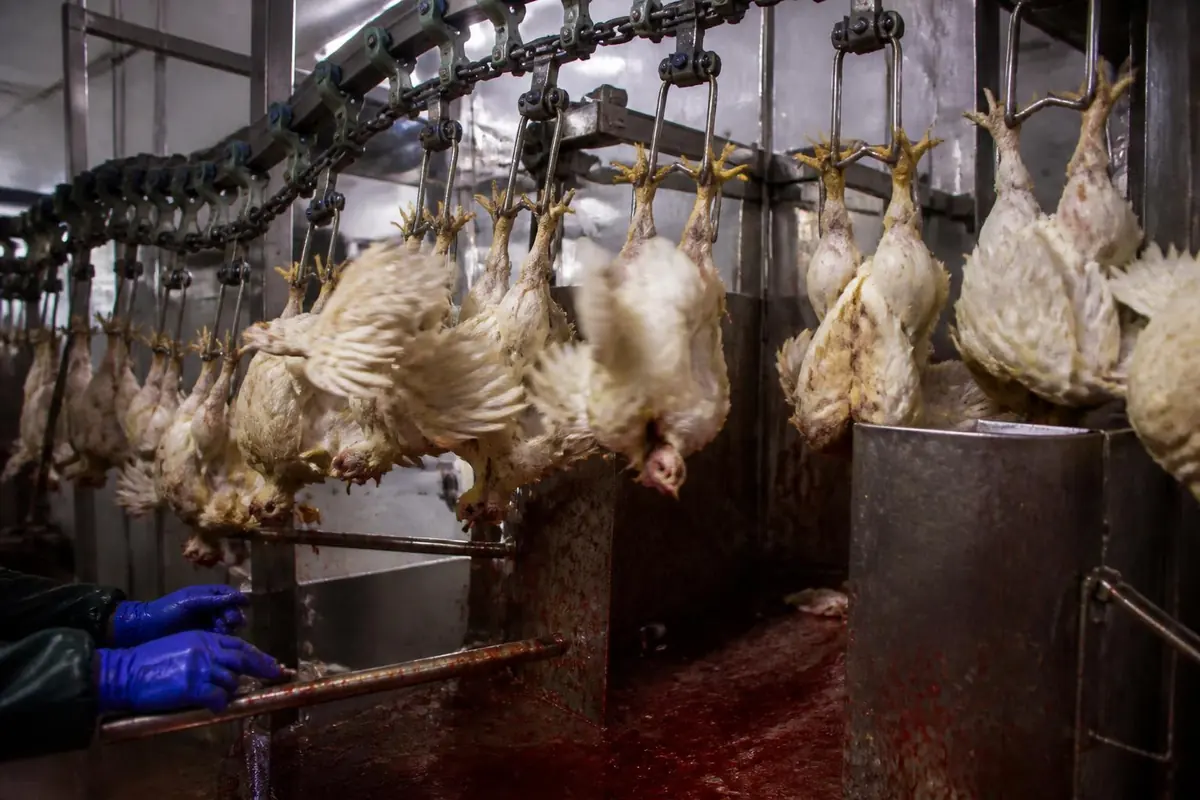
The most common stunning method in industrial poultry processing is electrical water-bath stunning: birds are shackled upside down by their legs on a moving line and their heads are dragged through an electrified water bath before reaching the slaughter point. This method is fast and cheap at scale, but animal welfare researchers have repeatedly flagged a structural weakness — birds vary in size, and a shackle line delivers a broadly uniform electrical exposure to a population of birds with different head and neck positions, body sizes and resistance, which means a meaningful proportion may receive an inadequate stun (remaining conscious or semi-conscious) or, less often, an excessive one. Some birds may also raise their heads and miss the water bath altogether, reaching the slaughter point unstunned or under-stunned, which then places extra weight on the accuracy of the cut and the visual check that follows. Certifiers who accept stunning in principle often still object to specific water-bath configurations on exactly these grounds, arguing that a method with a known, non-trivial failure or mis-stun rate cannot be assumed reversible for every bird on the line, even if it is reversible in a controlled laboratory test.
Captive bolt and gas stunning
Captive-bolt stunning, used mainly on cattle and sometimes sheep, fires a retractable bolt into the skull to cause immediate unconsciousness through direct trauma to the brain. Non-penetrating versions exist that aim to stun without penetrating the skull, intended to be more clearly reversible, though penetrating captive bolt — which causes physical brain damage — is harder to defend as reversible and is rejected by most scholars who otherwise accept some form of stunning, precisely because penetrating trauma to the brain is not a state an animal straightforwardly recovers from. Gas stunning, used mainly for pigs and increasingly for poultry, exposes animals to a controlled atmosphere (commonly carbon dioxide at varying concentrations, sometimes combined with other gases) intended to induce unconsciousness before slaughter; welfare researchers have also raised concerns that high concentrations of carbon dioxide can themselves be aversive to the animal in the seconds before unconsciousness sets in, an issue debated on animal-welfare grounds independently of the fiqh question of reversibility.
Mechanical blades and the single-slaughterer question
High-throughput poultry plants increasingly use mechanical or rotary blades to make the neck cut automatically as birds pass on the line, with a human slaughterer positioned to perform a manual back-up cut on any bird the machine appears to have missed. This raises a distinct fiqh question from stunning: many scholars hold that tasmiyah and intentional human action are integral to a valid dhabiha, and are uncomfortable extending that requirement to a machine blade cutting dozens of birds per second regardless of whether a person said "Bismillah" once at the start of the shift or continuously over a loudspeaker. Other scholars and certifiers accept mechanical slaughter provided a Muslim operator initiates and continuously supervises the machine with the correct intention, and provided every bird does in fact receive an adequate cut — treating the machine as an extension of the operator's hand in the same way a long knife is an extension of a hand, rather than as an independent agent. The practical dispute usually turns on verification: can an auditor actually confirm, bird by bird, that the automated cut met the anatomical requirements, or does the back-up manual cutter's presence functionally rescue only a fraction of the birds the machine mishandles.
Recorded tasmiyah
A related and contested practice is playing a recording of "Bismillah, Allahu Akbar" over loudspeakers in a plant, rather than requiring each individual slaughterer to pronounce it for each cut or continuously through their shift. Scholars who reject this practice argue that tasmiyah is an act tied to the person performing the slaughter at the moment of slaughter, and that a recording played independently of any specific cutting action cannot substitute for that intention-bearing utterance. Scholars and certifiers who accept it (more common in some regions and rarer in others) generally argue that continuous audible invocation covering the relevant period, combined with the operator's ongoing intention to slaughter in God's name, satisfies the requirement functionally, particularly on very fast lines where a human voice cannot physically keep pace with the cutting rate. This remains one of the more sharply contested points between certification bodies internationally.
Line speed, shackling and mis-cuts
Underlying several of the debates above is a simpler operational fact: industrial poultry lines can run at several thousand birds per hour, and even well-designed processes produce a non-zero rate of mis-cuts, birds that reach scalding tanks while still alive and insufficiently stunned or cut, and shackling injuries from live birds being hung upside down by the legs while conscious and distressed, a process that itself raises separate welfare objections regardless of the stunning question. From a fiqh standpoint, mis-cuts matter because an incomplete cut (one that fails to sever the required vessels) does not satisfy dhabiha, and because a bird that dies in the scalding tank before an adequate cut was made has, in effect, died by a method the Qur'an treats as invalidating — closer to strangling or a blow than to a proper slaughter. The rate at which this occurs on any given line is a matter of engineering, maintenance and staffing rather than doctrine, but it is precisely the kind of operational detail that a serious certification audit needs to check rather than assume away.
Can industrial killing be ihsan?
The ihsan hadith quoted above — «إنّ الله کتب الإحسان علی کلّ شیء... فإذا ذبحتم فأحسنوا الذبحة», "God has prescribed excellence in all things... so when you slaughter, slaughter well," transmitted in Sahih Muslim 1955 and shared across the Sunni and Shia traditions — is also the textual centrepiece of the anonymous Persian open letter to Shia Muslims discussed elsewhere on this site. The letter sets this hadith directly against the line speeds and mis-stun rates described above, and against Shi'i writing on slaughter that requires no frightening of the animal, no unnecessary pain, and a quick, calm death. It asks plainly whether a process built around thousands of birds an hour, where a measurable share arrive at the cutting point disoriented, injured or under-stunned, can honestly be called ihsan — and answers that it cannot. That conclusion is the letter's own; it is advocacy, not a fatwa from any named jurist, and it should be read as one contribution to the debate rather than as a ruling.
It is also worth stating the fair counter-argument plainly, because the letter's own logic can be read to run past it: dhabiha's legal validity and an animal's welfare during production are, in classical fiqh, distinct questions. A cut that satisfies the anatomical conditions set out earlier on this page — tasmiyah, a qualified slaughterer, severance of the required vessels with a sharp blade — renders meat lawfully slaughtered even where the surrounding system has treated the animal badly at earlier stages, in the same way that a validly performed prayer is not rendered invalid by the sins a person committed on the way to the mosque. Scholars who accept this distinction are not thereby indifferent to ihsan; many treat falling short of it as a separate moral and juristic wrong worth addressing on its own terms — through better regulation, slower lines and stricter certification of failure rates — without concluding that the resulting meat itself becomes haram. Whether that separation between validity and welfare should hold as firmly as classical fiqh generally treats it is precisely the disagreement between the letter's position and the mainstream one, and readers should recognise it as an open, contested question rather than one this page resolves.
Testing the letter's seven conditions
The anonymous open letter to Shia Muslims does not merely appeal to the general ihsan hadith; it sets out something closer to a checklist of seven conditions it says a lawful slaughter requires, and then asserts that industrial practice fails several of them systematically rather than occasionally. The checklist itself is a reasonable restatement of conditions found across classical fiqh manuals, including Ibn Idris al-Hilli's al-Sara'ir and al-Muhaqqiq al-Hilli's Shara'i' al-Islam on the Twelver side and the Sunni sources discussed earlier on this page. What is properly the letter's own contribution — and what deserves separate scrutiny — is the factual claim about what actually happens on an industrial line, which is contested to different degrees for each condition.
Reading the seven conditions this way clarifies what is really at stake. None of the letter's seven conditions are themselves controversial as statements of classical fiqh; what is doing the argumentative work is an empirical claim about industrial practice for each one, and those claims range from well corroborated (rough handling, some shackling injury) to genuinely disputed among specialists (mis-stun rates, recorded tasmiyah, mechanised cutting) to plausible but harder to quantify (health status at slaughter). Certification schemes exist precisely to answer these questions case by case, but a certificate answers a narrower, more procedural question than the letter is actually asking: it typically verifies that a named slaughterer of the correct religious status pronounced the tasmiyah and performed an anatomically adequate cut on an animal presented to them, at the standard the certifying body itself sets and audits. It does not, by itself, verify the animal's full welfare history, resolve the contested rate of mis-stuns on a particular line, or settle the mechanised-slaughter dispute — and it certainly does not, on its own, establish the letter's broader conclusion that the resulting meat is haram. Certification imperfectly answers a procedural question at scale; the letter is posing a different, more sweeping question that no certificate is designed to answer. See the full step-by-step case for how this fits alongside the letter's other arguments, and Halal Certification Explained for what certification actually audits.
Where certifiers and scholars stand
There is no single "Muslim position" on any of the technologies described above; there is a range of positions held by serious scholars and certification bodies, often differing by country and by species.
The stunning-accepting position
Reversible stunning does not invalidate dhabiha and reduces suffering.
Many national fiqh councils and certifiers, particularly in Europe, accept specific stunning methods — usually non-penetrating captive bolt for cattle, and carefully calibrated electrical or gas stunning for poultry and pigs — on the condition that veterinary evidence shows the method is reversible under normal operating parameters, that the animal is alive at the moment of the throat cut, and that death is caused by the cut and blood loss rather than by the stun itself. Proponents argue this position takes animal welfare science seriously, reduces the animal's perceived distress during handling and cutting, and remains fully consistent with the Qur'anic exception clause in 5:3, since the animal is not dead or dying from the stun when the cut is made.
The stunning-free position
Any stunning risks or actually causes the animal's death before the cut, invalidating slaughter.
Other certifiers and scholars, including several long-established stunning-free schemes, hold that no industrial stunning method can be reliably guaranteed reversible for every individual animal on a fast-moving line, that a meaningful failure rate is inherent to mass mechanised processing rather than an occasional defect, and that dhabiha as transmitted from the Prophet ﷺ envisions a fully conscious animal handled individually with visible care, which stunning as practised commercially does not reproduce. Proponents of this position often also argue on animal-welfare grounds that a well-performed conventional cut with a sharp blade, on a calm and properly restrained animal, causes loss of consciousness within seconds and need not be more distressing than a poorly calibrated stun.
These positions are not simply "traditionalist versus modernist." Serious jurists on both sides cite classical sources, engage with veterinary evidence, and reach different conclusions about how much uncertainty a Muslim consumer should tolerate in a chain of food production they cannot personally observe.
The structural argument about speed
A distinct argument, made by scholars on both sides of the stunning question, concerns speed itself rather than any single technology. The conditions bound up with ihsan — sharpening the blade out of the animal's sight, handling it gently, not delaying between restraint and the cut, ensuring the cut is clean and complete, allowing full bleed-out before further processing — describe a set of practices that were straightforward to observe for a single slaughterer working with a handful of animals, and considerably harder to guarantee, bird by bird or animal by animal, on a line processing several thousand units an hour. This is a structural claim rather than an accusation against any individual slaughterer: even a scrupulous, well-trained worker operating within an industrial system is working inside constraints on time, pace and oversight that were simply not part of the situation the classical texts describe. Some scholars conclude from this that industrial slaughter of any kind sits in real tension with the spirit, if not the bare legal letter, of dhabiha, and that certification needs to audit line speed and failure rates as seriously as it audits the wording of the invocation. Others reply that fiqh has always accommodated changes in method — the move from a single household slaughtering its own goat to abattoirs staffed by trained Muslim or People-of-the-Book slaughterers was itself a significant change — and that the correct response to speed-related risk is tighter auditing and better technology, not a wholesale rejection of industrial slaughter as a category. Both positions agree on one practical point: a certificate is only as good as the auditing regime behind it, which is the subject of the next page.
A note on tone
This page deliberately avoids recommending one position over another. Muslims who eat only stunning-free meat and Muslims who accept reversible stunning are both following positions held by credentialled scholars; neither should be treated as careless about their faith.
Research trail
Sources and further reading
- 01Qur'an 5:3 — The core verse enumerating what is forbidden, including carrion, blood, swine and what is killed by strangling, a blow, a fall or goring
- 02Sahih al-Bukhari 5498-5500 — Hadith on the basic requirements of slaughter and the naming of God
- 03Sahih Muslim 1955 — The ihsan hadith on sharpening the blade and sparing distress
- 04Ibn Rushd, Bidayat al-Mujtahid — Classical comparative fiqh on the conditions of lawful slaughter across schools
- 05European Council for Fatwa and Research, resolutions on stunning — A body that has permitted reversible stunning under specified conditions
- 06Halal Monitoring Committee (UK), position statements — A certifier that rejects mechanical slaughter and stunning of any kind
- 07Halal Food Authority (UK), stunning policy documents — A certifier that accepts certain reversible stunning methods
- 08European Food Safety Authority, opinions on stunning methods — Technical background on effectiveness and failure rates of stunning methods, cited qualitatively
- 09Temple Grandin, published writing on poultry and livestock handling — An animal-welfare scientist's technical assessment of stunning and handling methods
- 10Jamiat Ulama Britain, guidance on halal slaughter — A UK scholarly body's guidance distinguishing acceptable and unacceptable practice
- 11al-Qaradawi, al-Halal wal Haram fil Islam — A widely read contemporary fiqh discussion of slaughter and permissibility
- 12Grandin and Regenstein, 'Religious Slaughter and Animal Welfare: A Discussion for Meat Scientists' — A frequently cited technical paper comparing dhabiha and captive-bolt methods
- 13An Open Letter to Shia Muslims on the Livestock Industry, Animal Suffering and Moral and Legal Duty Today (Persian, anonymous) — Anonymous advocacy letter, not a fatwa; argues industrial-speed killing cannot meet the standard of ihsan
- 14Ibn Idris al-Hilli, al-Sara'ir; al-Muhaqqiq al-Hilli, Shara'i' al-Islam — classical Twelver fiqh statements of the conditions of lawful dhabh, used here to state the seven conditions tested against industrial practice
References are given so readers can check them in the primary sources. Hadith gradings and scholarly positions are summarised in good faith; where a text is disputed we say so. Verify before you rely on anything here.
Follow the thread
Continue reading
Share this page