Systems
What the Investigations Show
Two campaigning archives — cruelty.farm and onefork.org — document, in detail, what standard and entirely legal practice looks like inside industrial animal agriculture. This page reads both carefully, separates their well-evidenced claims from their weaker ones, and asks what the documented reality does to the Islamic argument that today's animal products are unlawful.
Almost every Islamic argument about industrial animal products turns, in the end, on a question of fact rather than a question of law. The legal principles are not seriously disputed: cruelty is forbidden, neglect of an animal in your care is sinful, waste and corruption on the earth are condemned, and slaughter must be carried out with ihsan. What Muslims disagree about is whether the system that actually produces the meat, milk and eggs in an ordinary supermarket breaches those principles routinely, occasionally, or hardly at all. That is a factual question, and it can only be answered by looking at what the system does.
This page examines two campaigning archives that exist precisely to document it: cruelty.farm, published by the Humane Foundation, and onefork.org, published as The One Fork. Neither is a neutral source. Both conclude that readers should stop eating animal products. We read them here the way one reads any interested witness: carefully, taking seriously what they can document, and marking clearly where their rhetoric outruns their evidence.
In short
- Both sites' central descriptive claim — that the practices shown are standard, legal and industry-wide rather than criminal exceptions — is the claim that matters most for Islamic ethics, and it is the one best supported.
- onefork.org states plainly that its footage comes from legal, regulation-compliant facilities: 'this is the system working as designed'.
- The documented pattern — confinement, forced breeding, mother-young separation, mutilation without pain relief, transport without food or water, and killing at line speed — maps almost item-for-item onto the harms classical Islamic sources single out as sinful.
- The Javadi-Masoudi study argues animals hold rights to space, light, natural food, rest and companionship that no owner may waive; the industrial system withholds these by design, not by accident.
- Some numbers on both sites are solid (Poore and Nemecek's land and emissions figures); others are contested or stated too confidently (the transport-sector emissions comparison, some health claims).
- None of this establishes that animal products are haram as a matter of settled law. It substantially strengthens the argument that the classical permission was granted for a form of animal use that no longer describes the ordinary case.
Why read campaign sites at all
- 01
Observe
Record a practice, facility or outcome without assuming one example represents a whole sector.
- 02
Corroborate
Check the same practice against regulations, industry manuals, academic studies and official data.
- 03
Classify
Separate standard legal practice from non-compliance, exceptional abuse and uncertain frequency.
- 04
Interpret
Only then ask what established Islamic legal and ethical principles make of the verified facts.
Graphic content — hidden by defaultConfinement as an operating systemShow image
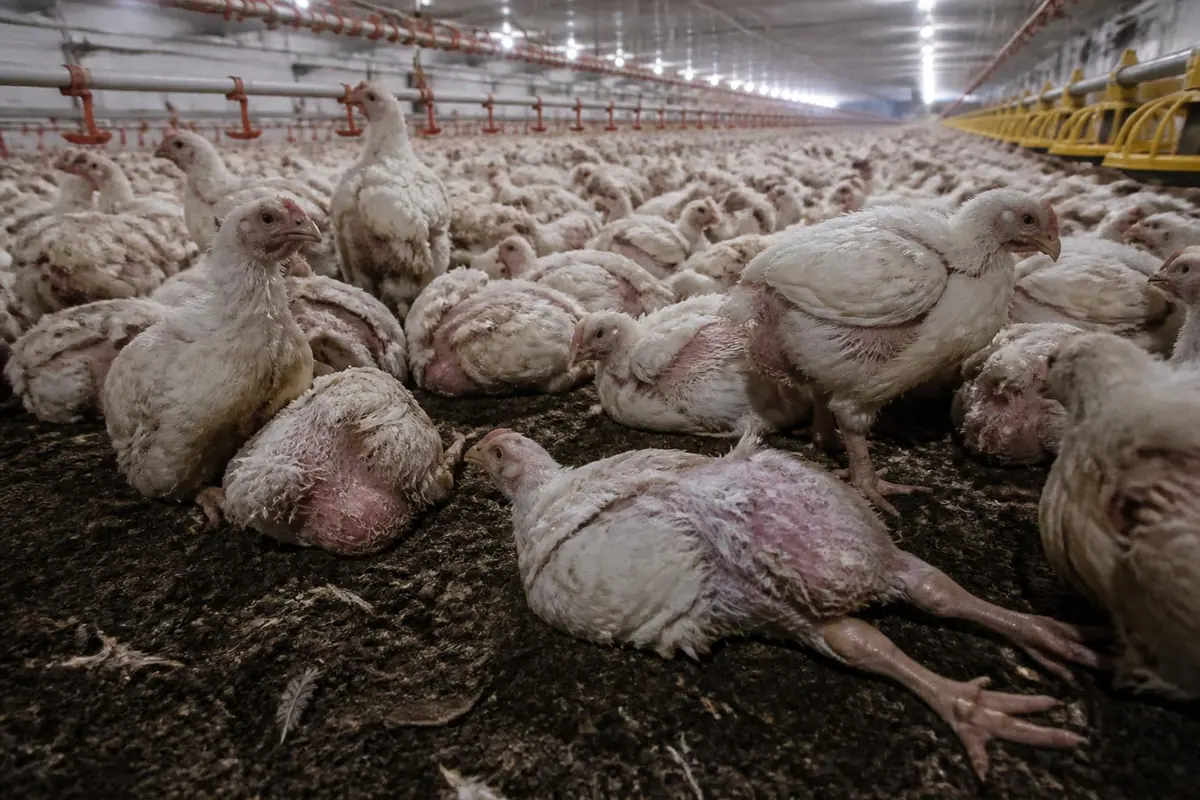
There is a reasonable objection to be made before we start. Advocacy sites select their evidence. They show the worst shed and not the better one; they photograph the sow in the crate and not the smallholder's field; they frame every statistic to point one way. A Muslim reader who wants to know whether their food is lawful has every right to ask why they should take such material seriously.
The answer is that on the question that matters most, these sites are not asking to be believed on trust. Their claim is not that cruelty happens somewhere; it is that the practices they document are the standard, legal method of production. onefork.org puts this with unusual precision in its section titled "Inhumane Treatment, Documented": the images, it says, "show standard practice inside legal, regulation-compliant facilities. Nothing here is unusual. This is the system working as designed." That is a falsifiable claim about ordinary industry practice, and it can be checked against agricultural literature, industry manuals and regulation — which permit, in most jurisdictions, exactly the practices shown.
This matters for fiqh in a specific way. Islamic law is generally relaxed about rare abuses committed by wrongdoers: a sinful butcher does not render an entire category of food unlawful. It is far less relaxed about a system whose ordinary, designed operation involves the harms the sources forbid. The whole weight of the argument rests on whether we are looking at exceptions or at design.
The two sources, and how to weigh them
The two archives are different in character, and the difference is worth noticing.
cruelty.farm
Species-by-species documentation, campaigning tone
Organised as a library: separate sections on cows and the dairy-veal link, pigs, poultry, fish and aquaculture, goats and rabbits, live transport, and slaughter. Its strength is descriptive granularity — gestation crates measured, transport conditions itemised, mutilations named. Its weakness is that headline figures are presented as flat facts without inline citation, so each has to be checked separately.
onefork.org
Comparative and quantitative, sources named
Organised around a smaller number of claims, each attributed: FAO slaughter data, fishcount.org.uk, Poore and Nemecek in Science (2018), Crippa et al. in Nature Food (2021), Mekonnen and Hoekstra on water footprints. Its comparative table of greenhouse gases, land, water and eutrophication per 100g of protein is the most checkable thing either site publishes.
What they share
A conclusion, and a framing
Both end at the same place: individual dietary change as the meaningful lever. Both frame the issue as animals, planet and health together. Neither is a religious source, neither addresses Islamic law, and neither should be quoted as though it were expert testimony on fiqh.
How we use them here
As evidence about the world, not about the law
The sites tell us what the industry does. The Qur'an, the Sunnah and the fiqh tradition tell us what that means. Confusing the two — treating an advocacy statistic as though it settled a legal question — is the single commonest error in this whole debate, and it is made by both sides.
Watch the evidence critically
Film can make hidden systems visible, but it also edits, selects and persuades. The films curated by OneFork's Other Side of the Plate are advocacy works, not neutral surveys and not Islamic legal authorities. Watch for what the camera establishes, check general claims against the sources, and keep the factual question of what happens distinct from the juristic question of what ruling follows.
Dominion (2018) — graphic, age-restricted viewing
Prefer a shorter introduction?
Birth, breeding and the mother
cruelty.farm's account of the industrial life cycle begins where the animal does: birth into a system built, in its words, "for efficiency, not welfare". Reproduction is controlled rather than natural. Sows are impregnated by artificial insemination on a managed cycle and bear large litters repeatedly; dairy cows are inseminated annually so that milk continues to flow, and their calves are taken from them within hours or days — the male calves entering veal or beef production, the females entering their mothers' cycle in turn. onefork.org captions a photograph of a dairy cow with a single line: "Behind every glass of milk, a mother."
This is the point at which secular animal-welfare documentation and Islamic source material converge most sharply, and it is worth being precise about why. The Islamic tradition contains an unusually specific body of material on mothers and their young. The Javadi–Masoudi study, working through Imami and Sunni collections alike, lists the separation of a mother from her offspring among the harms the reports single out, and treats an animal's need for companionship and for its natural pattern of life as part of what its owner owes it rather than an optional kindness. Among the reports most often cited in that literature is the incident, transmitted in the sira and manaqib material, in which the Prophet ﷺ ordered his companions to shield a mother dog and her puppies lying in the path of the army. The anonymous Persian open letter makes this material the emotional centre of its argument, and it is not hard to see why: a system that separates mother from young as a routine daily operation, millions of times over, is not committing an exceptional cruelty but an industrialised one.
Attribution note
Confinement as the normal case
Both sites treat confinement as the defining feature of the system rather than one of its incidents. cruelty.farm's summary of the life cycle names confinement as the second stage: "animals spend their lives in overcrowded, unsanitary spaces." Its article on gestation crates describes enclosures of metal or wire roughly two feet wide and seven feet long, in which a pregnant sow can stand and lie down but cannot turn around, and in which she spends the bulk of her productive life. onefork.org's photographic section shows the same structures from four directions at once — a battery hen shed in Finland, gestation crates in a Manitoba pork facility, a crowded turkey shed in North Carolina, an aerial view of a Missouri concentrated animal feeding operation — with the captions crediting the investigators and public agencies whose images they are. Its running caption under the broiler footage is the sharpest line either site writes: what is shown is "what 99% of farmed animals never get to do", meaning stand on earth in daylight.
The Islamic reading of this material is not a matter of sentiment. The Javadi–Masoudi study, surveying the fiqh of animal maintenance (nafaqa), draws up a list of what an animal in human custody is owed: adequate space, light, freedom of movement, food of the kind natural to it, water, shelter, hygiene, rest, companionship, and the ability to reproduce naturally. It stresses two things about these entitlements that matter here. First, they are protective rights that the animal cannot waive and the owner cannot buy out; some Imami jurists classify the duty of maintenance as a haqq Allah, a right of God, precisely so that no human agreement can extinguish it. Second, they are owed even to animals that are unlawful to eat, economically useless, or dying — which forecloses the argument that a productive purpose licenses withholding them.
Set that list against the documented system and the overlap is close to total. Space, light, natural food, movement, rest, companionship and natural reproduction are precisely the things battery cages, gestation crates, broiler sheds and feedlots are designed to restrict, because restricting them is what makes the economics work. This is the single strongest evidential contribution these archives make to the Islamic argument: not that cruelty occurs, but that the withholding of what classical fiqh treats as owed is the method of production rather than a failure of it.
A woman was punished on account of a cat she had imprisoned until it died. She did not feed it, nor did she let it free to eat from the vermin of the earth.
Classical commentators read this report as establishing that confining an animal and withholding what it needs is a sin of sufficient gravity to attract punishment, and that the sin lies in the confinement together with the deprivation, not merely in an intention to cause pain. The application to cages is an inference, not a ruling, and jurists who permit industrial products would say the analogy fails because these animals are fed and watered. The reply advanced by welfare-minded scholars is that food and water were never the whole of what the tradition required.
Mutilations without pain relief
cruelty.farm's species pages document the routine procedures: tail docking and teeth clipping in piglets, castration without anaesthetic, beak trimming in laying hens, dehorning and disbudding in cattle, and the culling of male chicks in the egg industry. The site's framing is that these are performed for management reasons — to prevent the injuries that crowding itself causes — and typically without pain relief, at speed, by workers processing very large numbers of animals.
Here the Islamic material is unusually direct, and it does not require any modern analogy. The Javadi–Masoudi study assembles the prohibitions transmitted in both Sunni and Shi'i collections against striking an animal in the face, branding it on the face, mutilation (muthla), overloading it beyond its strength, frightening it, and castrating it — the last being a point on which jurists differ, with a body of opinion treating it as at least disliked and some treating it as forbidden. What the study establishes is that the tradition treats bodily alteration and infliction of pain on an animal as a legally cognisable wrong, not a matter of taste. Whether the specific procedures used in modern husbandry fall under those prohibitions is a question for qualified jurists; that they are the same category of act is difficult to dispute.
Transport: the stage nobody certifies
Graphic content — hidden by defaultThirst, heat and crowding in transitShow image
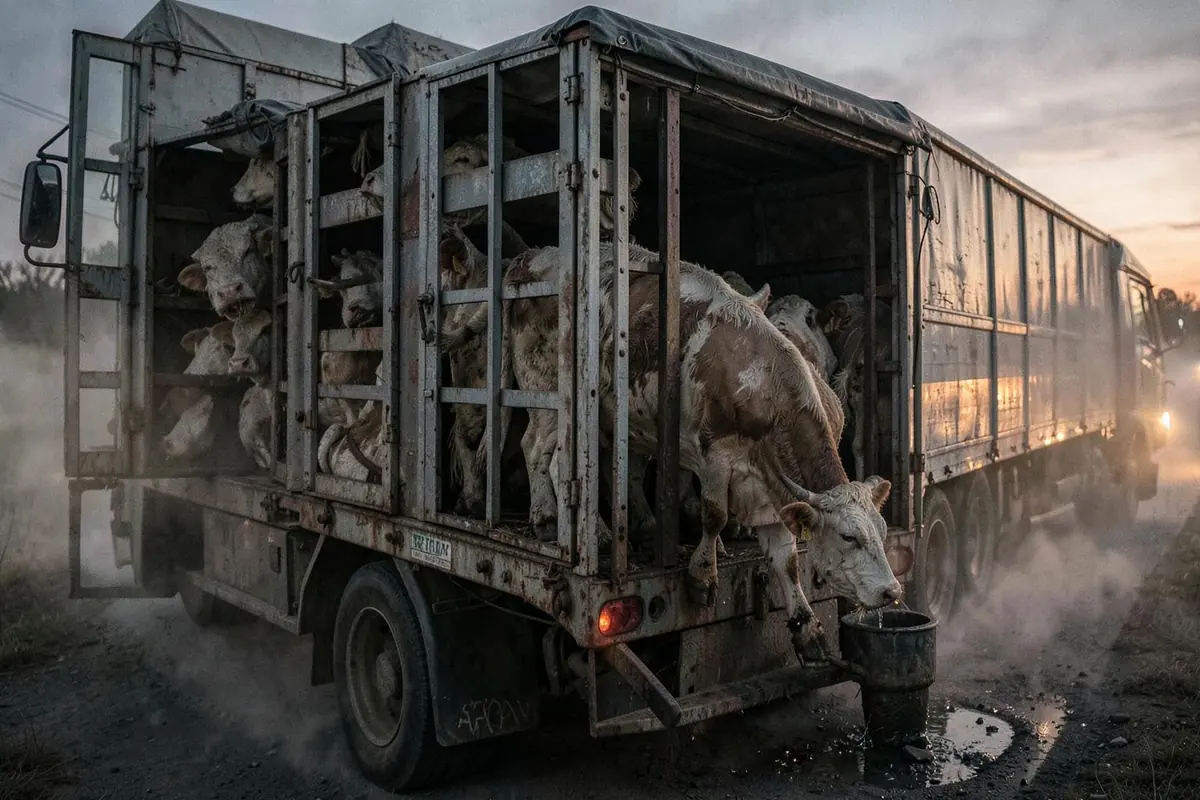
Both sites give live transport its own treatment, and this is the part of the industry that Muslim readers most often have not considered. cruelty.farm's transport articles describe journeys of hundreds of miles or several days, in overcrowded trucks or ships, in extreme heat or cold, without adequate food, water or rest; deaths in transit from exhaustion, dehydration and injury; and rough handling at loading, with broken wings and legs common in poultry.
Transport matters disproportionately for Islamic ethics because of a structural gap our page on halal certification examines in detail: certification audits the slaughter, and sometimes the plant, but very rarely the farm and almost never the journey. An animal can be reared in a crate, transported for two days without water, and then slaughtered in a manner that satisfies every condition of dhabiha, and the resulting meat will be certified without qualification. The certificate is not lying — it certifies what it says it certifies. But a Muslim who assumes the label speaks to the animal's life has misread it.
The Prophetic material on this point is among the best attested in the whole subject: the prohibition of overloading animals, the instruction to dismount and not make backs into pulpits, and above all the repeated reports of reward for giving water to a thirsty animal and sin for withholding it. A transport regime in which deprivation of water is a normal operating condition, permitted by regulation, is not a marginal case for that material.
Slaughter at industrial speed
Graphic content — hidden by defaultThe killing lineShow image
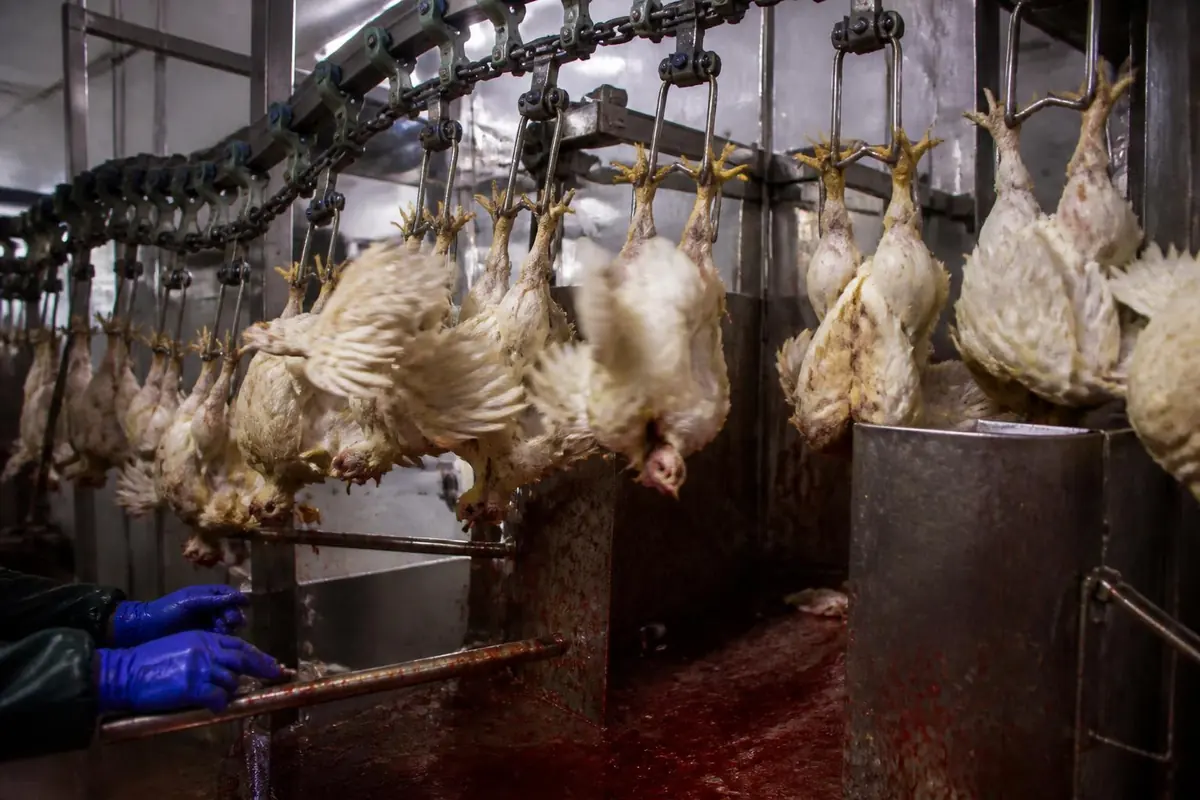
cruelty.farm's fourth stage is slaughter, "processed at industrial speed", and its articles on cows, pigs and chickens make the same specific allegation: that on high-throughput lines a proportion of animals remain conscious through procedures intended to be carried out on insensible animals, because stunning fails or is imperfectly applied and the line does not stop.
This is the point at which the evidence needs handling with the most care, and where the difference between advocacy and adjudication is sharpest. Mis-stun and failure rates are genuinely documented in the technical literature, including in the animal-welfare science our slaughter and stunning page draws on; they are also disputed in magnitude, vary widely between plants and methods, and are the subject of active regulatory attention. What is not in dispute is the structural point: line speed is set by throughput economics, and every requirement that depends on the attentiveness of an individual slaughterer — the sharpness of the blade, the accuracy and continuity of the cut, the pronouncement over each animal, the avoidance of distress in the animals waiting — is under pressure from that speed.
God has prescribed excellence (ihsan) in all things. So if you kill, kill well; and if you slaughter, slaughter well. Let each of you sharpen his blade and spare suffering to the animal he slaughters.
The anonymous Persian letter builds much of its case on this hadith, arguing that ihsan is not a formality attached to the cut but a standard governing the whole act, and that a process designed around throughput cannot satisfy a standard designed around attention. That is the letter's reasoning, and it is contested: many jurists and certifiers hold that a properly executed cut satisfies the legal requirement regardless of the speed of the line, and that ihsan here is a command about the manner of killing rather than a condition of validity. Both readings are available in the sources.
The animals nobody counts
Graphic content — hidden by defaultCrowding below the waterlineShow image
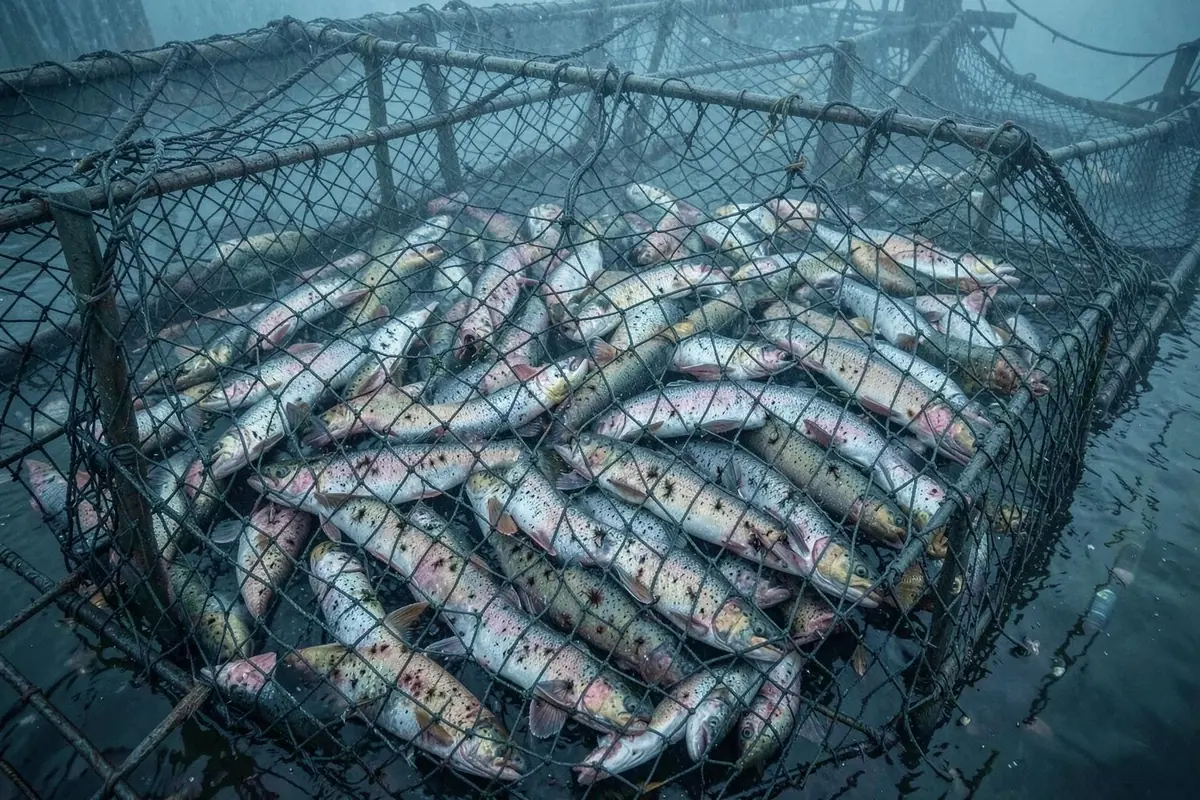
Both sites press a point that even committed Muslim animal-welfare writers tend to skip. cruelty.farm records that between one and 2.8 trillion sea animals are killed each year by fishing and aquaculture, and observes that most are not counted in animal-agriculture statistics at all. onefork.org runs a live counter distinguishing land animals from fish and marine animals, attributing the latter to fishcount.org.uk, and gives aquaculture its own photograph — open-net salmon pens — in its documentation section.
In fiqh terms, fish sit in a different place from land animals: the majority Sunni position does not require dhabiha for them, and Shi'i law has its own criteria (scales, and the requirement that the fish be taken alive from the water). But the welfare literature the sites point to — crowding, disease and sea-lice loads, and deaths by asphyxiation or crushing in nets — engages the general prohibitions on causing avoidable suffering, which are not restricted by category of animal. The honest position is that this is the least worked-out area of the whole discussion, in both the classical literature and the contemporary Muslim conversation.
Land, water, climate and hunger
On environmental impact, onefork.org is the more disciplined of the two. It rests on Poore and Nemecek's 2018 analysis in Science, which assembled data from roughly 38,700 farms in 119 countries and concluded that a shift to plant-based eating would cut food-related land use by around three-quarters and food-related emissions by roughly half — with the widely quoted corollary that even the lowest-impact meat carries a greater environmental burden than the highest-impact plant alternative. Its comparative table gives the underlying contrast per 100g of protein: single-digit kilograms of CO₂-equivalent and a few square metres of land for pulses and tofu, against tens of kilograms and hundreds of square metres for beef, lamb and cheese. cruelty.farm reaches for the same terrain with blunter figures: 80% of agricultural land used for livestock and feed returning 18% of calories, some 80% of Amazon deforestation linked to cattle ranching, and around a thousand million tonnes of grain fed annually to livestock.
For Islamic ethics the relevant categories are already in place, and our pages on khalifa and climate and israf, water and land work through them at length: fasad fil-ard, corruption on the earth; israf, excess; the mizan, the balance set in place in Sura al-Rahman which humans are told not to transgress; and the prohibition on waste in Qur'an 6:141 and 7:31. The grain figure is the one that bears most directly on Islamic social ethics, because it converts an environmental claim into a distributive one: feeding to animals what could feed people is not merely inefficient but, on the reading advanced by several contemporary scholars, a misuse of provision.
Corruption has appeared on land and sea because of what the hands of people have earned, so that He may let them taste part of what they have done, that perhaps they will return.
Health, antibiotics and pandemic risk
Both sites make health arguments, and this is where they are least reliable. cruelty.farm asserts that roughly 80% of antibiotics globally are used in farmed animals, and links the system to antibiotic resistance, chronic disease and pandemic risk. onefork.org marshals the observational cohort literature — Adventist Health Studies, EPIC-Oxford, PREDIMED — alongside The China Study, which is a popular book rather than a cohort and should not be listed with them.
What survives scrutiny is narrower but still substantial. The routine use of antimicrobials in food-animal production, and its contribution to resistance, is a documented concern of the World Health Organization and national regulators. The IARC's 2015 evaluation classified processed meat as carcinogenic to humans and red meat as probably carcinogenic. The zoonotic risk of dense animal populations is a mainstream concern in the public-health literature. Beyond that, claims that a plant-based diet reverses particular diseases, or that animal products are inherently unhealthy, run ahead of the evidence, and our nutrition and health page treats them sceptically. A religious argument that leans on overstated health claims will be discredited by them.
Which figures actually hold
Confinement and routine interventions are built into major intensive systems
Supported by welfare standards, agricultural manuals and the documented design of cages, crates and high-density housing.
Animal agriculture is a major user of land and a significant emissions source
Supported by peer-reviewed global food-system research, though exact shares change with boundaries and methodology.
Every certified facility produces identical welfare outcomes
Standards and enforcement vary; a system-level pattern does not erase differences between farms or jurisdictions.
The evidence by itself proves a universal haram ruling
Facts inform legal reasoning, but the legal conclusion depends on disputed questions of causation, scope and how ethical duties affect product status.
Readers who intend to use this material in a mosque study circle or a family conversation should know which numbers will survive a challenge and which will not.
Well supported
Use freely, with the source named
Poore and Nemecek's land and emissions comparisons; the food-system share of emissions from Crippa et al.; the very large scale of land use for livestock and feed relative to calories returned; IARC's processed and red meat classifications; antimicrobial use in food animals as a resistance driver; and the descriptive account of confinement, mutilation and transport as standard legal practice.
Roughly right, stated too confidently
Cite qualitatively, not to the decimal
Animal-numbers claims, which rest on FAO reporting of varying quality, and aquatic estimates with ranges spanning more than a factor of two — fishcount.org.uk says so itself. Amazon deforestation attribution figures vary by method and year. Water-footprint figures per kilogram vary enormously by production system and by whether rainfall is counted.
Contested or misleading
Do not lean on these
The claim that livestock emits more than the entire transport sector, which comes from an early FAO comparison later revised and disputed on methodological grounds; blanket statements that plant-based diets prevent chronic disease; and the inclusion of The China Study alongside peer-reviewed cohorts.
Not evidence at all
Rhetoric, and recognisable as such
Framing devices — running counters, impact calculators, appeals to imagine a particular animal. They are legitimate persuasion and they are not data. Quoting a calculator output as a fact in a religious argument invites, and deserves, dismissal.
What this does to the fiqh argument
Now the substantive question. Does this documentation strengthen the case that consuming industrial animal products is unlawful? Honestly assessed, it strengthens it considerably — while leaving it short of the settled ruling some advocates claim.
The argument runs in five steps, and the evidence bears on each differently.
First, the subject matter has changed. The classical permission to eat meat was issued in a world of household and pastoral husbandry, where an animal lived a recognisable version of its own life and was killed by a person who saw it. The anonymous Persian letter's central legal move is to argue that industrial production is not a harsher version of that practice but a different subject matter (mawdu'), so the old ruling does not automatically transfer. This is a recognised style of argument in both Sunni and Shi'i legal reasoning — rulings attach to their subjects, and when the subject genuinely changes, the ruling must be reconsidered rather than assumed. What the two archives supply is the factual predicate: they document, in detail, that the difference is one of kind and not merely of degree. The letter's conclusion remains its own, and it is a minority advocacy position rather than any school's holding.
Second, the harms are designed rather than incidental. If cruelty in industrial farming were the work of rogue operators, the fiqh response would be to punish the operators and eat the meat. The documentation supports the opposite characterisation: that confinement, deprivation of natural behaviour, mutilation and transport stress are specified in the production model. That shifts the analysis from individual sin to the lawfulness of participating in a system.
Third, la darar and the prohibition of idha'. The maxim la darar wa la dirar — no harming and no reciprocating harm — and the explicit prohibitions on causing animals distress are invoked by both the Javadi–Masoudi study and the letter. Javadi and Masoudi use them to establish enforceable welfare duties inside a lawful-use framework. The letter uses them to argue that a system built on continuous harm cannot be lawfully sustained by the consumer's purchase. The second step is the contested one.
Fourth, i'ana 'ala al-ithm — assisting in wrongdoing. Qur'an 5:2 forbids cooperating in sin and transgression. If the harms above are wrongs, the question becomes whether buying the product is assistance in them. Classical jurists distinguished near assistance from remote assistance, and consumers are remote. But scale complicates the classical picture: a system that exists to meet aggregate consumer demand makes each purchase a small, real input rather than a bystander's presence.
Fifth, ihtiyat — precaution. Where a matter is genuinely doubtful and the stakes involve the rights of creatures who cannot speak for themselves, both traditions recognise caution as a virtue and, in some formulations, a duty. This is the step on which even scholars who reject the haram conclusion often concede something: that reduction, sourcing care and restraint are defensible even if prohibition is not established.
The strongest reply to that argument
A page that only made the case would not be worth reading. Here is the reply, put as strongly as we can.
Islamic law distinguishes the lawfulness of a thing from the sinfulness of acts committed in producing it. Meat from a permitted animal, slaughtered with the name of God by a qualified slaughterer, satisfies the legal conditions of dhabiha; sins committed by the farmer, the driver or the plant do not travel into the food. This is not a technicality but a settled principle with wide application — wealth earned unjustly is a sin on the earner without rendering every downstream transaction void. The overwhelming majority of Sunni and Shi'i scholarship continues to hold that animal products are lawful, and no significant Sunni school or Shi'i marja' has ruled otherwise on the basis of industrial conditions.
A second reply concerns the evidence itself. Advocacy archives select. Practice varies by country and by producer; cage bans, crate bans, transport-time limits and welfare certification schemes exist and are tightening in several jurisdictions. A ruling drawn from the worst documented conditions may not describe the food in front of a particular reader.
A third reply is about who decides. Deriving prohibition requires the tools of usul al-fiqh and the standing to apply them. An anonymous letter, two campaign websites and a well-intentioned reader do not constitute that. The proper response to a strong ethical case is to bring it to scholars, not to announce a ruling in their absence — and our Sunni and Shia guide sets out how that conversation differs depending on the tradition you belong to.
Region by region
Both archives draw most heavily on Western Europe, North America and Australia, which is where undercover access and freedom-of-information law make documentation possible. That leaves an obvious gap for Muslim readers, since much of the meat, milk and eggs consumed in Muslim-majority countries is produced or shipped under quite different conditions. We have extended the picture in three regional studies: the Middle East and North Africa, covering live export into Gulf ports, Eid demand surges and desert dairy; South and Southeast Asia, covering the cattle trade, broiler expansion, antimicrobial resistance and aquaculture; and Europe, the Americas and Africa, covering cages, stunning law, CAFOs, Amazon soy and pastoralist herding. Reading them together makes one thing plain: the harms are not a peculiarity of one country's regulation, and pastoral husbandry — still real in parts of the Muslim world — is a genuinely different case from industrial confinement.
Where this leaves a reader
Reading these two archives alongside the Islamic material produces an uncomfortable but clear result. The documented practices of industrial animal agriculture are not peripherally related to Islamic prohibitions; they engage them almost point by point. What classical fiqh says an animal is owed — space, light, natural food, water, rest, the company of its own kind, an unmutilated body, freedom from fear and from overloading, a death carried out with attention — is close to a complete inventory of what the industrial system withholds, by design and by regulation's permission.
That does not make animal products haram, and this site does not say that they are. It does mean that a Muslim who has read this material and continues to buy without thought is no longer in the position of the classical consumer who could reasonably assume the animal had lived an ordinary animal life. Knowledge changes obligation. What follows from it — careful sourcing, substantial reduction, abstention, campaigning for better standards, or putting the question seriously to a scholar who knows your school and your circumstances — is a judgement each reader has to make. Our practical guide and the closing open letter are written for the reader who has decided that something in their eating should change and wants to begin somewhere small.
Research trail
Sources and further reading
- 01cruelty.farm (Humane Foundation), including the sections For Animals, Factory Farming, For the Environment and For Our Health — A campaigning animal-advocacy archive of species-by-species articles on confinement, mutilation, transport and slaughter, together with a summary statistics page. Advocacy material with an explicit vegan conclusion; used here for its descriptive account of standard industry practice, with its numerical claims checked against the underlying literature where possible.
- 02onefork.org (The One Fork), including the home page problem statement, 'Inhumane Treatment, Documented', the Four Pillars and the comparative figures table — A plant-based advocacy site that cites its sources unusually explicitly — FAO slaughter data, fishcount.org.uk, Poore and Nemecek (2018), Crippa et al. (2021), Mekonnen and Hoekstra. Advocacy, not peer review, but its central comparative claims are traceable.
- 03J. Poore and T. Nemecek, 'Reducing food's environmental impacts through producers and consumers', Science 360 (2018), 987–992 — The 38,700-farm, 119-country analysis both sites lean on for land, water and emissions comparisons; the source of the widely quoted 76% land-use and 49% emissions reductions for a plant-based diet.
- 04M. Crippa et al., 'Food systems are responsible for a third of global anthropogenic GHG emissions', Nature Food 2 (2021), 198–209 — The basis for the food-system emissions share cited by onefork.org.
- 05FAO livestock and slaughter statistics; fishcount.org.uk estimates of aquatic animals killed — The sources behind the animal-number claims on both sites. Aquatic figures are estimates with wide ranges, and both sites say so.
- 06World Health Organization and IARC, evaluations of processed and red meat (Monograph 114, 2015) and reports on antimicrobial resistance in food animals — Used here in preference to the sites' broader health claims, which are looser than the underlying evidence.
- 07Qur'an 5:3; 6:38; 6:141; 7:31; 30:41; 55:7–9 — The verses on carrion, animal communities, waste, corruption on the earth and the balance.
- 08Sahih Muslim 1955 — The ihsan hadith: God has prescribed excellence in all things, including slaughter — sharpen the blade and spare the animal distress.
- 09Sahih al-Bukhari 2365 and 3318; Sahih Muslim 2242 — Reports on reward for watering a thirsty animal and punishment for the woman who confined a cat until it died — the classical basis for treating confinement and neglect as sinful, not merely unkind.
- 10Mohsen Javadi and Asghar Masoudi, 'Animal Rights from the Islamic Perspective' (Persian), Pazhuhesh-ha-ye Akhlaqi 4:2 (Winter 1392 SH / 2013), 21–48 — A Qom-milieu academic study, supplied to this site as a PDF, arguing that animals hold protective rights — to space, light, natural food, rest, companionship and care — that they themselves cannot waive. Not a vegetarian argument.
- 11An Open Letter to Shia Muslims on the Livestock Industry, Animal Suffering and Moral and Legal Duty Today (Persian, anonymous; PDF supplied to Merciful Plate; translations ours) — Anonymous advocacy letter, not a fatwa and not the position of any named jurist, marja' or hawza body. Argues that the industrial system is a different subject matter from the husbandry the classical rulings addressed.
References are given so readers can check them in the primary sources. Hadith gradings and scholarly positions are summarised in good faith; where a text is disputed we say so. Verify before you rely on anything here.
Follow the thread
Continue reading
Share this page