Most conversations about Islam and animals default quickly to food. But a great deal of everyday material culture — the leather of a wallet or shoe, the wool of a jumper, the gelatine in a sweet, the musk in a perfume — is animal in origin, and Islamic law has a long, careful, sometimes surprising literature on exactly these objects. What this literature is not always doing, however, is asking the welfare question a contemporary reader might expect. Classical fiqh on materials is overwhelmingly organised around tahara (ritual purity) and halal/haram categorisation, not around the treatment of the animal the material came from. Seeing that gap clearly — rather than assuming purity rulings settle welfare questions, or the reverse — is the point of this page.
In short
- The hadith 'when the hide is tanned, it is purified' (Muslim 366) is the foundation of Islamic law on animal skins, and the madhahib differ on its scope.
- Purity (tahara) rulings on materials are largely independent of how the animal was treated in life or in death — a distinction worth holding onto throughout this page.
- The prohibition of silk for men, while unrelated to animal welfare, shows that Islamic law is willing to restrict a material on ethical/social grounds unconnected to purity.
- Contemporary derivatives — gelatine, rennet, shellac, carmine — raise the separate fiqh concept of istihala (transformation), which can change a substance's ruling even when its origin is impermissible.
- Leather alternatives are not automatically the more ethical choice once their own environmental and labour costs are counted; there is no material choice free of trade-offs.
Tanning and purity
The single most load-bearing text in this entire area is a short hadith recorded in Sahih Muslim: "idha dubigha al-ihab fa-qad tahur" — when the hide is tanned, it is purified. Multiple versions of this narration exist across the Sunni hadith collections, some specifying "any hide" (ayyuma ihab), which became the basis for an expansive reading in which tanning transforms even the skin of an animal that died without Islamic slaughter (mayta) — ordinarily impure — into something ritually pure and usable.
"When the hide is tanned, it is purified."
The logic behind this ruling is itself worth pausing on, because it previews a theme that recurs throughout this page: Islamic purity law frequently treats processing — a physical or chemical transformation of a substance — as capable of changing its legal status, independent of the substance's origin. Tanning removes the proteins and organic residues that make untreated skin a vector for impurity; the process itself, not any act of slaughter, is doing the legal work. This matters because it means the tanning hadith is fundamentally a ruling about purity and usability, not a comment on how the animal died or whether it suffered. A hide from an animal that starved, or was killed inhumanely, or died of disease, becomes ritually pure by the same mechanism as a hide from an animal slaughtered with full ihsan (excellence). Purity and welfare are simply answering different questions.
Skins across the madhahib
The schools diverge on how far the tanning ruling extends, largely because they weigh the different hadith wordings and supporting reports differently.
Hanafi position
Broadly permissive: tanning purifies the hides of almost all animals, including most mayta.
The Hanafi school reads the general wording of the hadith ('any hide') as covering the skins of animals that died without slaughter, animals not normally eaten, and in some formulations even certain carnivorous animals, with the notable exception of pigs. Once tanned, such a hide may be used for non-food purposes (bags, shoes, prayer mats) without further restriction, though some Hanafi jurists retain reservations about hides of swine specifically.
Shafi'i and Hanbali positions
More restrictive: tanning purifies most hides, but not those of dogs and pigs, and some scholars tie purification to the animal being of an edible species.
The Shafi'i school generally holds that tanning purifies the hide of any animal except dogs and pigs, whose impurity is considered too severe (najasa mughallaza) to be removed by processing. Hanbali jurists have historically debated whether the ruling should be limited to animals that are permissible to eat in the first place, which would exclude, for some jurists, the skins of predators regardless of tanning. The Maliki school occupies something of a middle position, generally following the broader reading but with its own internal disagreements recorded by Ibn Rushd.
For a contemporary Muslim buying a leather belt, this technical disagreement rarely surfaces, since almost all commercial leather today comes from cattle and sheep — animals that are unquestionably halal to eat and whose hides raise no dispute regardless of school. The disagreement becomes practically relevant mainly for exotic leathers (snake, alligator, certain fish) and for anyone wanting to use the skin of an animal that died of natural causes rather than slaughter — a genuinely live question, for instance, for smallholders and homesteaders who lose livestock to illness or predation and want to use the hide rather than discard it.
Wool, hair and living animals
Wool, hair, feathers, and fur taken from a living animal occupy a notably different, and simpler, category from skins: since nothing is killed to obtain them, questions of tahara and slaughter do not arise in the same way. Classical fiqh treats sheared wool from a living permissible animal as pure and freely usable, and this is one of the least contested corners of the entire subject. The welfare question that does arise here is not about purity but about treatment during shearing and husbandry — a concern the purity literature simply has no mechanism to register, since it was never designed to. A fleece taken from a sheep sheared roughly, in poor conditions, or in a system involving practices like mulesing (a welfare-contested procedure in some commercial wool industries) is exactly as pure, in the fiqh sense, as wool from a well-tended flock. The fiqh category "pure and permissible" and the ethical category "obtained without unnecessary harm" are simply not tracking the same thing, and conflating them — assuming a permissibility ruling has done the work of a welfare audit — is one of the more common errors in casual reasoning about animal materials.
Silk and what its prohibition shows
Silk is instructive precisely because it has nothing to do with animal welfare and yet shows that Islamic law is entirely willing to regulate a material on ethical or social grounds. Multiple authentic hadiths report the Prophet ﷺ prohibiting silk garments for men while permitting them for women (Bukhari 5828–5832, Muslim 2069), with the reasoning offered by later jurists centring on concerns about luxury, effeminacy in dress norms of the time, and moderation — not on anything to do with the silkworm.
It is worth noting, as an aside frequently raised in contemporary discussions of insect ethics, that conventional silk production kills the silkworm pupae inside the cocoon (usually by boiling or steaming) to harvest an unbroken thread — a practice some modern vegans and a minority of contemporary Muslim ethicists object to on welfare grounds, and which has prompted "peace silk" or "ahimsa silk" alternatives that allow the moth to emerge first. This welfare question is almost entirely absent from the classical fiqh discussion of silk, which was settled on other grounds centuries before insect sentience became a live topic in Islamic ethics. The lesson to draw is not that silk is therefore problematic — the classical prohibition for men stands on its own reasoning, and silk for women was never restricted — but that Islamic law's willingness to regulate a material for ethical reasons (luxury, moderation, social meaning) shows that "it's technically halal" was never meant to end every reasonable question a Muslim might have about a material's production.
Ivory and fur farming
Ivory presents a case where classical texts are largely silent on the specific modern practice — industrial elephant poaching for tusks — because the scale and method simply did not exist in the same form. What classical and modern jurists alike can draw on is the broader Qur'anic and prophetic material on israf (extravagance/waste), the prohibition on killing without legitimate need, and hadiths cautioning against killing animals gratuitously ("whoever kills a sparrow or anything smaller without just cause will be questioned about it by God," Sunan al-Nasa'i 4446, and comparable narrations). Most contemporary Muslim scholars treat modern ivory as either clearly prohibited or at minimum strongly discouraged on these general grounds, reinforced by the fact that ivory harvesting today is inseparable from illegal poaching and endangerment of a species — concerns that map onto Islamic legal principles against corruption and destruction on the earth (fasad fil-ard, Qur'an 30:41) even without a specific hadith naming elephants.
Fur farming raises a related but distinct concern. Where wool involves no killing, fur nearly always does, and modern fur farming — raising animals such as mink or fox in often confined conditions specifically to be killed for pelts — has drawn welfare criticism across secular and religious commentators alike, generally on grounds of confinement and killing method rather than purity. Classical fiqh has relatively little to say specifically about commercial fur farming as a system (as opposed to fur as a material, which is treated similarly to other hides), which means most of the ethical weight in assessing it today has to come from the general welfare principles discussed elsewhere on this site (see Mercy in the Hadith) rather than from a specific ruling on fur itself.
Cochineal, gelatine and rennet
Several common ingredients sit at the intersection of purity law, food law and processing science, and each has generated real disagreement among contemporary scholars.
Cochineal / carmine
Cochineal (and its extract carmine, E120) is a red dye derived from the crushed bodies of the cochineal insect, used widely in food colouring, cosmetics and some medicines. As an insect-derived product, its ruling intersects with the broader and genuinely unsettled fiqh question of whether insects are halal to consume at all — a matter on which the schools already differ before welfare is even considered (Hanafi jurists are generally more restrictive on insects than Maliki jurists, for instance). Halal certification bodies vary in their treatment of carmine: some treat the transformation involved in extraction as sufficient to permit its use in non-food or minor food applications, others avoid certifying products containing it. The welfare dimension — that it requires killing large numbers of insects, tens of thousands to produce a small quantity of dye — receives essentially no attention in the classical or most contemporary fiqh literature, since insect welfare is only beginning to be treated as a serious topic in Islamic ethics.
Gelatine and istihala
Gelatine, typically derived from the collagen in animal bones, skin and connective tissue (commonly pork or bovine), raises one of the more consequential debates in modern fiqh: the doctrine of istihala, the transformation of a substance's chemical identity so thoroughly that its origin no longer determines its ruling. Some contemporary scholars and fiqh councils argue that the industrial hydrolysis of collagen into gelatine changes the substance so completely — different molecular structure, different properties — that even gelatine derived from pork could, in principle, be judged pure and permissible by istihala, on analogy with the classical example of wine turning to vinegar (khall), which is uncontroversially permitted despite wine's prohibition. Other scholars reject this extension, arguing that hydrolysis is a physical and chemical process short of the kind of complete transformation the vinegar analogy requires, and that gelatine from non-halal-slaughtered or porcine sources remains impermissible. This disagreement is precisely why halal certification schemes require gelatine source verification rather than treating the ingredient as settled — a good illustration of a live, technical, ongoing fiqh debate rather than folklore.
Rennet
Rennet, the enzyme traditionally used to curdle milk in cheesemaking, was historically sourced from the stomach lining of calves, raising the same halal-slaughter and istihala questions as gelatine when animal-derived. Most commercial cheese today uses microbial or fermentation-produced rennet specifically to sidestep this issue, which is one case where food technology has made a fiqh dispute largely moot in practice for most consumers, though traditional and artisanal cheeses using animal rennet still raise the original question for those who wish to check.
Shellac and the two musks
Shellac, a resin secreted by the lac insect and used as a glaze on confectionery, pills and furniture, is analogous to cochineal in being insect-derived without requiring the insect's death in every method of harvesting (though large-scale harvesting typically does kill many insects in the process). Its fiqh treatment tends to follow the same insect-permissibility debate as cochineal, generally treated leniently by most contemporary certification bodies given its minimal quantity and non-food primary uses.
Musk (misk) offers one of the more textually well-supported examples of a favourably regarded animal product in the hadith corpus. It is described approvingly in multiple hadiths — as the best of perfumes, used to scent the Ka'ba, and even employed as a metaphor for good company (Bukhari 5534, Muslim 2628) — and its use is uncontroversially permitted. Traditional musk is obtained from a gland of the musk deer, and historically its extraction killed the animal, which sits uneasily alongside the hadith's favourable tone if the method is scrutinised closely; the hadiths praise the scent, not the extraction method, which was presumably not what a seventh-century listener would have visualised. A different, less discussed animal-derived musk-like substance comes from the civet, extracted by scraping secretions from a gland, a process that — in commercial civet farming for the perfume industry — has drawn documented welfare criticism for the confinement and handling involved, though it does not require killing the animal outright. Today the overwhelming majority of "musk" in commercial perfumery, and effectively all of it in mainstream halal-certified products, is synthetic (musk ketone and related aromachemicals), which sidesteps both the deer and the civet question entirely — again, a case where technology has moved faster than most people's awareness of the underlying fiqh question.
Leather alternatives and their own costs
It has become common, particularly among younger and welfare-conscious Muslims, to reach for "vegan leather" as an obviously more ethical choice. This deserves scrutiny rather than automatic endorsement. Most mass-market synthetic leather is polyurethane or PVC — petrochemical plastics whose production involves fossil fuel extraction, energy-intensive manufacturing, and, in the case of PVC, the release of persistent and sometimes toxic by-products; the finished material is also generally non-biodegradable and contributes to microplastic pollution over its lifecycle in a way tanned leather, whatever its other costs, does not. Genuine leather production carries its own well-documented environmental burden — chromium tanning chemicals, water use, and the land and feed footprint of the cattle industry that leather is usually a co-product of — and there are also serious labour and worker-safety concerns in some tanning regions of the world. Newer plant-based leather alternatives (derived from pineapple leaf fibre, cactus, mushroom mycelium, apple pomace) generally have a lower environmental footprint than either conventional plastic-based "vegan leather" or animal leather, but most still require some synthetic backing or coating to achieve durability, and none are yet produced at a scale or price that makes them a realistic default for most consumers.
The honest conclusion is that there is no cost-free material choice available here. Choosing leather implicates the animal agriculture system and its tanning chemistry; choosing conventional synthetic alternatives implicates fossil fuels and plastic pollution; choosing newer bio-based alternatives is currently the least-worst option on several metrics but is neither universally available nor without its own inputs. A Muslim trying to make a considered choice here is weighing genuinely comparable harms against each other, not choosing between a harmful option and a harmless one.
Javadi–Masoudi on shearing, hides, branding and mutilation
Mohsen Javadi and Asghar Masoudi's academic article "Animal Rights from the Islamic Perspective" (Pazhuhesh-ha-ye Akhlaqi 4:2, Winter 1392 SH / 2013) gives this page's material discussion something the purity literature above largely lacks: an explicit concern with how a material is taken from the animal, not only with what the material becomes afterwards. On wool and hair specifically, the article does not discuss commercial shearing directly, but it reports a Prophetic instruction that reasons from exactly the same underlying concern the shearing question raises: do not cut a horse's forelock, for there is good in it; do not cut its mane, for it warms the animal and shades its neck in summer; and do not cut its tail, for it is the animal's fly-whisk (Bihar al-Anwar 64/173, no. 25). The reasoning is functional rather than purity-based — each part of the animal's hair or hide is doing something for the animal's own comfort, and removing it without regard for that function is treated as a harm rather than a neutral act of husbandry. Applied to wool-bearing animals, the same logic would ask a straightforward question this page's earlier section on shearing left open: not whether wool may be taken (classical fiqh is untroubled by that), but whether the taking is done with the animal's own comfort and season in view, or purely for convenience and yield.
On hides, branding and mutilation, the article's material is direct rather than inferential. Al-Tusi's al-Mabsut (1/261) specifies that branding, where practised at all, should be placed on the strongest, toughest part of the animal's body, free of wool or hair, precisely so the animal is not harmed by the mark; Imam al-Sadiq is reported to have permitted marking away from the face and instructed Yunus b. Ya'qub to mark a sheep on the ear rather than anywhere more sensitive (Wasa'il al-Shi'a 11/485, b.11, h.4–5). This sits alongside the Sunni-transmitted report, via Abu Dawud (3/26, no. 2564), of the Prophet cursing whoever brands or strikes an animal on the face, and the report in Kanz al-'Ummal (9/66) cursing whoever mutilates an animal outright — the same mutilation-cursing report discussed earlier on this site in connection with the Qur'anic condemnation of altering God's creation (4:119). None of this material is about tahara or halal/haram categorisation of the finished hide; it is about the act of taking a hide, a brand-mark, or an identifying cut from a living or slaughtered animal, and it sits exactly in the gap this page has already identified between purity law and welfare ethics — a gap the Javadi–Masoudi article, unusually, tries to close with specific, sourced rulings rather than leaving it as a matter of general exhortation.
The open letter's assisting-wrongdoing argument, applied to by-products
A separate Persian-language document this site draws on, an anonymous open letter addressed to Shia Muslims about the livestock industry, argues at length that purchasing meat, dairy and eggs constitutes hurmat al-i'ana 'ala al-zulm — forbidden assistance to wrongdoing — because every purchase finances cages, debeaking, forced separation of mother and young, and the routine killing of male chicks. The letter itself argues this about food products specifically; it does not discuss leather, wool or other animal-derived materials. Extending its argument to by-products is this page's own inference, not the letter's stated conclusion, and it should be read as exactly that.
The extension is nonetheless worth setting out, because it is a natural one. If buying meat is said to finance the conditions that produce it, the same reasoning would apply with equal or greater force to leather and wool from the same industrial supply chains, since hides and fleeces are frequently co-products or by-products of an animal agriculture system the letter's central argument is directed against — a leather jacket sourced from a factory-farmed, industrially slaughtered animal implicates the buyer in the same production chain as a purchase of its meat, on the letter's own logic. This is, however, precisely the kind of argument this page has flagged throughout as an inference rather than a ruling. The letter has no named author, no marja' and no hawza affiliation behind it; its haram conclusion about food is a minority advocacy position that no major Sunni or Shia authority has adopted, and extending that same reasoning to materials carries no more institutional weight than the original argument does. What the extension usefully illustrates, without settling anything, is that purity and permissibility categories (discussed throughout this page) and the fiqh maxim against assisting wrongdoing are simply asking different questions — and a reader who finds the assisting-wrongdoing argument persuasive for food has a coherent, if untested, reason to ask the same question about the wool jumper or leather belt on the shelf next to it. Readers who want the letter's fuller argument, including the fiqh maxims it draws on and the cautions this site attaches to its hadith citations and empirical claims, can read it at the open letter.
When purity law and welfare ethics diverge
The recurring theme across every material discussed on this page is that Islamic purity and permissibility law was built to answer questions about ritual cleanliness, lawful use, and category (what may touch the body, be worn in prayer, be eaten, be sold) — not, primarily, questions about how an animal was treated before the material reached that state. This is not a criticism of the fiqh tradition; it is simply what the tradition was built to do, using the conceptual tools available to jurists working centuries before industrial animal agriculture, synthetic chemistry, or global supply chains existed in anything like their current form.
A working principle, not a ruling
A tanned hide can be ritually pure (tahir) and halal to use while having come from an animal raised or killed in a way that falls well short of the Qur'an's language of mercy (rahma) and the hadiths' insistence on excellence (ihsan) even toward animals being slaughtered. Recognising this gap does not require rejecting the purity ruling — it requires recognising that the purity ruling was never trying to answer the welfare question in the first place, and treating "it's halal" as a complete ethical verdict on a material conflates two different, both legitimate, but distinct Islamic conversations.
A practical way to hold this together, adopted implicitly by many conscientious Muslims already, is to treat halal/haram and tahir/najis categorisation as a floor — the minimum legal condition a material must meet — and to treat tayyib (wholesome, good) and the broader ethic of ihsan as a further, voluntary aspiration that asks harder questions the purity category was never built to answer: how was this animal kept, how did it die, what did producing this material cost the land, the workers, and the species involved. Nothing in Islamic law compels a Muslim to only ever choose the tayyib option over the merely halal one. But nothing prevents it either, and a great deal of the Qur'an's own language about excess, mercy and the earth as a trust (amana) suggests it is at minimum a live and worthy question to keep asking material by material, rather than settling once and assuming the fiqh label has done all the ethical work there is to do.
Origin, use and welfare: separate questions
A shoe or coat's material name cannot answer every question. Leather may require the species, slaughter status and the followed school's position on tanning; animal care and tannery workers remain separate concerns. In Imami jurisprudence tanning is not assumed to purify carrion hide, so slaughter provenance may matter for prayer and imported leather should be assessed under the followed authority's rules. Sunni disagreement should not be reduced to a claim that all cattle leather is usable in every circumstance, regardless of death and intended use.
Separating these questions does not make welfare invariably optional. Duties against torment and neglect remain binding on the actor; the effect on buying a particular material needs a separate analysis. Javadi and Masoudi discuss the animal's uses of hair and tail, branding location and protection from harm. Applying that reasoning to wool shearing is an extension by the reader, not a modern wool-industry audit supplied by the study. Ask whether shearing avoids injury, occurs without exposing the animal to cold, and includes treatment if injury occurs.
Comparing the whole product life, not only the purchase
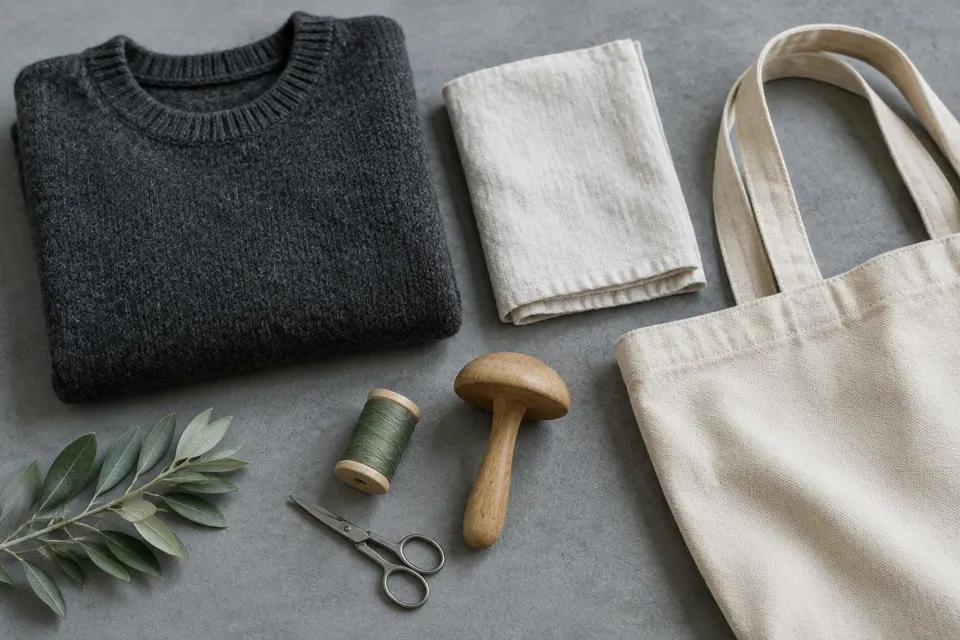
Life-cycle comparisons need a comparable function. A kilogram of leather versus a kilogram of substitute does not necessarily answer the question of a shoe worn for years. Results depend on lifespan, durability, energy, chemicals and allocation of animal-rearing burdens between meat and hide. If a study assigns leather a small share because it is a co-product, that does not make it impact-free or remove its economic contribution to the supply chain.
Likewise, plant-based leather does not necessarily mean biodegradable or plastic-free. Agricultural fibres may be combined with synthetic coatings or backing. Request full composition and durability data, and distinguish an independently reviewed comparison from an unmethoded marketing claim. Keeping and repairing a serviceable item may be preferable to replacing it immediately: a new purchase has inputs even when it aligns with an important value. Buying second-hand does not erase every legal or symbolic question, but it differs from demanding new production.
Ritual purity establishes that an animal was treated well.
An invalid inference: the ruling is not a welfare audit.
Every plant substitute has a lower footprint than every animal leather.
No blanket ranking is justified without composition, lifespan and a defined comparison method.
Processing collagen into gelatine settles istihala for everyone.
Authorities differ on transformation and its legal effect; assess gelatine and rennet separately.
Repair can avoid a new purchase while an item remains serviceable.
A specific practical benefit, not a quantified environmental saving without a study.
A reasoned, proportionate decision
Begin with need: is a new purchase necessary? Then examine origin and intended use, followed by what is known about welfare, durability and labour. An information gap is not a quality certificate; a different consumer choice is not necessarily cruelty. A material can be avoided ethically while acknowledging its separate legal details and the debated responsibility attached to purchasing it.
Comparison foundations: Muslim 366; Ibn Rushd, Bidayat al-Mujtahid, Book of Purification; Javadi and Masoudi, Animal Rights from the Islamic Perspective (2013). The environmental discussion explains how to read comparisons; it is not a numerical material ranking.
Research trail
Sources and further reading
- 01Sahih Muslim 366 — "When the hide is tanned, it is purified" — the foundational hadith on tanning and tahara (ritual purity).
- 02Sunan Abu Dawud 4123–4128 — Further narrations on tanned hides, including debate on hides from animals that died without slaughter (mayta).
- 03Ibn Rushd, Bidayat al-Mujtahid, Kitab al-Tahara — Comparative survey of Maliki, Shafi'i, Hanafi and Hanbali positions on tanning and purification of skins.
- 04al-Kasani, Bada'i' al-Sana'i' (Hanafi) — Hanafi position permitting tanned hides of mayta broadly, including some carnivorous and non-slaughtered animals.
- 05al-Nawawi, al-Majmu' Sharh al-Muhadhdhab (Shafi'i) — Shafi'i position on tanning purifying hides except those of dogs and pigs.
- 06Ibn Qudama, al-Mughni (Hanbali) — Hanbali discussion restricting purification to hides usable after tanning, with debate over edibility of the source animal.
- 07Sahih al-Bukhari 5828–5832; Sahih Muslim 2069 — Hadiths prohibiting silk garments for men while permitting them for women, cited in discussions of Islamic material ethics.
- 08Sunan Abu Dawud 4057; Sunan al-Nasa'i 5310 — Narrations on exceptions to the silk prohibition, e.g. for medical necessity or narrow trim (a'lam).
- 09Sahih Muslim 2252; Sahih al-Bukhari 5928–5930 — Hadiths referencing musk (misk) favourably, including its comparison to good character and its use in perfuming the Ka'ba and the dead.
- 10AAFCO / food science literature on gelatine hydrolysis — Background on istihala (chemical transformation) as applied to collagen-to-gelatine processing, discussed in contemporary fiqh councils' rulings.
- 11European Council for Fatwa and Research, resolutions on gelatine and istihala — Example of a contemporary fiqh body's reasoning on transformed animal derivatives.
- 12Islamic Fiqh Academy (OIC), resolutions on rennet and enzymes in food processing — Contemporary fiqh discussion of animal-derived processing aids and their permissibility.
- 13Ibn 'Abidin, Radd al-Muhtar (Hanafi) — Extended discussion of istihala as a purifying transformation in Hanafi law, applied later by scholars to processed derivatives.
- 14Life-cycle assessment literature on leather, synthetic and plant-based alternatives — Comparative environmental studies (tanning chemicals, land use for cattle vs petrochemical inputs for synthetics).
- 15Mohsen Javadi and Asghar Masoudi, "Animal Rights from the Islamic Perspective" (Persian), Pazhuhesh-ha-ye Akhlaqi 4:2 (Winter 1392 SH / 2013), 21–48 — Academic, Qom-milieu article drawing on Imami and Sunni sources; cited below for its material on branding location, mutilation, and the treatment of hair and hides on a living or working animal.
- 16An Open Letter to Shia Muslims on the Livestock Industry, Animal Suffering and Moral and Legal Duty Today (Persian, anonymous) — An anonymous advocacy letter, not a fatwa; cited below only for its assisting-wrongdoing argument, extended here to by-products as this page's own application, not the letter's stated example.
References are given so readers can check them in the primary sources. Hadith gradings and scholarly positions are summarised in good faith; where a text is disputed we say so. Verify before you rely on anything here.
Follow the thread
Continue reading
Share this page