Systems
Industrial Animal Agriculture
Before asking whether factory-farmed meat is halal or tayyib, it helps to know, in plain terms, how it is actually produced. This page describes the system stage by stage and then reads each stage against Islamic ethical categories.
Most people who eat meat, drink milk or crack an egg have only a hazy picture of how that food arrived on their plate. That is not an accident: modern animal agriculture is a highly specialised industrial process, largely invisible to consumers, spread across breeding companies, contract farms, feed mills, hauliers and processing plants that rarely share a name or a public face. Before any Muslim can weigh the question of whether factory-farmed meat is halal, haram or merely permissible-but-regrettable, it is worth understanding, without exaggeration or euphemism, what the system actually does.
In short
- Broiler chickens are bred to reach slaughter weight in roughly six weeks, a small fraction of their natural lifespan.
- Housing density, litter quality and ammonia levels are the everyday welfare variables in poultry and pig sheds, not just headline cage bans.
- Farrowing crates, tail docking and beak trimming exist to manage problems created by confinement and stress, not as ends in themselves.
- Antimicrobial use at scale raises both an animal welfare question and a public-health question about resistance.
- The sector is dominated by vertical integration: farmers often own the sheds and labour but not the birds, feed or margin.
- There is real diversity — pasture-based, organic and higher-welfare farms exist inside the same national statistics as the most intensive operations.
Why describe before judging
Islamic ethics does not work well from slogans. The Qur'an and hadith set out categories — ihsan (excellence, doing good with care), the prohibition on muthla (mutilation), the duty to feed and water an animal in one's charge, and the broader ideal of tayyib (wholesome, good, pure) — and those categories only become useful once we know what they are being applied to. A description of a caged layer shed or a broiler house is not an argument in itself; it is the raw material an argument needs. This page tries to give that raw material honestly, without either sanitising the industry or painting it as uniformly cruel, because neither picture is accurate and neither helps anyone make a considered judgement.
- 01
Breed
Animals are selected for rapid growth, high yield or reproductive efficiency.
- 02
Confine
Housing, feed and interventions are engineered to control movement, disease and cost.
- 03
Move
Catching and transport transfer animals from farms to markets or processing plants.
- 04
Process
High-throughput slaughter and disassembly turn living animals into standardised products.
Each stage has its own welfare questions. A halal slaughter audit at the final stage does not automatically answer what happened in the first three.
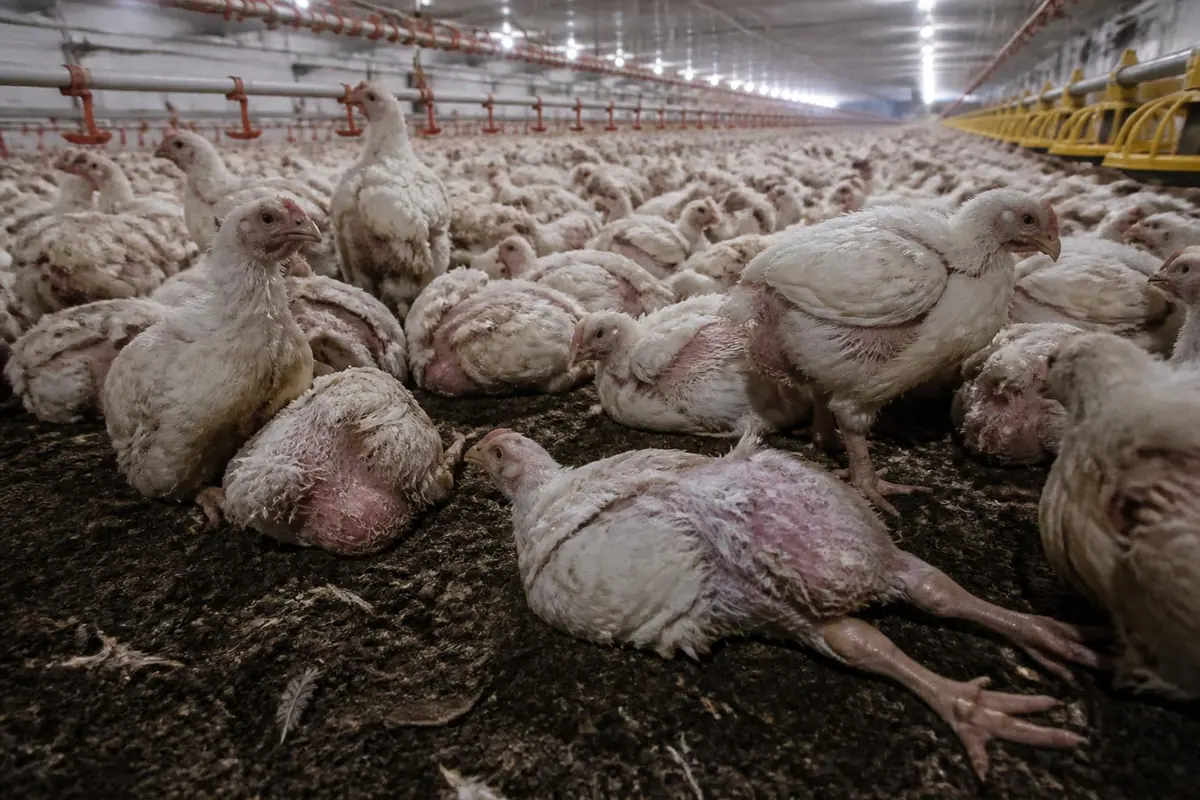
Graphic content — hidden by defaultInside an intensive broiler shedShow image
A letter's seventh-century contrast
An anonymous Persian open letter addressed to Shia Muslims, circulated as advocacy rather than as a fatwa from any named jurist or hawza body, opens its argument with exactly the contrast this page is built around. The letter argues that the fiqh rulings on meat, milk and eggs were formed to address the conditions of the Prophet's own era: animals lived largely freely, calves and lambs were not routinely separated from their mothers within hours of birth, no antibiotics or hormones existed to alter growth or reproduction, a cow calved roughly once a year rather than being pushed through repeated forced cycles, and slaughter was an individual, human-scale act rather than a line killing thousands of birds an hour. On the letter's reading, because the underlying subject matter has changed so completely — from a healthy, free animal slaughtered by hand to a confined, selectively bred animal processed at industrial speed — the classical rulings cannot simply be read across unchanged. This is the letter's own argument, not a settled position of Islamic law; it goes on to draw a conclusion, that meat, dairy and eggs are today haram, that remains a minority advocacy view with no institutional backing from any major Sunni or Shia authority, all of whom continue to treat these foods as permissible. What the letter's historical contrast usefully does, independent of its conclusion, is sharpen exactly the question this page tries to answer descriptively: how far, and in what specific ways, has the underlying practice actually moved from the conditions the classical texts had in view?
Broiler genetics and growth rates
The chicken raised for meat today, commonly called a broiler, is the product of decades of selective breeding by a small number of international breeding companies. The trait most aggressively selected for has been growth rate and feed conversion: how quickly a bird converts feed into muscle, particularly breast muscle. The consequence is a bird that reaches a slaughter weight in a matter of weeks that its ancestors, or a traditional farmyard breed, would take several months to reach. This rapid growth has well-documented side effects on skeletal and cardiovascular development — legs that struggle to bear an adult bird's weight at a juvenile age, and hearts and lungs that in some cases cannot keep pace with muscle growth. Breeding companies and some retailers have begun introducing slower-growing breeds in response to welfare concerns, but the fast-growing broiler remains the overwhelming majority of chicken produced worldwide. Laying hens and dairy cattle have undergone parallel, if less dramatic, selection: hens bred for very high annual egg output, and dairy cows bred and managed for milk yields that would have been considered extraordinary two generations ago.
Stocking density and housing
Most broiler chickens are raised in large, windowless or partially ventilated sheds holding tens of thousands of birds on a single floor of litter, without cages, but at stocking densities that leave each bird with barely more space than a sheet of paper by the time it approaches slaughter weight. This is different from the cage system used for laying hens, where birds may be kept in conventional battery cages (now banned in some jurisdictions, including the EU, but still used elsewhere), "enriched" cages that provide a perch, a nest box and some scratching area, or in barn and free-range systems with more space and outdoor access. Pigs, similarly, are commonly housed in group pens on slatted concrete floors, with sows individually confined during farrowing (see below). Stocking density matters because it interacts with almost every other welfare variable: crowded birds struggle to access feed and water lines evenly, cannot express normal behaviours like dust-bathing or perching, and generate more waste per square metre, which affects air quality.
Ammonia, litter and air quality
Litter — the bedding material, usually wood shavings or straw, spread across the floor of a poultry shed — absorbs droppings for the whole flock's life cycle in many systems, since it is typically only replaced between flocks rather than continuously. As it breaks down, it releases ammonia, a gas that irritates the eyes and respiratory tracts of birds housed close to floor level, and can cause hock burns and footpad lesions where birds sit or stand in damp, ammonia-laden litter for extended periods. Ventilation systems are designed to manage this, and well-run farms monitor ammonia levels closely, but poor litter management combined with high stocking density is one of the more common and least visible welfare problems in the sector — less dramatic than a cage, but affecting a bird every hour of its short life.
Cages, crates and routine mutilations
Graphic content — hidden by defaultA body constrained by the production systemShow image
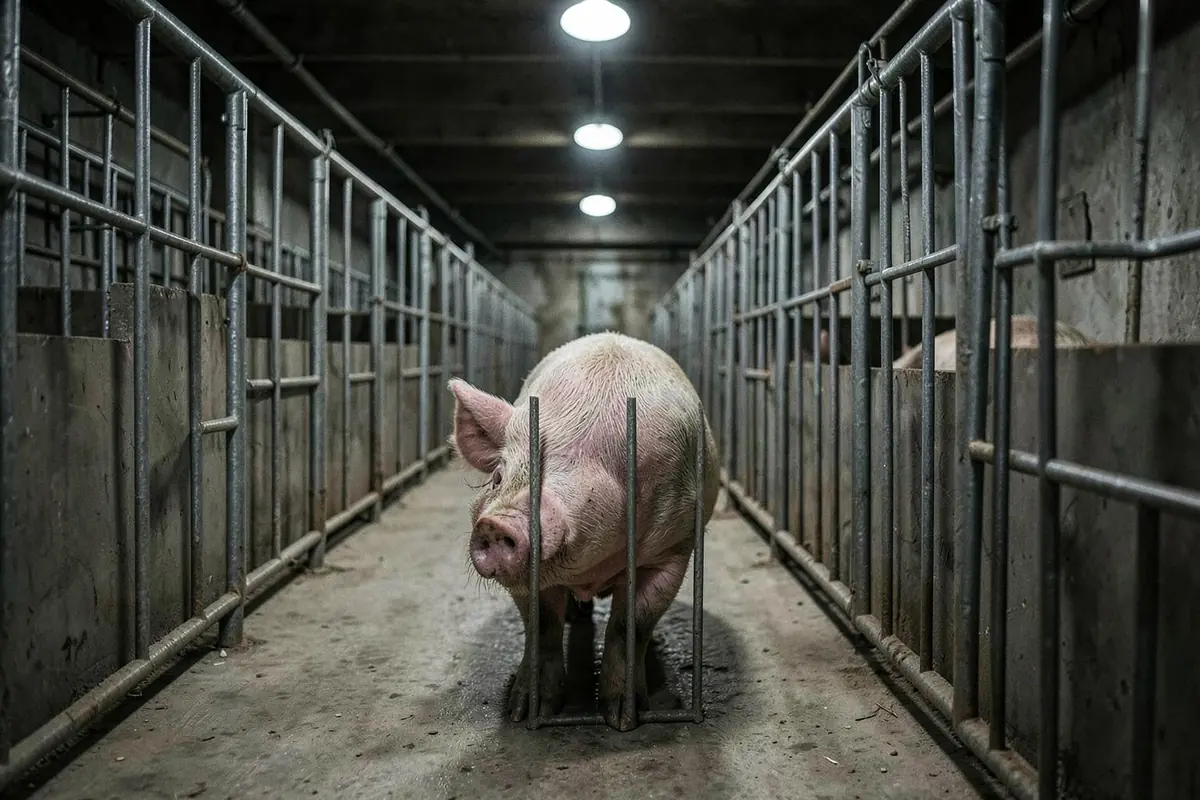
Several specific confinement practices deserve to be named plainly. Battery cages for laying hens restrict a bird so severely that it cannot spread its wings, and were designed primarily to make egg collection and disease control efficient rather than to serve the hen. Enriched cages ease some of these restrictions without eliminating close confinement. Farrowing crates confine a sow for the period around giving birth and suckling, restricting her movement to prevent her from crushing piglets in the tight space allotted to her — a problem created in large part by the same tight space. Tail docking in pigs and beak trimming in poultry are performed, usually without anaesthetic, to prevent injuries caused by tail-biting and feather-pecking, behaviours that themselves tend to emerge from stress, boredom and overcrowding rather than occurring in more naturalistic, lower-density conditions. In each case the practice is best understood not as gratuitous cruelty but as a management response to a welfare problem generated upstream by the system's own design — which does not make the practice comfortable to look at, but does clarify where the underlying decision actually sits.
The open letter discussed above presses this same catalogue harder, arguing by a fortiori reasoning: if a hadith threatens punishment for withholding even a little water from an animal, then long-term caging, debeaking without anaesthetic, forced repeated calving and the routine separation of a calf from its bellowing mother are all the more forbidden. It pairs this argument with a saying it attributes to Ghurar al-Hikam, «لا تکن قاسیاً فإنّ اللحم ینبت اللحم» ("do not be hard-hearted, for flesh grows flesh") — adab material of uncertain grading, and cited here only as the letter's own supporting text, not as an established hadith. The letter also asks whether hormone injection and antibiotic dependence, unknown to seventh-century husbandry, fall under the classical prohibition of idha' (causing an animal avoidable pain); that is a live argument rather than a settled ruling, but it names the same practices — caging, debeaking, forced calving, hormone use — this page has already described in technical terms.
Feedlots and the dairy line
Beef cattle in many parts of the world spend the earlier part of their lives on pasture and the final months in a feedlot, a densely stocked outdoor pen where they are fed a grain-heavy diet to add weight quickly before slaughter. Feedlots trade the welfare advantages of pasture (space, foraging, varied terrain) for speed and consistency of finishing. Dairy production runs on a different but related logic: a cow must calve to produce milk, calves are typically separated from their mothers within a day or two of birth so that the milk can be collected for sale, male dairy calves have historically had limited economic value and were often slaughtered young or reared for veal, and cows are bred and fed for yields that place sustained physiological demand on their bodies, shortening their productive lifespan compared with lower-intensity systems. None of this is usually visible on a milk carton.
Catching, transport and depopulation
Graphic content — hidden by defaultLive transport between farm and slaughterShow image
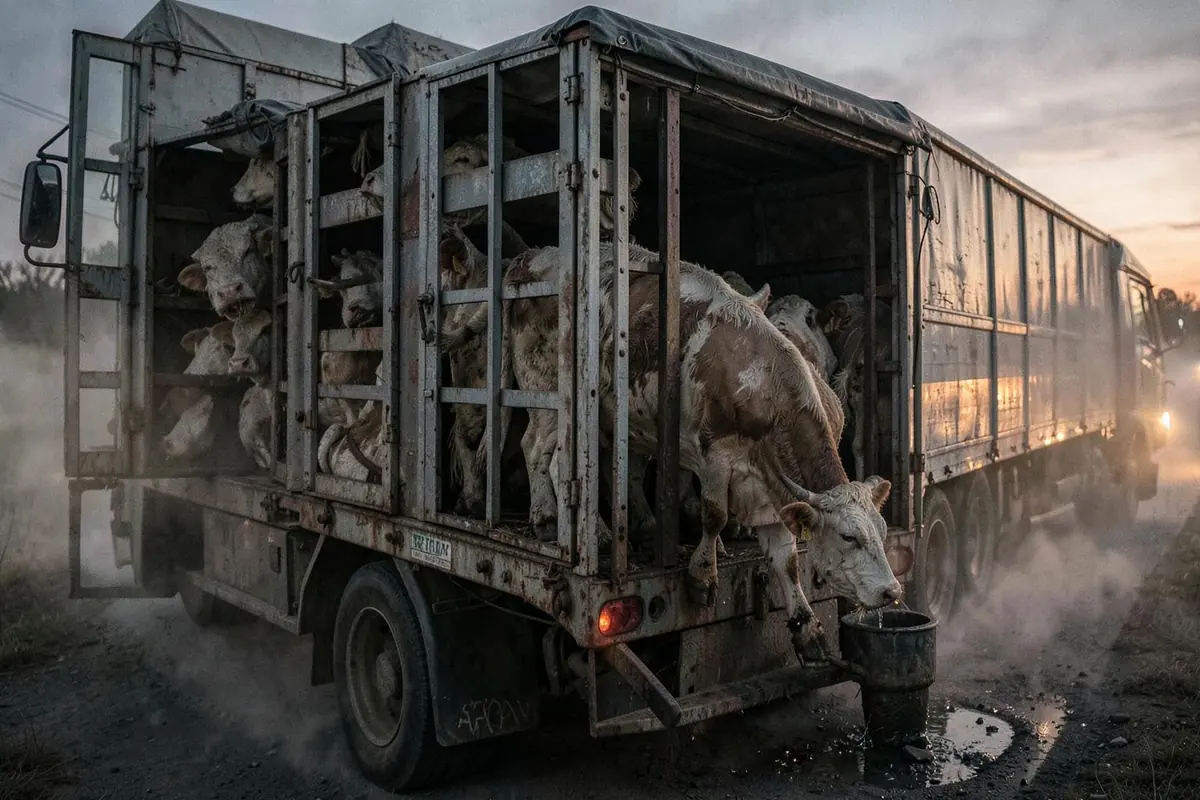
Getting birds and animals from farm to slaughter is itself a distinct stage with its own welfare issues. Broiler chickens are typically caught by hand in the dark (to keep them calmer) by catching teams working quickly against a piece-rate incentive, often grabbed by the legs and carried upside down in bunches before being placed into transport crates. Bruising, dislocated joints and broken bones occur at measurable, if variable, rates during catching and crating. Transport itself can involve long journeys in conditions of temperature stress, especially for animals moved across borders for slaughter in another country. "Depopulation" is the industry term for the mass killing of a flock or herd on-farm, most commonly used during disease outbreaks such as avian influenza, using methods that animal welfare scientists continue to debate for their speed and reliability at scale.
Antimicrobial use and zoonotic risk
Housing large numbers of genetically similar animals at high density creates ideal conditions for disease to spread, and historically the sector has responded partly with antimicrobial drugs, used both to treat illness and, in some countries, to promote growth or offset the pressures of crowded housing. Many jurisdictions have restricted or banned routine non-therapeutic use, and awareness of antimicrobial resistance — the process by which bacteria evolve to survive the drugs designed to kill them — has pushed the industry and regulators toward tighter controls, but usage still varies enormously between countries and companies. The same crowding that drives antimicrobial use also creates the conditions in which zoonotic diseases (illnesses that can pass from animals to humans, of which avian influenza is the most familiar recent example) can emerge and spread, which is one reason public health bodies pay close attention to livestock housing standards quite apart from any animal welfare concern.
Vertical integration and contract farming
A detail easily missed in ethical discussions is who actually controls the decisions described above. In much of the poultry sector, and increasingly in pigs, production is vertically integrated: a small number of large companies own the breeding stock, the feed mills, the hatcheries and the processing plants, while the physical farm and its labour are often supplied by an independent contract grower who owns or leases the shed, takes out substantial debt to build it to the integrator's specification, and is paid according to a formula that rewards efficient feed conversion relative to other growers in the same batch. This arrangement concentrates commercial power and technical decision-making — stocking density, genetics, feed formulation, veterinary protocols — well above the level of the individual farmer, who may have limited ability to change conditions even where they would wish to. Any account of responsibility for welfare outcomes in the sector has to reckon with this structure rather than assuming the farmer alone sets the terms.
What animals are owed, on one academic reading
A separate and more cautious academic source, Mohsen Javadi and Asghar Masoudi's Persian study "Animal Rights from the Islamic Perspective" (Pazhuhesh-ha-ye Akhlaqi, 2013), is worth bringing in here precisely because it is not a plant-based argument at all — it assumes lawful ownership, riding, milking and slaughter throughout, and its conclusions are squarely within the Qom scholarly milieu it comes from. What the Javadi–Masoudi study argues is that "animal rights" in an Islamic frame does not mean rights identical to human rights, but does mean something concrete: animals need freedom, adequate light, enough space to express their natural behaviours, natural food, the company of their own kind and rest, and the human obligation is to refrain from trampling those natural entitlements. The authors treat these as claims of God (huquq Allah) rather than as merely the owner's discretion, resting the argument on a structural point worth foregrounding: unlike a human rights-holder, an animal cannot waive its own rights or forgive a wrong done to it, so the only way the obligation is discharged is by actually performing it, not by any act of the animal's own. Read against the confinement systems described above — a caged hen unable to spread her wings, a sow unable to turn in a farrowing crate, a broiler shed lit and stocked for growth rather than for the bird's own behaviour — the Javadi–Masoudi list of entitlements gives a second, independent vocabulary, distinct from the letter's, for asking whether a given system meets even the older jurists' own standard, without needing to reach for the letter's contested haram conclusion at all.
Reading the system through Islamic categories
With that description in place, several Islamic categories become directly applicable rather than abstract.
Ihsan, excellence performed with awareness that God sees it, is the term the Prophet ﷺ used specifically about slaughter and, by extension, has been read by many scholars as a broader disposition toward animals in one's care. A hadith transmitted by Muslim records the Prophet ﷺ saying that God has prescribed ihsan in all things, including the manner of killing, and instructing that the blade be sharpened and the animal spared distress.
Indeed God has prescribed excellence (ihsan) in all things. So when you kill, kill well, and when you slaughter, slaughter well. Let one of you sharpen his blade and spare suffering to the animal he slaughters.
The prohibition on muthla, mutilation, is well attested in hadith literature condemning the practice of maiming animals, including reports about the Prophet ﷺ forbidding the mutilation of animals and the pre-Islamic practice of cutting off a camel's hump or a sheep's tail fat while the animal was still alive for food (a practice explicitly condemned in hadith as equivalent to eating carrion from a living animal). Scholars have applied this principle by analogy to modern practices such as unanaesthetised tail docking and beak trimming, though there is no unanimous fiqh ruling naming these specific procedures, and reasonable scholars differ on how directly the analogy transfers, given that the intent behind trimming is injury prevention rather than mutilation for its own sake.
The duty to feed and water an animal in one's charge, and not to overburden it, is grounded in several hadith, including the well-known report in Sahih Muslim about a woman punished for confining a cat and neither feeding her nor releasing her to forage for herself — a hadith frequently cited in Islamic animal-welfare writing as establishing a general principle that confinement without provision is itself a wrong, independent of any other cruelty. Applied to housing density, ammonia exposure and farrowing crates, this principle raises a live question, even if it does not by itself settle whether any given practice crosses from discomfort into prohibited harm.
Finally, tayyib — wholesomeness, the Qur'anic pairing of halal and tayyib in verses such as 2:168 — is where most contemporary Muslim writers locate the sharpest critique of industrial systems. A food can meet the technical legal conditions of halal (permissible species, proper slaughter, no forbidden additive) while still inviting the question of whether its production was wholesome, good and consistent with the wider Qur'anic vision of stewardship (khalifa) and mercy (rahma). That is a question about ethics and quality of life, not primarily about ritual validity, and it is the question that industrial agriculture, described plainly, puts most pressure on.
The systemic-critique view
Industrial confinement is structurally in tension with ihsan and tayyib.
On this view, the specific practices described above — extreme stocking density, unanaesthetised mutilations, breeding for growth rates the animal's own body cannot support — amount to a pattern of harm that a Muslim should weigh heavily under the tayyib requirement, even where each individual animal is slaughtered according to the technical rules of dhabiha. Proponents argue that the volume and speed of the system make case-by-case ihsan nearly impossible to guarantee, and that a tradition which forbids sharpening a blade in front of an animal awaiting slaughter can hardly be indifferent to a whole life lived in a crowded shed.
The permissibility-with-caution view
The system is imperfect but the underlying meat remains lawful; reform, not abstention, is the answer.
On this view, halal is a defined legal category concerned chiefly with species, slaughter and contamination, and stretching it to include rearing conditions risks collapsing a settled area of fiqh into a much broader and more contestable ethical programme. Proponents of this view typically agree that many industrial practices are regrettable and worth reforming — through better regulation, higher-welfare certification schemes, and consumer pressure — but resist the claim that ordinary factory-farmed meat becomes haram or that abstaining from it is religiously obligatory, while often still encouraging voluntary avoidance as an act of caution or excellence.
Diversity within the sector
It would be inaccurate, and unfair to the farmers involved, to describe the entire sector as a single undifferentiated system. Pasture-based poultry and pig operations, organic certification schemes, slower-growing broiler breeds adopted by some retailers, free-range and barn egg production, and small-scale mixed farms all exist within the same national statistics as the most intensive confinement operations, and they differ substantially on stocking density, mutilation practice, antimicrobial use and the amount of natural behaviour an animal is able to express. Some of these higher-welfare systems carry independent certification (such as organic or RSPCA-assured labelling in the UK, or pasture-raised claims that are independently verified rather than merely marketed); others rely on direct relationships between farmer and customer that make verification easier in practice than any label could achieve. A Muslim consumer weighing the tayyib question is not choosing between "factory farming" and "no meat" as the only two options; the realistic choice set includes a spectrum of systems with genuinely different welfare profiles, at correspondingly different price points, and part of an informed ethical decision is knowing that spectrum exists rather than assuming all meat is produced the same way.
Two campaigning archives, read carefully
Much of the detail on this page can be checked against two publicly accessible advocacy archives that exist to document industrial practice: the Humane Foundation's cruelty.farm, which catalogues confinement, mutilation, transport and slaughter species by species, and onefork.org, which publishes investigation photography from named, legal facilities alongside comparative environmental figures drawn from Poore and Nemecek's 2018 study in Science, Crippa and colleagues in Nature Food, FAO slaughter data and fishcount.org.uk. Both argue for a vegan conclusion, and some of their headline numbers — the transport-sector emissions comparison in particular — are stated more confidently than the literature warrants. Our What the Investigations Show page works through both archives in detail, separates the well-evidenced claims from the weak ones, and asks what the documented reality does to the Islamic legal argument.
A note on scope
This page describes production practices as documented by industry sources, welfare organisations and public agencies; it does not assign a fiqh ruling. See Is Factory-Farmed Meat Haram? for how different scholars and Muslim ethicists weigh this description against the sources of Islamic law.
Research trail
Sources and further reading
- 01Compassion in World Farming, industry briefings on broiler and layer systems — Descriptive material on stocking density, cage systems and catching practice, used cautiously and cross-checked
- 02FAO, Livestock's reports on production systems — Background on global structure of poultry, pig and dairy production
- 03Ibn Qudama, al-Mughni — Classical Hanbali fiqh discussion of animal welfare duties incumbent on an owner
- 04Sahih Muslim 2242 — Hadith on the woman punished for confining a cat without feeding it or releasing it to forage
- 05Sunan Abi Dawud 2549 — Hadith commanding kind treatment of riding and beast-of-burden animals
- 06Qur'an 6:38 — Animals and birds described as communities like human communities
- 07al-Nawawi, commentary on Sahih Muslim, hadith on muthla — Classical discussion of the prohibition on mutilating animals
- 08World Health Organization, background on antimicrobial resistance in food animals — General context for antibiotic use in intensive systems
- 09USDA and Defra statistics on broiler growth rates over time — Documented trend of selective breeding for faster growth, treated qualitatively here
- 10RSPCA Assured and similar welfare-labelling schemes — Examples of higher-welfare alternatives that exist within the same sector
- 11Peter Singer and Jim Mason, The Ethics of What We Eat — A widely read secular account of industrial systems, used for descriptive detail only
- 12Ibn Taymiyyah, Majmu al-Fatawa, on the rights of animals — Discussion of the duty not to overburden or starve animals in one's care
- 13An Open Letter to Shia Muslims on the Livestock Industry, Animal Suffering and Moral and Legal Duty Today (Persian, anonymous) — Anonymous advocacy letter, not a fatwa or the work of any named jurist; used here for its descriptive contrast between seventh-century husbandry and industrial practice
- 14Mohsen Javadi and Asghar Masoudi, "Animal Rights from the Islamic Perspective", Pazhuhesh-ha-ye Akhlaqi 4:2 (Winter 1392 SH/2013), 21-48 — Academic study in a Qom scholarly milieu; assumes lawful use and slaughter and argues for what animals are owed as a matter of right
References are given so readers can check them in the primary sources. Hadith gradings and scholarly positions are summarised in good faith; where a text is disputed we say so. Verify before you rely on anything here.
Follow the thread
Continue reading
Share this page