Halal & food questions
Is fish halal? Schools, scales, slaughter and farmed fish
Fish is halal for all Muslims, but the schools differ on which sea creatures count and how fish must die. A school-by-school guide to catfish, shark, tuna, sushi, fish sauce and the ethical questions about fishing and fish farming.
The short answer
Bottom line
Yes. Fish is halal in every Sunni and Shia school, and it does not need the ritual slaughter (dhabihah) required for land animals. The schools differ on the details. Shafi’i, Maliki and Hanbali scholars permit almost all sea creatures. The Hanafi school permits fish but not other sea animals, and it disapproves of fish that die and float up without a cause. Imami (Shia) law permits only fish with scales, plus shrimp, and requires the fish to die out of the water after being caught alive. Sauces, batter and shared fryers often matter more than the species. And the Qur’anic pairing of halal with tayyib invites questions about how the fish was caught or farmed.
The Qur’anic permission and the “dead of the sea”
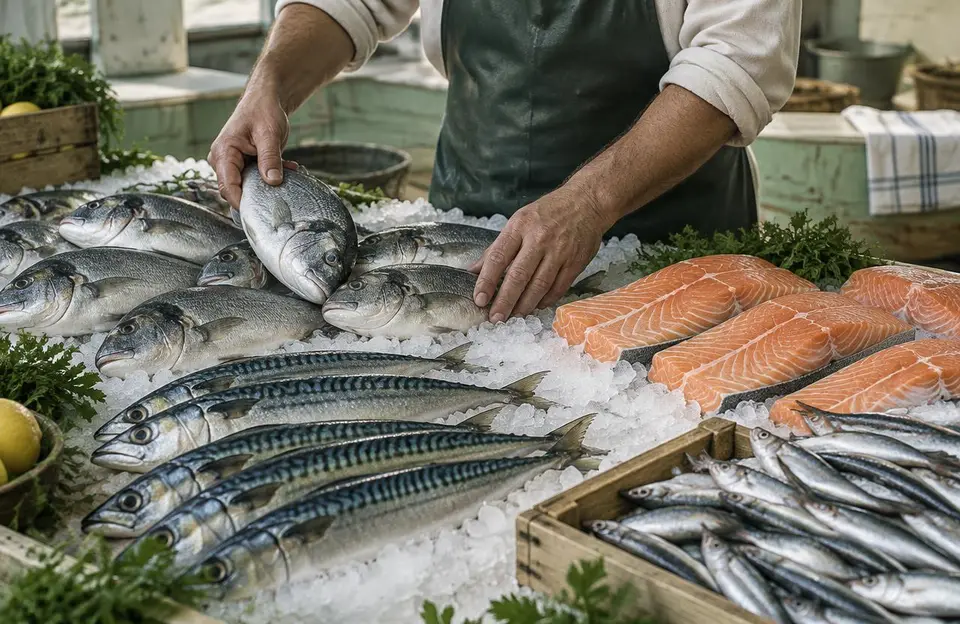
Qur’an 5:96 reads: “Lawful to you is the game of the sea and its food, as provision for you and for travellers.” Qur’an 16:14 and 35:12 praise the sea as a source of “fresh meat”. These verses are the starting point for every school.
When asked about using seawater for ablution, the Prophet ﷺ said: “Its water is pure and its dead are lawful” (Sunan Abi Dawud 83; Sunan al-Tirmidhi 69). On the basis of this hadith most jurists hold that fish does not need slaughter. A report in Ibn Majah lists fish and locusts as the two kinds of “dead” meat that are permitted. None of this removes all rules. It moves the questions from how the throat is cut to which species, how the fish died, and what it is cooked with.
The four Sunni schools
The Maliki school is the broadest. It permits essentially everything that lives only in the sea, including fish found dead in the water. Shafi’i and Hanbali scholars are close to this, with limited exceptions for creatures that are poisonous or harmful, and for some that live both on land and in water, such as frogs and crocodiles.
The Hanafi school limits lawful sea animals to samak, fish. On this view crab, lobster, mussels and squid are not permitted, and shrimp is debated within the school. Hanafis also disapprove of al-samak al-tafi, a fish that dies of natural causes in the water and floats to the surface, as opposed to a fish that dies because it was caught or left on dry land. In practice almost every fish sold for food is acceptable to Hanafis, including tuna, salmon, cod, sardines, catfish and shark, because all of them count as fish.
The Imami (Shia) rule: scales and capture
Imami law is the most specific. A fish is lawful only if it has scales, so species such as catfish, eel and most sharks (whose skin is not covered in true scales in the jurists’ sense) are excluded. Shrimp is the named exception. Other shellfish, such as crab, lobster, mussels and oysters, are not permitted.
Capture is also a condition. In Ayatollah Sistani’s published rulings, a scaled fish becomes lawful when it is taken alive from the water, or dies in a net or trap, and then dies out of the water. A fish that dies in the water by itself is not lawful. The person catching the fish does not have to be Muslim, but the fish must be known to have died out of the water. Commercial fishing usually meets this condition. Shia readers buying species they do not know should check a list of scaled species from their marja’s office.
- Lawful for nearly all Imami authorities: salmon, trout, tuna, cod, haddock, sea bass, sea bream, carp, sardine, anchovy, herring, mackerel.
- Not lawful under the scales rule: catfish, eel, most sharks, rays, monkfish, and shellfish other than shrimp.
- Check with your marja’ for borderline species such as swordfish, sturgeon, turbot and some flatfish.
Sushi, fish sauce, batter and shared fryers
Once the species is settled, the rest of the dish is the more common problem. Sushi rice is often seasoned with mirin or sake, and some sushi is brushed with sauces containing them. Beer batter in fish and chips contains alcohol. A shared fryer can carry traces of pork products or of shellfish from other dishes. Ask in a concrete way: what is in the batter and the sauce, and what else is fried in the same oil?
Fermented fish sauce, made from anchovies and salt, is generally considered permissible, because the fish is lawful and fermentation is in salt, not alcohol. Imami readers may still want to know which species it contains. Fish gelatine is a widely accepted alternative to pork gelatine, and it is accepted by Imami authorities when it comes from scaled fish. Omega-3 capsules can contain fish oil or algae oil, but the capsule shell is often bovine or porcine gelatine, so read the shell ingredients as well.
Farmed fish and fishing: the tayyib questions
According to the FAO’s State of World Fisheries and Aquaculture, farming has overtaken wild capture as a source of aquatic animals, and a large share of assessed wild stocks are fished beyond sustainable levels. Farmed salmon, carp, tilapia and pangasius often spend their lives in dense pens or ponds where disease, parasites and water quality can be serious problems. A halal label does not address any of this, because no halal standard assesses stocking density or how fish are killed.
Fish welfare used to be dismissed, but the evidence has changed. Peer-reviewed research since the early 2000s, including work by Lynne Sneddon on trout, has documented nociceptors and pain-related behaviour in fish. Many farmed and wild fish die slowly by suffocation in air or on ice, and the methods differ greatly between producers. For a Muslim reader, the hadith that God has prescribed excellence (ihsan) in all things (Sahih Muslim 1955) and Qur’an 6:38, which calls animals “communities like you”, are reasons to ask how a fish lived and died, even when no throat-cutting is required.
- Ask whether farmed fish were stunned before killing; some producers use electrical or percussive stunning.
- Bycatch and habitat damage differ greatly by gear. Pole-and-line and some trap fisheries are lower-impact than bottom trawling.
- An eco-label assesses stock sustainability, not halal status or individual welfare. Read what each label actually covers.
Mercury, pregnancy and plant omega-3
Fish provides protein, iodine and long-chain omega-3 fats, and public health agencies generally recommend it as part of a varied diet. Large predatory fish such as shark, swordfish, king mackerel and some tuna can contain more mercury, so pregnant women and young children are usually advised to limit them. These are health questions, separate from the halal ruling.
If you are reducing animal foods for ethical reasons, algae-based omega-3 supplements provide the same long-chain fats (EPA and DHA) that fish get from algae. Walnuts, flax and chia supply the plant omega-3 ALA, although the body converts only part of it. A dietitian can help you plan this, especially during pregnancy.
A practical way to decide
First, find out your school’s rule on species: almost all sea creatures (Maliki, Shafi’i, Hanbali), fish only (Hanafi), or scaled fish plus shrimp caught and dying out of the water (Imami). Second, check the dish: mirin and sake, beer batter, wine sauces, shared fryers and capsule shells. Third, ask the tayyib question that halal rulings leave open: how was this fish caught or farmed, and would a plant-based dish serve the meal just as well?
- 01
Define the question
Separate lawfulness, nutrition and welfare.
- 02
Know the product
Check ingredients, issuer and standard.
- 03
Read the evidence
Use the source relevant to that question.
- 04
Choose honestly
Do not turn an unknown into a guarantee.
Common questions
Do fish need to be slaughtered to be halal?
No school requires the throat-cutting used for land animals. Imami law does require that a scaled fish dies out of the water after being caught, and the Hanafi school disapproves of fish that die naturally and float.
Is catfish halal?
Yes for Sunni schools, including the Hanafi school, since catfish is a fish. Not for Imami (Shia) authorities, because catfish has no scales.
Is shark halal?
Sunni schools generally permit shark as a fish. Imami authorities generally do not, because shark lacks true scales. Shark is also high in mercury and many species are threatened.
Is sushi halal?
The fish usually is, depending on your school’s species rule, but sushi rice and sauces often contain mirin or sake. Ask for rice seasoned only with rice vinegar, sugar and salt.
Is farmed fish halal?
Yes, the halal ruling does not depend on whether a fish was farmed. How it was farmed is a tayyib and welfare question that halal labels do not assess.
Original references and their boundaries
- Qur’an 5:96 — The permission of the game and food of the sea.
- Sunan Abi Dawud 83 — “Its water is pure and its dead are lawful.”
- Sahih Muslim 1955 — Excellence (ihsan) prescribed in all things, including killing.
- Sistani: rules on food and drink — Imami rules on scaled fish, shrimp and capture.
- FAO: The State of World Fisheries and Aquaculture — Global data on aquaculture growth and the state of fish stocks.
- Sneddon, Braithwaite & Gentle (2003), Proceedings of the Royal Society B — Evidence of nociceptors and pain-related responses in rainbow trout.
For claims and source boundaries, explore the evidence library.
Research trail
Sources and further reading
- 01Qur’an 5:96 — The permission of the game and food of the sea.
- 02Sunan Abi Dawud 83 — “Its water is pure and its dead are lawful.”
- 03Sahih Muslim 1955 — Excellence (ihsan) prescribed in all things, including killing.
- 04Sistani: rules on food and drink — Imami rules on scaled fish, shrimp and capture.
- 05FAO: The State of World Fisheries and Aquaculture — Global data on aquaculture growth and the state of fish stocks.
- 06Sneddon, Braithwaite & Gentle (2003), Proceedings of the Royal Society B — Evidence of nociceptors and pain-related responses in rainbow trout.
References are given so readers can check them in the primary sources. Hadith gradings and scholarly positions are summarised in good faith; where a text is disputed we say so. Verify before you rely on anything here.
Follow the thread
Continue reading
Share this page