Halal & food questions
Halal meat in non-Muslim countries: the People of the Book, stunning and certification
Can Muslims in Europe, the Americas or East Asia eat supermarket meat? The Qur’anic verse on the food of the People of the Book, the Sunni and Shia positions, stunning laws, certifiers, and the options for Muslims living as minorities.
The short answer
Bottom line
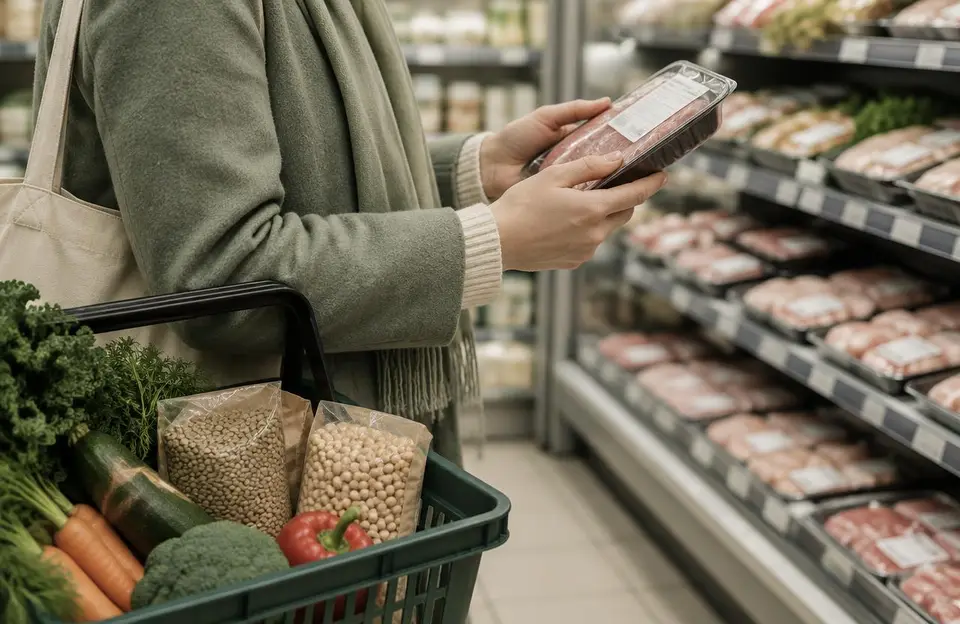
It depends on whose slaughter you accept and what you know about how the animal was killed. Qur’an 5:5 permits “the food of those given the Scripture”, and some Sunni scholars accept meat slaughtered by Christians or Jews in a way that matches Islamic requirements. Many other Sunni scholars and nearly all Imami (Shia) authorities require a Muslim slaughterer, the invocation of God’s name, and an animal that is alive at the cut. In most non-Muslim countries ordinary supermarket meat does not meet the stricter conditions, and the certified halal meat that does is supervised by private bodies whose standards differ, especially on stunning. That is why many Muslims living as minorities choose certified meat, others choose a halal certifier whose standard they have checked, and others eat vegetarian or plant-based food when they cannot verify the meat.
The food of the People of the Book
Qur’an 5:5 states: “The food of those who were given the Scripture is lawful for you, and your food is lawful for them.” Many classical commentators understood “their food” to include their slaughtered animals. Two questions follow from this, and they have always been debated. Who counts as People of the Book today? And does their slaughter have to meet Islamic conditions, such as cutting the throat while the animal is alive and not invoking another name?
Qur’an 6:121 adds: “Do not eat of that over which the name of God has not been mentioned.” Jurists weighed the two verses differently. Some Shafi’i scholars held that the invocation is recommended rather than required. Hanafi, Maliki and Hanbali scholars treat it as required, though they forgive forgetting it. A small number of contemporary scholars have argued that ordinary Western supermarket meat is permissible under 5:5. Most fatwa bodies reply that today’s industrial slaughter is not the religious slaughter of Jews and Christians that the verse describes.
The Imami (Shia) position
Nearly all contemporary Imami maraji’, including Ayatollah Sistani, require that the slaughterer be Muslim, that the animal face the qibla, that God’s name be mentioned and that the four main vessels of the neck be cut. On this view, meat slaughtered by Christians or Jews, including kosher meat, is not halal. Meat from a non-Muslim market is presumed not halal unless there is a reliable indication that a Muslim slaughtered it correctly.
For Shia Muslims in non-Muslim countries this usually means buying from a Muslim butcher they trust, choosing a certifier whose standard matches their marja’s conditions, or not eating meat when this cannot be confirmed. Seafood follows the separate rules of the fish guide.
Stunning laws in Europe and beyond
The EU’s Regulation 1099/2009 requires animals to be stunned before slaughter but allows member states to permit religious slaughter without stunning. Several jurisdictions have used their discretion to require stunning for all slaughter. Denmark ended the exemption in 2014, Flanders and Wallonia in Belgium did so in 2019, and in 2020 the Court of Justice of the EU (case C-336/19) ruled that such bans can be compatible with EU law. Switzerland has prohibited slaughter of mammals without stunning since 1893, although imported meat is allowed.
Muslim scholars are divided on stunning. Many accept reversible stunning, which leaves the animal alive at the moment of the cut, and some certifiers require evidence that a stun would not have killed the animal. Others reject all stunning, mainly because a certain proportion of animals may die from the stun before slaughter. In the United Kingdom, for example, the Halal Food Authority certifies some stunned slaughter, while the Halal Monitoring Committee does not accept stunning. The difference between these standards is real, and the word “halal” on a pack does not tell you which one was applied.
What a halal certificate can and cannot tell you
There is no single worldwide halal authority. In countries with Muslim minorities, certification is done by private organisations, mosque committees and import bodies, each with its own standard. A certificate may cover the slaughterer, the method, stunning, separation from pork, and how meat is tracked from abattoir to shop. Its scope depends entirely on the certifier, so the questions to ask are which body issued it, under which standard, and whether every stage, not only the abattoir, is supervised.
A certificate is not a welfare audit. It does not tell you whether a chicken was raised in a crowded shed, how far a sheep was transported, or how long an animal waited at the abattoir. Most halal meat sold in Europe and North America comes from the same intensive farming systems as other meat. This is the gap this site keeps returning to: a slaughter rule can be satisfied while the Qur’anic standard of tayyib and the Prophetic command of mercy are ignored during the animal’s life.
- Ask: who certifies this shop or brand, and under which published standard?
- Ask: is the meat stunned, and if so, how does the certifier confirm that the animal was alive at the cut?
- Ask: does supervision include cutting, processing and transport, or only the abattoir?
- Ask: what is known about how the animal was raised? A halal certificate will not tell you.
Restaurants, school meals and workplaces
A restaurant’s “halal” sign can mean anything from full certification to “we buy chicken from a halal supplier”. It is fair to ask which supplier and certifier they use and whether every meat item is halal, or only some. In mixed kitchens, also ask about shared grills and fryers.
In schools, hospitals and workplaces, the vegetarian or vegan option is often the most reliable choice when halal meat cannot be checked. Many Muslim students and workers abroad simply default to it, and their schools and employers usually find it easier to provide than separate halal meat. For Muslim families the main thing is to make the request clearly and early, in writing where possible.
When the meat cannot be verified
The hadith “What is lawful is clear and what is unlawful is clear, and between them are doubtful matters… whoever avoids the doubtful matters has protected his religion and his honour” (Sahih al-Bukhari 52) is often quoted on this question. Eating meat is permitted, but it is not an obligation, and no school requires a Muslim to buy meat whose status they cannot confirm. For a Muslim in a non-Muslim country, pulses, grains, vegetables, eggs and dairy, or a fully plant-based diet, avoid the doubt completely.
Many readers also arrive at this choice from the ethical side: if the certified meat available comes from intensive farms, avoiding it addresses the tayyib question as well as the legal one. This site argues that case in detail elsewhere. On this page the conclusion is narrower: choosing not to eat unverifiable meat is a well-grounded Islamic response, not a strange one.
A practical way to decide
First, know your school’s position on the slaughter of the People of the Book and on stunning, or ask your scholar or marja’. Second, if you buy halal meat, learn which certifier your butcher or brand uses and what its standard covers. Third, when you are travelling, eating out or at an institution and cannot check, a vegetarian or plant-based meal is always an option.
- 01
Define the question
Separate lawfulness, nutrition and welfare.
- 02
Know the product
Check ingredients, issuer and standard.
- 03
Read the evidence
Use the source relevant to that question.
- 04
Choose honestly
Do not turn an unknown into a guarantee.
Common questions
Can Muslims eat meat slaughtered by Christians?
Some Sunni scholars permit it under Qur’an 5:5 if the animal was slaughtered by cutting the throat and not dedicated to another name. Most fatwa bodies hold that industrial supermarket meat does not meet this, and Imami authorities require a Muslim slaughterer.
Is kosher meat halal?
Some Sunni scholars accept it as the food of the People of the Book. Others do not, because the invocation of God’s name is not made on each animal. Imami authorities do not accept it. See our halal vs kosher guide.
Is stunned meat halal?
Many scholars and certifiers accept reversible stunning when the animal is alive at the cut; others reject all stunning. Check the certifier’s published standard.
What should I eat if I cannot find halal meat?
Vegetarian or plant-based meals are permitted in every school and avoid the doubt. Eating meat is permitted, not obligatory.
Original references and their boundaries
- Qur’an 5:5 and 6:121 — The food of the People of the Book, and the invocation of God’s name.
- Sahih al-Bukhari 52 — Lawful and unlawful are clear; avoid doubtful matters.
- Sistani: rules on slaughter and food — Imami conditions for slaughter, including a Muslim slaughterer.
- EU Regulation 1099/2009 on the protection of animals at the time of killing — Stunning requirement and the religious-slaughter derogation in Article 4(4).
- Court of Justice of the EU, case C-336/19 (2020) — Ruling that a member-state requirement to stun can be compatible with EU law.
- Halal Monitoring Committee (UK) — A certifier that does not accept stunning.
- Halal Food Authority (UK) — A certifier that accepts some forms of stunning.
For claims and source boundaries, explore the evidence library.
Research trail
Sources and further reading
- 01Qur’an 5:5 and 6:121 — The food of the People of the Book, and the invocation of God’s name.
- 02Sahih al-Bukhari 52 — Lawful and unlawful are clear; avoid doubtful matters.
- 03Sistani: rules on slaughter and food — Imami conditions for slaughter, including a Muslim slaughterer.
- 04EU Regulation 1099/2009 on the protection of animals at the time of killing — Stunning requirement and the religious-slaughter derogation in Article 4(4).
- 05Court of Justice of the EU, case C-336/19 (2020) — Ruling that a member-state requirement to stun can be compatible with EU law.
- 06Halal Monitoring Committee (UK) — A certifier that does not accept stunning.
- 07Halal Food Authority (UK) — A certifier that accepts some forms of stunning.
References are given so readers can check them in the primary sources. Hadith gradings and scholarly positions are summarised in good faith; where a text is disputed we say so. Verify before you rely on anything here.
Follow the thread
Continue reading
Share this page