The short answer
Bottom line
Usually yes. Chocolate made from cocoa mass, cocoa butter, sugar, milk, vanilla and plant lecithin contains nothing that any Sunni or Shia school forbids. Checking matters in four places: liqueur or rum fillings and alcohol-based flavourings; gelatine in mousse, marshmallow or jelly centres; additives that can come from animals, such as E471 and whey made with animal rennet; and insect-derived colours and glazes (E120 carmine, E904 shellac) on decorated sweets, which the schools treat differently. A halal logo answers these ingredient questions for one recipe in one market. It does not answer the separate question this site also asks: was the cocoa grown and harvested justly?
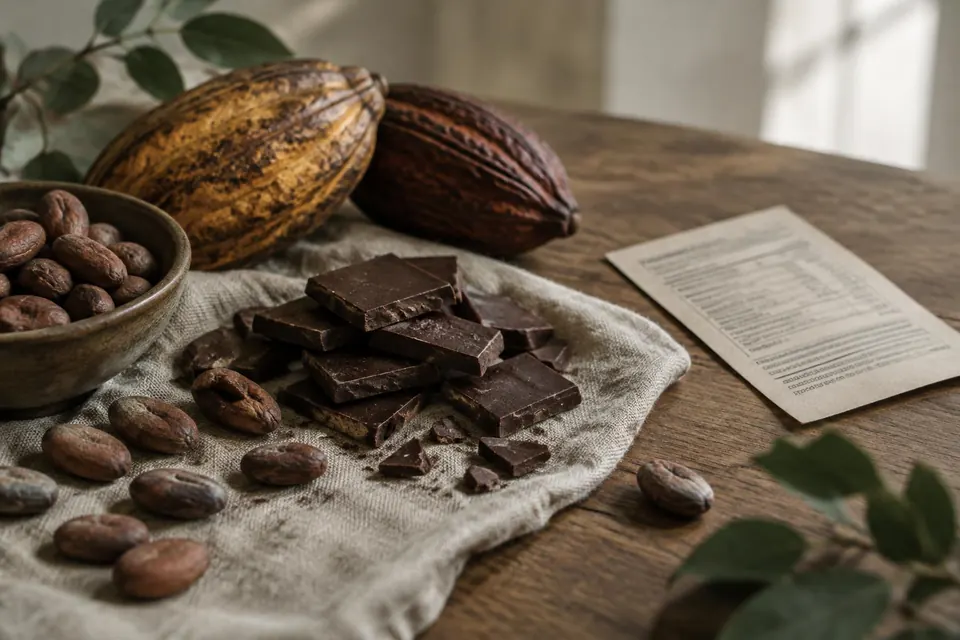
What plain chocolate is made of
A bar of dark chocolate is usually cocoa mass (ground roasted cocoa beans), cocoa butter (the fat pressed from the beans), sugar, an emulsifier and a flavouring such as vanilla. Milk chocolate adds milk powder or milk fat, and white chocolate is cocoa butter, sugar and milk without the cocoa solids. Every one of these is a plant product or cow’s milk, and all schools treat them as lawful.
Cocoa butter is sometimes misread as dairy because of the word “butter”. It is a vegetable fat, and it is also suitable for people avoiding animal products. Many dark chocolates are dairy-free by recipe, but a label stating “may contain milk” is an allergy warning about shared equipment. It is not a religious issue, because milk is halal; it matters only to people avoiding dairy for health or ethical reasons.
- Cocoa mass, cocoa butter, cocoa powder: plant products, lawful.
- Sugar, vanilla pods, vanillin: lawful.
- Milk powder, milk fat, cream: lawful in every school.
- Soy or sunflower lecithin (E322): plant-derived, lawful.
Emulsifiers and E-numbers: which ones to check
Most bars use lecithin (E322) from soy or sunflower. Some cheaper chocolates and coatings also use polyglycerol polyricinoleate (PGPR, E476), which the European Food Safety Authority describes as made from castor oil and glycerol. In practice it is plant-based, although a manufacturer can confirm the source of the glycerol.
The additive to watch is mono- and diglycerides of fatty acids (E471), found in some fillings, spreads and compound coatings rather than in plain bars. E471 can be made from vegetable oils or from animal fat, and the label rarely says which. A halal certificate, a vegan label or a direct answer from the manufacturer settles it. The same applies to glycerol (E422) in some fillings.
- E322 lecithin: plant-derived in chocolate.
- E476 PGPR: castor oil and glycerol; generally plant-based.
- E471 and E422: may be plant or animal; check certification or ask.
Fillings, mousse and marshmallow: where gelatine and alcohol hide
Problems in chocolate products are much more likely in what surrounds the chocolate than in the chocolate itself. Marshmallow, jelly centres, some mousse and cream fillings, and certain mass-market chocolate bars with chewy layers can contain gelatine, usually from pigs or non-zabiha cattle. Most Sunni and Imami scholars treat that gelatine as unlawful. A minority view, discussed in our gelatine guide, holds that full chemical transformation (istihala) changes the ruling; many Muslims do not rely on it.
Liqueur chocolates, rum truffles, brandy-soaked cherries and “Irish cream” pralines contain alcohol added as an ingredient, which almost all scholars reject. Flavourings are harder: some “rum” or “whisky” flavours are made without alcohol, others are extracts in ethanol, and the label may simply say “flavouring”. Our alcohol guide explains why the claim that the alcohol evaporates does not settle the question.
Whey powder, milk fat and the rennet question
Some milk chocolates use whey powder, a by-product of cheese-making. Cheese is made with rennet, which can be microbial, plant-based or taken from the stomachs of calves. Scholars disagree about whey from cheese made with rennet from animals that were not slaughtered according to Islamic law. Many Hanafi scholars and some Imami authorities consider rennet pure regardless of the slaughter; others are stricter. Our cheese guide explains the positions.
For most readers this means: whey in a chocolate bar is not automatically a problem, but it is a reason to look for certification or a manufacturer’s statement if you follow a stricter view. Plain milk powder and milk fat do not raise the rennet question at all.
Colours and shiny glazes: carmine and shellac
Coloured chocolate buttons, coated sweets, decorations and red fillings may use carmine (E120), a red dye made from crushed cochineal insects. The Food Standards Agency lists it among approved additives, but approval for food safety says nothing about religious rules. Shafi’i, Hanbali and Imami scholars generally do not permit eating insects other than locusts, while many Maliki scholars allow them; some contemporary scholars also treat a tiny amount of colour as negligible. Plant colours such as beetroot red, paprika extract or spirulina blue avoid the question.
The shine on some chocolate-coated sweets comes from shellac (E904), a resin secreted by lac insects and sometimes labelled “confectioner’s glaze”. Because it is a secretion rather than the insect itself, many scholars permit it, comparing it to honey; others are cautious. Gum arabic (E414) and carnauba wax (E903) are plant-based glazing agents.
What a halal logo on chocolate does and does not tell you
Large manufacturers often certify chocolate for specific markets. The same brand can have different recipes, factories and certificates in different countries, so a bar bought in Malaysia or the Gulf tells you little about the version sold in Europe. Check the logo on the packet in your hand and the name of the certifying body, not the brand’s reputation.
Certification usually covers ingredients, processing aids, cross-contamination with non-halal materials, and sometimes alcohol limits. It does not normally assess the conditions on the farms where the cocoa was grown. A logo can therefore settle the question “may I eat this?” while leaving open the question “was this produced in a way I can stand behind?”
The tayyib question: child labour and forests in the cocoa trade
Qur’an 2:168 asks believers to eat what is lawful and good (halalan tayyiban). In the case of chocolate, the most serious ethical issue is not an ingredient but the conditions under which cocoa is grown. The United States Department of Labor lists cocoa from Côte d’Ivoire and Ghana, which together grow more than half of the world’s supply, as produced with child labour. Research commissioned by the department and published by NORC at the University of Chicago in 2020 estimated about 1.56 million children working in cocoa production in those two countries, most of them in hazardous work.
Islamic teaching on labour is direct. In Sahih al-Bukhari 2227, God names among those He will oppose on the Day of Resurrection the person who hires a worker, takes full work from him and does not pay his wage. Cocoa growing has also contributed to forest loss in West Africa, which is why the European Union included cocoa in Regulation (EU) 2023/1115 on deforestation-free products. Fairtrade and similar schemes have limits and have been criticised, but they at least publish standards and audit them. A Muslim who looks for traceable or fairly traded cocoa is applying the same concern that leads others to ask about slaughter: lawful food should not depend on harm that could reasonably be avoided.
- Prefer brands that name their cocoa origin and publish how they monitor child labour.
- Treat “sustainably sourced” without detail as a marketing claim, not evidence.
- Buy less, better chocolate rather than more cheap chocolate.
A 30-second check at the shop
Read the ingredients from top to bottom and look for four things: alcohol or spirits (including “liqueur”, “rum” or “flavouring” in a filled product), gelatine, E471/E422 or whey if you follow a stricter view, and E120 or E904 if insect-derived ingredients concern you. If none of these appears and the bar is plain, it is halal for practically every school. If one appears, look for a recognised halal logo or a vegan mark, or choose another bar.
Doubt has a recognised place in Islamic ethics. In Sahih al-Bukhari 52 the Prophet ﷺ describes the person who avoids doubtful matters as protecting his religion and honour. With chocolate, that rarely requires giving anything up: plain dark chocolate and many certified or vegan bars avoid all four questions at once.
- 01
Define the question
Separate lawfulness, nutrition and welfare.
- 02
Know the product
Check ingredients, issuer and standard.
- 03
Read the evidence
Use the source relevant to that question.
- 04
Choose honestly
Do not turn an unknown into a guarantee.
Common questions
Is milk chocolate halal?
Yes, normally. Milk is lawful in every school. Check fillings for gelatine or alcohol, and check whey if you follow a strict view on animal rennet.
Is dark chocolate vegan?
Often, but not always. Many dark bars contain milk fat or whey. Read the ingredients; “may contain milk” is an allergy note about shared equipment.
Is E476 halal?
PGPR (E476) is made from castor oil and glycerol and is generally considered plant-based and halal. If you want certainty about the glycerol, look for certification.
Are chocolates with alcohol halal if the alcohol is only a flavour?
Chocolates with liqueur or spirits as an ingredient are rejected by almost all scholars. “Rum flavour” may or may not contain ethanol, so check certification or ask the maker.
Does a halal logo mean the cocoa was ethically sourced?
No. Halal certification checks ingredients and processing. Labour and forest standards need separate evidence, such as published supply-chain monitoring.
Is chocolate from a non-Muslim country halal?
The country does not decide it. Plain chocolate is halal wherever it is made; filled and decorated products need the same checks everywhere.
Original references and their boundaries
- Qur’an 2:168 — “Eat of what is on earth, lawful and good” — Basis for the halal-and-tayyib distinction used throughout.
- Sahih al-Bukhari 52 — the halal is clear and the haram is clear — On avoiding doubtful matters.
- Sahih al-Bukhari 2227 — the hired worker who is not paid — Hadith qudsi on withholding wages.
- EFSA (2017), Re-evaluation of polyglycerol polyricinoleate (E 476) as a food additive — Describes manufacture from castor oil and glycerol; a safety evaluation, not a religious ruling.
- Food Standards Agency, Approved additives and E numbers — Lists E120, E322, E471, E476, E904 and others as approved; approval concerns safety only.
- US Department of Labor, List of Goods Produced by Child Labor or Forced Labor — Lists cocoa from Côte d’Ivoire and Ghana; the 2020 NORC study of child labour in cocoa was commissioned by the department.
- Regulation (EU) 2023/1115 on deforestation-free products — Includes cocoa and chocolate among regulated commodities.
For claims and source boundaries, explore the evidence library.
Research trail
Sources and further reading
- 01Qur’an 2:168 — “Eat of what is on earth, lawful and good” — Basis for the halal-and-tayyib distinction used throughout.
- 02Sahih al-Bukhari 52 — the halal is clear and the haram is clear — On avoiding doubtful matters.
- 03Sahih al-Bukhari 2227 — the hired worker who is not paid — Hadith qudsi on withholding wages.
- 04EFSA (2017), Re-evaluation of polyglycerol polyricinoleate (E 476) as a food additive — Describes manufacture from castor oil and glycerol; a safety evaluation, not a religious ruling.
- 05Food Standards Agency, Approved additives and E numbers — Lists E120, E322, E471, E476, E904 and others as approved; approval concerns safety only.
- 06US Department of Labor, List of Goods Produced by Child Labor or Forced Labor — Lists cocoa from Côte d’Ivoire and Ghana; the 2020 NORC study of child labour in cocoa was commissioned by the department.
- 07Regulation (EU) 2023/1115 on deforestation-free products — Includes cocoa and chocolate among regulated commodities.
References are given so readers can check them in the primary sources. Hadith gradings and scholarly positions are summarised in good faith; where a text is disputed we say so. Verify before you rely on anything here.
Follow the thread
Continue reading
Share this page